
 FR
FR
 EN
EN
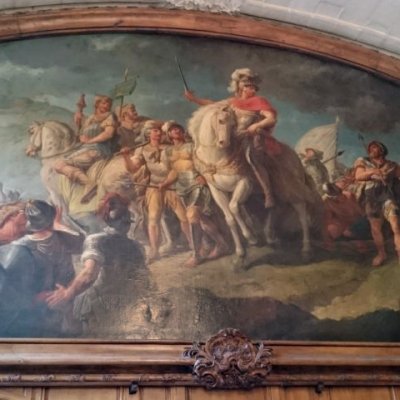
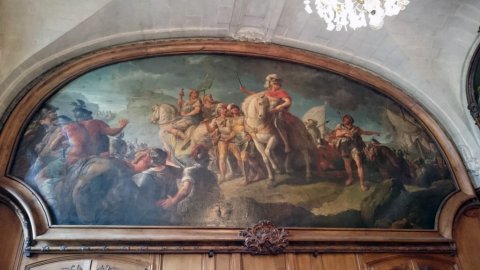
William the Conqueror's descent into England - Lépicié
Notice précédente Notice n°91 sur 103 Notice suivante
Description
Booklet from the 1765 Salon :
"By Mr. Lepicié, Agréé.
162. The Descent of William the Conqueror on the Coasts of England. William, Duke of Normandy, boarded at the Sussex Coast, exhorts his army to conquer or die ; and to determine his soldiers by the boldest move, he fixes their attention on his burning fleet. The famous battle of Hastings, which resulted from this, decided the fate of England, and by the death of Harold, who was killed there, William saw himself possessor of the throne.
Painting 26 feet wide, 12 high."
Deloynes 8, 107. Critique des peintures et sculptures de messieurs de l'Académie royale. L'an 1765. (anonyme sl), p. 29:
" By M. Lépicié, Agréé.
The descent of William the Conqueror, on the coasts of England.
We see William, Duke of Normandy, [30] to urge his Army to conquer or die, fix their eyes on his fleet ablaze: we notice in this Hero much nobility & greatness of soul; the composition of this painting is happy; but we wish it were more correct in design, better colored, & of more effect.
His other two paintings are well drawn and have a beautiful effect. Il faudrait plus de coloris. "
Note Guillaume's strange Roman costume, a purely conventional costume for a history painting. The painting is very difficult to photograph, as a chandelier hangs in front of it, prohibiting any recoil. The right-hand side of the painting, which is not visible in this image, depicts William's ships in flames, having just landed in Normandy. A soldier, on the far right of the picture, asks William why he has burned the ships. In response, he draws his sword, signaling the charge for the Battle of Hastings. The blue-and-pink-striped standard on the right, behind, bears the inscription "VINCERE AUT MORI", to conquer or die, which sums up William's speech after burning the ships, and before the battle. The green sign on the left bears the initials D.O.M (?), Deus Optimus Maximus, which could allude to Taranis, the Gallic Jupiter (the painting was not originally intended for the abbey where it stands today, and the allusion remains discreet). This hypothesis is suggested to me by the presence next to the sign of a horseman dressed in a lion's body, which undoubtedly represents the Gallic Hercules.
The Normans therefore went ahead with their project.
The Normans thus advance on English soil grouped around three figures: on the right, the soldier asking about the burning ships; in the center, William; on the left, the Gallic Hercules.
Opposite them, the English soldiers are shown at bottom left. On the helmet of one of them, not visible in the photograph, a dragon symbolizes England. The Celtic warriors who had invaded England a few centuries earlier had chosen the dragon as their heraldic emblem, a symbol of sovereignty. The dragon appeared on the shields of the Teutonic tribes who invaded England in turn and, until the 16th century, on the battle flags of the kings of England, as well as on the coat of arms traditionally worn by the Prince of Wales.
In the background, completely out of focus, the dragon is the symbol of England.
In the background, completely to the left, and almost invisible here, English troops are retreating inland.
Deceived by the narrative wording of the painting's title on the Livret, Diderot misunderstood the subject. It's not essentially about William's speech to his troops, but the face-off between the Normans and the English. Lépicié masterfully applies the principles of the "instant prégnant", which consists in concentrating history into an artificial instant, with both the past and the future: the past is on the right, in the form of the landing ships; the future is on the left, in the form of the routed English army. Obviously, too much concentration can lead to illegibility, and that seems to be what happened...
In addition to the costume fantasies, there's a historical inaccuracy: William didn't burn his ships; he only demated them.
2. Purchased by the Benedictines of Saint-Maur to decorate the refectory of the Abbaye-aux-Hommes in Caen, the canvas still hangs there. Originally rectangular, it was curved to fit into the top of the woodwork. William the Conqueror was the founder of this abbey. He is buried here, in the church of Saint-Etienne. Plundered by Protestants at the start of the Wars of Religion, the abbey was bought back by the Benedictines of Saint-Maur and completely rebuilt and refurbished in the 18th century. It was on this occasion that they purchased Lépicié's painting in Paris, which was not commissioned, but whose subject, rarely depicted, was particularly well-suited to its destination. It was the artist's "tableau d'agrément" (i.e., with which he was accepted by the Académie royale de Peinture in 1764). Lépicié was accepted in 1769 with "Achille et le centaure Chiron" (see link). The Abbaye-aux-Hommes was converted into a lycée under the Empire, and later became the Lycé
.Technical Data
Notice #001003