
 FR
FR
 EN
EN

Orlando seeking Angelica saves Bireno (Orlando furioso, 1584, c.9) - G. Porro
Notice précédente Notice n°9 sur 46 Notice suivante
Description
In the foreground, Orlando, who has left Paris in search of Angelica, crosses the camp of the sleeping Saracens and asks a soldier if he has seen his beloved (stanzas 3-7).
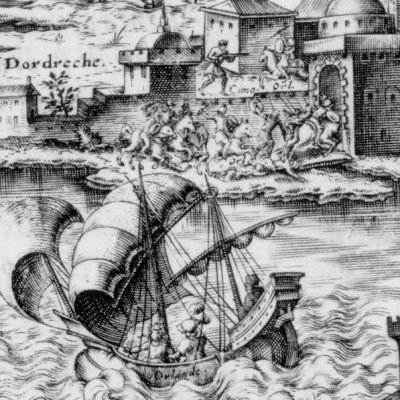
In the upper left part of the engraving, Orlando (ORL) walks onto the pontoon where the young woman in the boat will take him across to Brittany in exchange for his promise to free the Ebudians from the orc (stanzas 8-14). On the right, Orlando leaves Saint Malo by boat (stanzas 15-16). Following a storm, he arrives in Antwerp at the top left, where an old man (Vecchio) takes him to Olimpia, who, on the far left, tells him her story (stanzas 17-57).
On the right, Orlando, who has promised his help to Olimpia, enters the fort of Dordrecht and triumphs over Cimosco despite the latter's rifle (stanzas 61-77).
At the top center, Orlando throws the diabolical rifle into the sea (stanzas 89-91).
Girolamo Porro seems to have organized his image around two main spaces, the Saracen camp below and the sea above, with the river separating Normandy from Brittany becoming an extension of the latter. The episodes of the damsel in the boat, Antwerp, and Dordrecht are distributed around this enclosed sea, circumscribed like a stage: as in the theater, nothing happens on stage; the reality of the story is “marginal”...
In contrast, the lower section is organized according to the device of the encounter; it repeats a recurring motif in quest-based narratives: the knight meets someone on his way who provides him with information and thus moves the story forward. However, this is still an anti-performance, as no soldier gives Orlando any information about Angelica.
The engraving clearly superimposes Roland's requests: at the bottom, the request to the unfaithful soldiers; in the center, the request to the young girl in the boat; at the top, the request to the old man of Dordrecht. The motif of the request is fundamentally part of the narrative model.
1. The engraving is exceptionally signed in the lower right corner, “Porro.”
3. As with the engraving for canto V, Girolamo Porro, seeking to render the textual content of the canto scrupulously and exhaustively, added the conclusion of the story begun in the previous canto at the bottom of the engraving, which the Valgrisi edition had omitted for the sake of narrative consistency. In fact, Ariosto begins almost every canto with the end of a story, which poses a problem of space organization when it comes to illustration. Here, Orlando, searching for Angelica in the Saracen camp besieging Paris, seems to be heading towards us, while in the background he is facing the damsel in the boat. The concern to establish a path for the hero in the engraving that is also a path for the viewer-reader's gaze seems to have been forgotten, unlike what we see in the engraving for Canto V, which follows Rinaldo's journey through the city of St. Andrews.
Technical Data
Notice #003018