FR
FR
 EN
EN
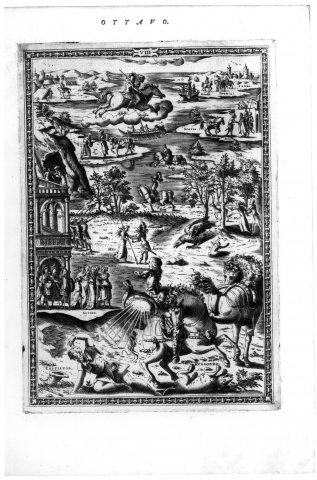
Roger unveils Atlant's shield (Roland furieux Franceschi 1584 ch8) - G. Porro
Notice précédente Notice n°8 sur 46 Notice suivante
Description
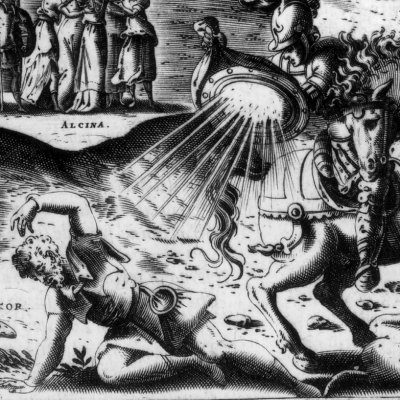
In the center foreground, Roger fights one of Alcine's servants on the left (Cacciator, the hunter), revealing Atlant's shield. On the right, he defeats his hound. Above them, the hunter's bird of prey seems ready to swoop down on Roger. On the right, the hunter's horse sends a stampede. Girolamo Porro has no qualms about depicting this inglorious episode, in which Roger has to resort to magic to get rid of a mere villain. The depiction of fine chivalry is no longer the designer's main criterion, as he favors spectacular episodes.
On the left, in front of her palace, the wicked magician Alcine (Alcina) mourns with her wives, while her soldiers await her orders (str. 12). Turning behind the palace, Alcina's people (Gente de Alcina.) set off in pursuit of Roger. The palace was not depicted in the engraving of the Valgrisi edition, where the draftsman had shown only the palisade surrounding the courtyard through which Roger had fled. G. Porro consistently favors architecture, using it to unify the engraving's narrative territories. Here, Alcine's palace serves as a kind of observatory, a vantage point from which to witness the various episodes unfolding at her feet.
Above, in the center, the good magician Mélisse (Mel.) returns to Astolphe, to whom she has restored his human form, the golden spear of Argail that Alcine had stolen from him (str. 17). Then, on the right, she leads Astolphe along the path that leads to the fairy Logistille, Alcine's virtuous sister. At the top of the engraving, they ride through the clouds on the virtues of Angélique's ring (str. 18). This overhanging position also serves to unify the narrative territories around a totalizing point of view: Porro adopts the layout of the engraving in the Valgrisi edition, as well as those in Canto IV.
In the center of the engraving, Roger walks along the shore in the heatwave (str. 20-21).
In stanza 22, there's a narrative break: we return to Renaud in Scotland, abandoned at the start of Song VI when Ariodant revealed his identity to him and the king. Scotland (Scotia) is shown at the top of the engraving, on the right: Renaud (Rinaldo) bids farewell to the King at the port of Berwick (str. 25).
At the very top of the engraving on the right, continuing his tour to ask for reinforcements against the Infidels besieging Paris, Renaud lands in England ("Inghil" and further on "terra"), above Scotland (!). The Prince of Wales comes to meet him (str. 28). The city of London can be seen in the background.
In stanza 29, another narrative break: we return to Angélique who, fleeing Renaud, had met a hermit in Canto II. To ensnare the beautiful young girl, the hermit insinuates a demon into her horse, which leaves the shore and sinks into the sea (str. 35). On the left, above Alcine's palace, we see the hermit giving instructions to the demon. Angelica finally returns to shore, near a grotto. The hermit comes to meet her (on the left, under the cloud carrying away Mélisse and Astolphe). Behind the grotto, the hermit tries to rape Angélique (str48-50): but his impotence betrays him. G. Porro has grouped together on the left the whole story of Angelica, which was scattered in the Valgrisi edition between the left and right of the engraving.
In stanza 51, another digression: Ariosto recounts the origin of the killer whale that infests the island of the Ebudians. Their king punished his daughter with death when he discovered she was pregnant by the god Proteus. A furious Proteus has aroused the orc : the Ebudians must deliver him a young girl to replace the one he has lost. Digressions, or narratives within the narrative, are not generally represented in engravings until the 18th century. On the contrary, G. Porro groups and unifies narrative territories: under the cloud of Mélisse and Astolphe, he places the Ébudiens rowing their boat towards Angélique to kidnap her (str. 61).
In stanza 69, we return to besieged Paris. Roland dreams of Angélique, whom he has lost track of for so long. The dream predicts that she will never be his. He sets out to find her: the engraving at top left shows him asking about Angélique in the camp of the Infidels. Two figures answer him from their tent. In the background, Paris under siege. We are already in Chant IX: IX, 4. In the episodes at the top of the engraving, the same motif is repeated: the hero, on his horse or holding his horse behind him, faces the stranger, in the position of inquiry. Angelique asks the hermit for directions, Roland asks the infidel soldiers in the tent for directions, Renaud asks the English for reinforcements. This position of the request, which is not emphasized in this way in the engraving in the Valgrisi edition, insists on the narrative thread, of which the path, the quest, are so many figures. The overall composition of the engraving is articulated by a first diagonal that runs from the stricken hunter at bottom left to Atlant's shield and then to the gyrfalcon. A second diagonal runs from the hunter's horse, overturned and bucking, through the gyrfalcon and up to Mélisse and Astolphe flying on their horse towards Logistille. Thus, three spaces organize the entire engraving: bottom right, the space of the spectacle; center left, the space from which the spectacle is viewed; top right, the space of the narrative. This tripartition clearly shows how G. Porro is in full transition from narrative engraving to scenic engraving.
1. The engraving is numbered VIII in a small medallion at the top center of the border. Exceptionally, it is printed recto, on a right-hand page, and has no page number. However, at the top it reads [CANTO, p. 68 opposite] OTTAVO. The argument is therefore printed on the verso of the engraving, p. 70:
"Fugge Ruggier: Melissa Astolfo in tanto E gli altri torna à lor prima faccia. Rinaldo ammassa genti, accioche al santo Imperio, al gran bisogno sodisfaccia. Angelica, trouata al vecchio à canto, Per cibo del marin monstro s'allacia. Orlando che sognando il suo mal vede, Moue dolente da Parigi il piede."
3. The composition of this engraving is significantly different from that of the Valgrisi edition, particularly in the lower part. Girolamo Porro adds a piece of architecture, Alcine's palace, which is suggested in the Valgrisi edition only by the palisades in the foreground. Roger's fight against Alcine's servant with the gyrfalcon moves to the foreground, and G. Porro emphasizes the luminous effect of the magic shield emerging from its scabbard, whereas the shield is not represented in the Valgrisi edition, which chooses the moment when Roger is in difficulty rather than when he triumphs. Finally, G. Porro has grouped the hermit's evocation of the spirits and the attempted rape of Angelique on the same mountain on the left, for the sake of narrative, but not geographical, coherence.
.Technical Data
Notice #001296