FR
FR
 EN
EN

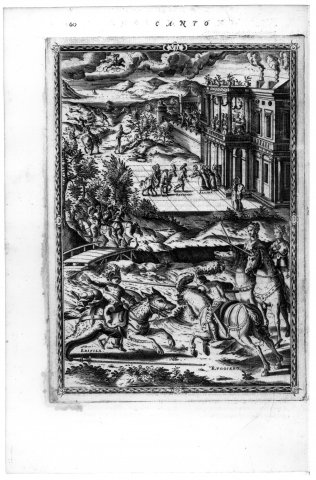
Roger kills Eriphile & arrives at Alcine's (Roland furieux Franceschi 1584 ch7) - G. Porro
Notice précédente Notice n°7 sur 46 Notice suivante
Description
Eriphile guards the bridge: Roger must defeat her to cross this bridge (middle right) and reach Alcine's palace (top center).
In the foreground, Roger on the right (RVGIERO) strikes Eriphile on the left (ERIFILA), mounted on a wolf, and hits her eye with his spear ("sotto l'elmo", VII,6). Behind Roger, the two damsels who asked him to engage in this fight watch on unicorns.
Beyond the bridge, in the center, Roger, flanked by the two unicorn ladies, makes his way to Alcine's palace.
Top center, Alcine greets the three arrivals at the threshold of her palace, which occupies the right-hand side (VII,9). In the palace loggia on the second floor, they are seated at a banquet table.
Further up on the left, the magician Mélisse (Mel.) comes to meet Bradamante (Brad.), mounted on her horse. Then, further right, in the guise of the Atlant magician who raised him (Meliss.), she addresses her admonitions to Roger, who is chilling in effeminate garb under a tree by a stream (str. 53). In the courtyard behind the palace, on the right, Roger, who has retrieved his weapons, escapes from the palace, fending off Alcine's servants.
High left, in the clouds, Mélisse rides her flying steed from the forest where she met Bradamante to Alcine's island.
As in the engraving in Canto III, divided between the landscape above and Merlin's cave below, the image is organized around two main spaces, the medieval space of combat below, the Renaissance setting above, with its colonnaded palace, loggia and large paved courtyard. The bridge, at stake in the battle against Eriphile, becomes the linking element between the two spaces.
The space below is the space of agonistic counter-performance: Roger fights a parody of an adversary in a parody of courtly service.
The upper space organizes all the elements of a rich, complex narrative around the paved courtyard, a veritable stage: who is this couple in the foreground of this scene, on the right, halfway up the engraving, strolling embracingly in front of the palace? It can hardly be anything other than Roger and Alcine, cleverly constituted by Girolamo Porro as screens: Alcine turns away from the scene and prevents Roger from seeing her, which neatly sums up the whole narrative.
1. The engraving is numbered VII in a small medallion at the top center of the border. Top left, page number, 60 and CANTO [SETTIMO, right page]. Argument p. 61:
"La gigantessa Erifila ha già vinto Ruggier, per chi l'incarco ne gli ha dato. Indi sen va nel cieco Labirinto, Ou'Alcina ha più d'un preso e legato. Melissa il graue errore, ou'è sospinto. Li fa vedere, ha il remedio à lato. Ond'ei, c'ha per rossor basse le ciglia, Subito à prender fuga si consiglia."
3. The lower part of the engraving visibly imitates the woodcut of the Valgrisi edition. As is often the case here, what was on the left is on the right. The valet holding the hippogriphe has been removed for better legibility. The semiotic transformation from narrative composition to scenic device is clear: in the foreground, the agonistic space is now circumscribed, in front by Eriphile's fallen spear (instead of the traditional crossed spears in the Valgrisi edition), and in the background by the overhanging position of the spectating ladies, whose gaze is blocked by the horns of the unicorns. In the upper part of the engraving, on the other hand, the model of the Valgrisi edition is abandoned: Alcine's palace is moved from the center to the right, and the courtyard is paved in a dotted grid to create the geometrical space of a scene. The depiction of Mélisse meeting Bradamante represents a departure from the unification of the performance space. The Valgrisi edition had no problem with this. Here, the engraver has added Mélisse riding in the clouds, in an attempt to establish spatial continuity.
Technical Data
Notice #001297