
 FR
FR
 EN
EN
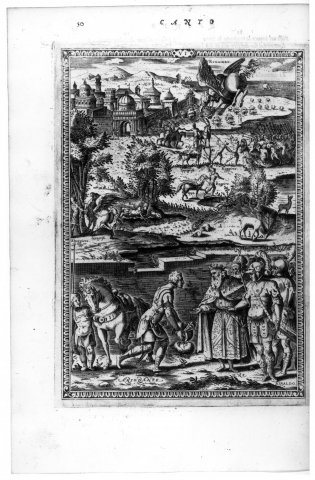
Ariodant & le roi d'Ecosse, Roger & l'hippogriffe (Roland furieux 1584 ch6) - G. Porro
Notice précédente Notice n°6 sur 46 Notice suivante
Description
The foreground of the engraving is beneath the walls ("le mura"; V, 78) of Saint-Andrews, where the King of Scotland holds court; the background is occupied by the island of Alcine, beyond the Columns of Hercules (VI, 17), in the middle of the Atlantic Ocean. These two geographically heterogeneous spaces are separated by a conventional wall. The wall is both the material wall of the city of Saint-Andrews and the structural wall that divides the spaces of representation.
The foreground corresponds to the first sixteen stanzas, which conclude the story of Ariodant and Guinevere, begun in the previous song. Recall that there were two battles: Lurcain saw his brother Ariodant throw himself into the sea, in despair over what he believed to be Guinevere's infidelity with Polinesse, but which was merely a set-up. Lurcain, to avenge his brother's supposed death, publicly accuses Guinevere. Ariodant, who is not dead, returns incognito and demands a judicial duel against his brother, to clear Guinevere's honor, whom he still loves despite what he believes he saw. The duel between the two brothers is interrupted by the arrival of Renaud who, thanks to the story told by Dalinde, Guinevere's maid seduced by Polinesse into staging Guinevere's love story, unmasks Polinesse. Renaud then challenges Polinesse, the real culprit, to battle and triumphs.
The scene depicted in the engraving takes place on the "campo" of the legal battle ("un prato spazïoso e piano", V, 79). It actually illustrates the last stanza of Canto V (str92): on the right, the King of Scotland, who has finished congratulating Renaud on his victory over the traitor Polinesse, turns to the mysterious knight who has taken up the defense of his daughter, unjustly accused of illegitimate love affairs, provoking the judicial duel against Lurcain. The stranger has just dismounted from his horse and discovers his identity by removing his helmet: his name will not be given until the beginning of Canto VI (str3). The king then extends his arms to Ariodant, granting him the hand of his daughter Guinevere, for whom he has remained a respectful and faithful lover. It's a scene of forgiveness, recognition and consent.
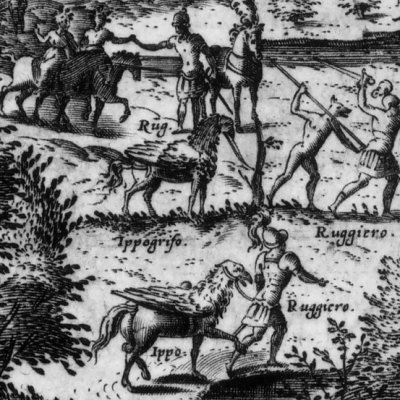
In the background, top right, Roger (only his left leg visible) rides his hippogrip towards Alcine's island (str19). On the far left, he accidentally ties his mount to a myrtle, which is none other than Astolphe metamorphosed by Alcine (str23). Further right, he rests and quenches his thirst at the river (str25). In the center, on Astolphe's advice, he takes the mountain road to the right, to avoid Alcine's city on the left (str55-60). On the right, a little higher up, he encounters, as Astolphe had warned him, a troop of monstrous creatures charged with driving him back towards the city of Alcine. He engages in an unequal battle (str61-67), interrupted higher up in the center by the arrival of two beautiful ladies riding unicorns from the city (str68). He follows them to the city, where he receives a magnificent steed in exchange for his hippogriphe (str76): for simplicity's sake, the engraving shows Roger in front of the two ladies, holding the horse by the bridle. The hippogriphe has disappeared.
The picture space is completed by ornamental figures that are not involved in the narrative: in the right foreground, two rabbits, a stag and a doe are strolling through the forest. On the left, above the hippogriphe tied to the myrtle, two young goats lie in the grass. Above left, two strollers leave the town. At top right, behind an inlet or river, a man is leaning on a stick. Finally, in the distance, the sails of a few boats can be made out.
While Girolamo Porro follows the composition of the Valgrisi edition in the upper part of the engraving, the lower part is of his own making, which probably explains its extremely scenic character.
1. The engraving is numbered VI in a small medallion at the top center of the border. Top left, page number, 50 and CANTO [SESTO, right page]. Argument, p. 51: "Con l'amata sua Donna Ariodante Ha in dote il bel Ducato d'Albania. Ruggiero in tanto sù'l destrier volante Al regno capitò d'Alcina ria. Oue da l'uman Mirto ode le tante Frode di lei, e per partir d'inuia; Ma troua alto contrasto; echi da pena Indi l'ha tratto à noua pugna il mena." 3. G. Porro has added the Scottish scene in relation to the composition of the Valgrisi engraving.
Technical Data
Notice #001298