
 FR
FR
 EN
EN
Ut pictura poesis erit
(Horace, Poetic Art, v. 361)
The Utpictura18 project is a research program developed since 2009 in the Centre Interdisciplinaire d'Étude des Littératures d'Aix-Marseille (CIELAM, EA4235)
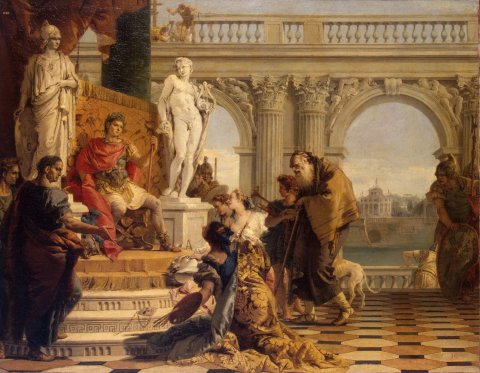
Mecenas presenting the liberal arts to Emperor Augustus - Tiepolo
Utpictura18: why the name?
Utpictura refers to the famous doctrine of ut pictura poesis developed from the Renaissance onwards by Italian theorists of representation. The idea was to define codes, frameworks, rules to be applied to represent a subject in an image. The great theory of representation inherited from the Greeks was Aristotle's Poetics (4th c. BC), but it concerned poièsis, i.e. essentially theatrical creation and more precisely, in the part of the text that has come down to us, tragedy. There was no Greek treatise on painting.
But a famous text by Horace, a Latin poet of the 1st century AD, a protégé of Maecenas and Augustus, asserted that ut pictura poesis erit, that good, great poetry will be like painting: if poetry must be like painting, painting must reciprocally respect poetry's rules of composition. So there's a Greek theory of painting: all we have to do is transpose for painting what Aristotle wrote for tragedy!
Since the Renaissance, therefore, this formula of ut pictura poesis has been used to designate any theorization of representation based on an equivalence, and even an identity between poetic representation (textual, literary) and iconographic representation (pictorial and artistic in general). This system of equivalence peaked in the eighteenth century, before unravelling completely: painting claimed its materiality, its visual and sensitive evidence, which dispensed with words; literature explored the ghosts and shadows of the unspeakable and unrepresentable. The 18 of Utpictura18 refers to this high point in the history of representation, when pictura and poesis formed a perfect coupling.
Utpictura18 proposes to explore the articulation and disarticulation of these two terms, pictura and poesis, based on the corpus of images gathered here in the database of the site you are consulting and a theoretical reflection on representational devices, which are the representational models that circulate from text to image.

Machine for inventing books (Gulliver, tr. fr., The Hague, 1727)
The database
The iconographic database that has been set up is growing steadily (around 1,000 records per year): images are indexed conventionally (by artist, period, location, nature of image), but also by object (the objects represented, but also typical configurations of gaze, of audience) and by device (magisterial, performative, scenic...). Detailed indexing of textual sources enables systematic use of iconographic material for literary analysis. The analysis of contents and devices draws on the theoretical tools set out in particular in the rubriques and in the livres linked to the project.
Four sets of images have been chosen:
-
The history painting is read in the classical period as the equivalent of the ancient or biblical texts it illustrates. Through images, it provides the equivalent of a discourse, and is ordered around a instant-pregnant, contradictorily supposing a duration and the absence of duration.
-
The enluminures, historiated capitals, medieval mosaics, oppose the classical codes of scenic representation with other codes and come to remind us each time that, for a given subject, no representation is natural.
-
The illustrative engraving offers the reader's eye the vis-à-vis of a written scene and an engraved scene. In novels, it adapts to fiction the motifs and arrangements of great history painting, with parodic effects highlighted by comparison.
-
The paintings, engravings and sculptures commented on by Diderot in his Salons allow us to contrast the real image with the textual performance that Diderot claims to substitute for it. Here, it is the text that makes the picture, through a movement that reverses the textualization of painting initiated by history painting.
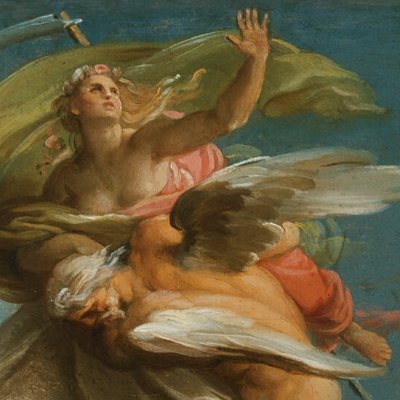
Time Unveiling the Truth - Pompeo Batoni
Genealogy of a project
The Utpictura18 project began in spring 2001, within the Centre d'étude du dix-huitième siècle, then the Institut de recherche sur la Renaissance, l'âge Classique et les Lumières, UMR5186 du CNRS, with the support of the Université Paul-Valéry de Montpellier and the Région Languedoc-Roussillon. From August 2003, the Utpictura18 database was accessible on the Internet, on a server at the Université Paul-Valéry in Montpellier.
Since February 2004, it has also been hosted on the Galatea server at the Université de Toulouse-le Mirail, and from 2004 to 2008 was integrated into the research programs of the Lettres, Langages et Arts host team, now LLA-Créatis, at the Université de Toulouse-Le Mirail, and the teaching programs of the Lettres modernes and Histoire de l'Art Departments. From 2007, she contributed to Master's courses at the Ecole Supérieure d'Audiovisuel de Toulouse (ESAV).
Since 2009, Utpictura18 has been developed at the University of Provence, and since December 25, 2016 on a server at the University of Aix-Marseille.
The Utpictura18 site is now more than just a database. It also includes online courses, articles, theoretical and methodological definitions, and pedagogical tools.
On June 30, 2020, the Utpictura18 site in Montpellier is closed, after 17 years of existence at the Paul-Valéry University. In autumn 2020, the project to redesign and migrate the Utpictura18 site in Aix-Marseille is launched. To this end, an agreement is signed between CIELAM and Happyculture, the service provider selected for the project. In spring 2021, the Toulouse site is closed, and the new Utpictura18 site is launched on a dedicated Aix-Marseille Université server.
In spring 2023, the AM*IDEX foundation grants its financial support for the development of the IRV-Utpictura18 project. A new service provider, ITSS, is recruited in December 2023 with the mission of optimizing the search engine, internationalizing the site and opening new areas, Text Edition and Galerie.