
 FR
FR
 EN
EN
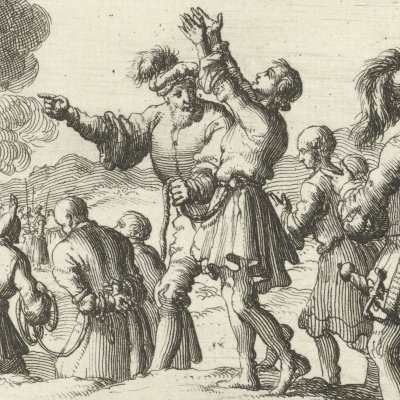
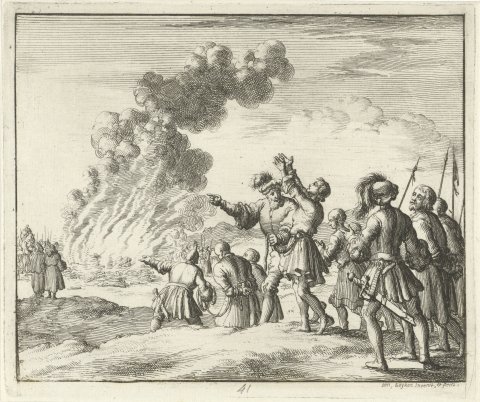
14 canons of Orléans burned for heresy in 1022 (Luyken, Théâtre des Martyrs)
Notice précédente Notice n°41 sur 104 Notice suivante
Description
On Christmas Day 1022, a dozen canons from the cathedral chapter of Orléans were accused of heresy in their teachings by a Norman knight from Chartres named Arefat. King Robert the Pious of France ordered their arrest and convened a synod composed exclusively of bishops to judge these members of the Orléans clerical elite, among whom were Lisoie, cantor of Sainte-Croix, and Étienne, confessor to Queen Constance. The participants in the synod convened by Robert the Pious are known from a royal decree dated the same day. In addition to Oury, the Bishop of Orléans, those present included Gauzlin, abbot of Fleury and archbishop of Bourges; Francon, bishop of Paris and the king’s chancellor; Guérin, bishop of Beauvais; and Liéry, the archbishop of Sens, who, as metropolitan, was the immediate superior of the Bishop of Orléans.
The debates within the synod lasted a day, while outside the crowd demanded the death of the accused. After defending the orthodoxy of their behavior (“they slipped through our fingers like eels, and we could not grasp their heresy,” notes Arefat via Paul of Chartres), the accused eventually admitted to the charges against them and even openly claimed them; on December 28, 1022, they were led out of the city and locked in a wooden hut that was set on fire. The heretics, caught up in a mystical fervor, are said to have experienced this end as a liberating martyrdom.
This was the first time that medieval Christendom had resorted to burning at the stake to punish heretics, undoubtedly in violation of canon law, which did not prescribe the death penalty as a punishment for heresy until the 13th century.
See Robert-Henri Bautier (ed.), “The Heresy of Orléans and the Intellectual Movement at the Beginning of the 11th Century: Documents and Hypotheses,” in Proceedings of the 95th National Congress of Learned Societies. Reims 1970. Section on Philology and History up to 1610. Volume I: Education and Intellectual Life, Paris, 1975, pp. 63–88.
- Signed beneath the engraving on the right: “ian. Luyken invenit. et fecit.”
- Book I, p. 270.
Technical Data
Notice #010387