FR
FR
 EN
EN

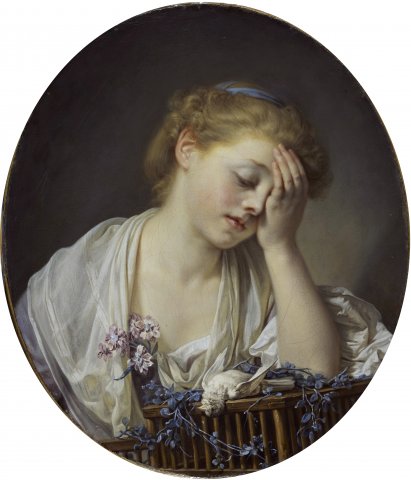
A young girl, crying for her dead bird (version of 65) - Greuze
Notice précédente Notice n°66 sur 103 Notice suivante
Description
Booklet from the 1765 Salon :
"By Mr. Greuze, Chartered.
110. A young girl, mourning her dead bird.
This oval Painting, 2 feet high, belongs to M. de la Live de la Briche, Introducteur des Ambassadeurs. "
Deloynes 8, 107. Critique des peintures et sculptures de messieurs de l'Académie royale. L'an 1765. (anonyme sl) p. 25 :
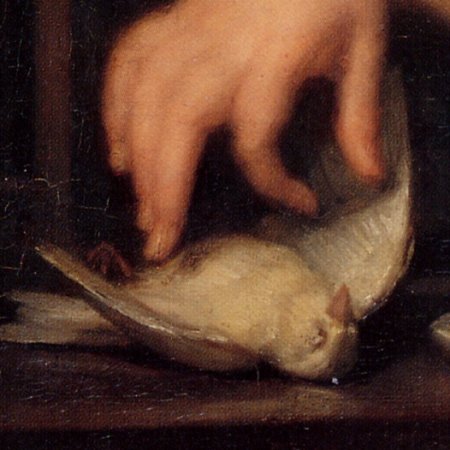
"We see this little girl leaning on one hand, overwhelmed with grief; her bird, which is a Serin, is [26] lying on its cage[.] Everyone admires the truth of this painting; the coloring & the design are well executed. "
Mercure de France, October 1765, p. 167 :
"The small number of works exhibited this year by M. Greuze, like all the others, bear the stamp of the most touching truth, & of an imitation so naive & so faithful to nature, that they engage all eyes. We'll start with the one depicting the bust of a young girl, her head resting on one hand, mourning the death of a canary bird lying on a cage. It is impossible to imagine all the truth of expression to be found in this painting, and all the illusion it produces. It is a distinctive merit of M. Greuze's talent, to know how to choose from the simplest subject, all the relationships of detail that can make it interesting, & that contribute to the most perfect imitation. It is also an admirable art to match all the parts of his representations so well, that there is not a single one that shows the artist's skill, and that they all appear natural and necessary. This precious piece has never ceased to be crowded, many spectators have returned several times to the salon to see it again, & the curiosity always satisfied by this object has never experienced satiety. "
Diderot's comment in the Salon of 1765:
" 110. La jeune fille qui pleure son oiseau mort The pretty elegy ! the pretty poem ! the beautiful idyll Gessner would make of it ! This is the vignette of a piece by this poet. Delightful painting ! the most pleasant and perhaps the most interesting of the Salon. Her head is resting on her left hand: the dead bird is resting on the top edge of the cage, head hanging, wings trailing, legs in the air. How naturally she is placed how beautiful her head how elegantly coiffed how expressive her face ! Her sorrow is deep she's in her misfortune, she's all in it. What a lovely catafalque this cage is what a graceful garland of greenery winds around it ! O the beautiful hand ! the beautiful hand ! the beautiful arm ! See the truth of the details of these fingers, and these dimples, and this softness, and this tint of redness with which the pressure of the head has colored the tips of these delicate fingers, and the charm of it all. You'd come right up to this hand to kiss it, if you didn't respect this child and her pain. Everything about her is enchanting, right down to her fit. This neckerchief is thrown in such a way it's so supple and light ! When we see this piece, we say: Delicious ! If you stop or come back to it, you'll exclaim: Délicieux ! délicieux ! Soon you find yourself conversing with and consoling the child. It's so true, in fact, that here's what I remember saying to her on several occasions. "But, little one, your pain is very deep, very thoughtful ! What is the meaning of this dreamy, melancholy air? For a bird, you don't cry. You're afflicted, and thought accompanies your affliction. Is it really the death of this bird that draws you so strongly and so sadly into yourself? You lower your eyes; you don't answer me. Your tears are ready to flow. I'm not a father I'm not indiscreet, nor am I severe...
Well I'm not! Well I understand he loved you, he swore to you, and had sworn for a long time. He suffered so much: what's the point of seeing someone you love suffer?... And let me continue why close my mouth with your hand? That morning, by misfortune, your mother was absent. He came you were alone: he was so handsome, so passionate, so tender, so charming he had so much love in his eyes so much truth in his expressions he said those words that go so straight to the soul, and as he said them he was on your knees: it's still understandable. He held one of your hands from time to time you felt the warmth of a few tears falling from his eyes and running down your arms. Your mother never came back. It's not your fault; it's your mother's fault... But now you're crying... But I'm not telling you this to make you cry. And why cry? He promised you he won't break anything he promised you. When you've been lucky enough to meet a charming child like you, to become attached to him, to please him that's for life... - And my bird? - You're smiling." (Ah ! my friend, how beautiful she was ! ah ! if you'd seen her smile and cry !) I continued. "Well ! your bird ! When you forget yourself, do you remember your bird? When the time came for your mother to return, the one you love left. How happy he was, how transported how hard it was to tear himself away from you !... How you look at me! I know all about it. How many times he got up and sat down how many times he said goodbye to you, and said it again without leaving how many times he went out and came back ! I've just seen him at his father's: he's charmingly cheerful, a cheerfulness they all share, without being able to help it... - And my mother? - Your mother? No sooner had he left than she came home to find you dreamy, as you were just now. We're always like that. Your mother spoke to you, and you didn't hear what she was saying; she commanded you to do one thing, and you did another. A few tears would appear at the edge of your eyelids you'd either hold them back, or turn your head away to furtively wipe them away.
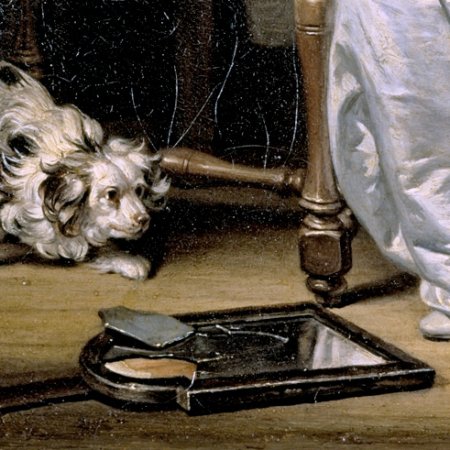
Your mother became impatient with your continual distractions; she scolded you, and this was an opportunity for you to weep without restraint and relieve your heart... Shall I continue? I'm afraid what I'm about to say will renew your pain. Do you want me to? Well your good mother reproached herself for having upset you she approached you, took your hands, kissed your forehead and cheeks, and you cried even more. Your head bent over her, and your face, which was beginning to turn red, just as it is now turning red, went to hide in her bosom. How many sweet things this mother said to you! And how much these sweet things hurt you! However much your canary sang, warned you, called you, flapped his wings, complained about your forgetfulness you didn't see him, you didn't hear him: you were busy with other thoughts. Its water and seed were not renewed and this morning, the bird was no more... You're looking at me again do I still have something to say ? Ah I can hear that bird, he's the one who gave it to you well he'll find another one just as beautiful... And that's not all yet: your eyes are fixed on me, and are distressed what's the matter now ? Speak up I can't guess... - What if this bird's death was just a harbinger of things to come? What would I do ? what would become ? If he were ungrateful... - What madness! Don't be afraid it won't be, it can't be... " But, my friend, don't you laugh to hear a serious person amusing himself by consoling a child in paint for the loss of his bird, for the loss of anything you please? But you can also see that it's beautiful that it's interesting ! I don't like to grieve nevertheless, it wouldn't displease me too much to be the cause of her pain. The subject of this little poem is so fine, that many people didn't hear it they thought this young girl was only crying for her canary. Greuze has already painted the same subject once in front of a cracked mirror, he placed a tall girl in white satin, penetrated by a deep melancholy. Don't you think it would be just as foolish to attribute the weeping of the girl in this Salon to the loss of a bird, as the melancholy of the girl in the previous Salon to her broken mirror? This child cries something else, I tell you. First of all, you've heard her, she agrees and her reflected affliction says it all. This pain ! at her age ! and for a bird ! - But how old is she ? - What can I tell you and what question did you ask me? Her head is fifteen to sixteen years old, and her arm and hand, eighteen to nineteen. It's a flaw in this composition that becomes all the more noticeable, as the head is pressed against the hand, and one of the parts gives everything against the measure of the other. Place the hand in a different position, and you will no longer notice that it is a little too strong and too characteristic. My friend, the head was taken from one model, and the hand from another. In any case, the hand is very real, very beautiful, very perfectly colored and drawn. If you want to give this piece that light stain, with a slightly purplish color tone, it's a very beautiful thing. The head is well-lit, in the most pleasing color you could give a blonde; perhaps we'd ask for a little more roundness. The striped handkerchief is broad, light and of the most beautiful transparency; all strongly touched, without detracting from the finesse of detail. This painter may have done as well, but not better. This piece is oval it is two feet high. When the Salon was wallpapered, the first honors went to M de Marigny. Poisson Mécène went there with the procession of favorite artists he admits to his table the others were there: he went, he looked, he approved, he scorned. Greuze's La Pleureuse stopped and surprised him. "That's beautiful", he said to the artist, who replied: "Sir, I know that; I'm praised for the rest, but I'm short of work. - It's just that," replied Vernet, "you have a cloud of enemies, and among these enemies, a quidam who seems to love you madly, and who will lose you. - And who is this quidam?" asked Greuze. - It's you," replied Vernet. It's true, my friend Greuze, that you're unforgivably at fault with yourself. You imagine that all you have to do is have genius, great talent, a proud and sensitive soul, make beautiful paintings and wait for fortune to come and remove you from your attic in the Sorbonne district and offer you an asylum in some royal house. So where do you come from? Why don't you learn to be flexible, to act like a valet in the antechamber of the director-ordinator, to flatter your colleagues who have credit with him, to look on them as your masters, and to assure them that you are only a child in their eyes? Perhaps, by dint of your baseness, you'll succeed in being forgiven for having genius and making beautiful paintings but what does it matter? You'll have lodgings in the Louvre, pensions, the Cordon de Saint-Michel, perhaps. Your masterpieces will no longer offend the vanity of any of your fellow artists, and the entire Académie de peinture will cry out that you are a great painter, as soon as you cease to be one. Don't you want to submit to my advice? Vernet told you so you are the cruelest of your enemies. So stay with your genius and your poverty. Make beautiful paintings, and don't pretend to make a fortune! - Here is a list of the graces that the Director of the Arts has bestowed on M. Greuze to date. When this painter's talent became known, he was allowed to make a trip to Rome at his own expense and when he had eaten up the little money he had raised for this trip, he was allowed to return to Paris, before he could reap the rewards he had hoped for. Since his return, he has been allowed to paint the most beautiful pictures and sell them as cheaply as he could. When his painting of the Paralytic was successful at the last Salon, he was allowed to have it taken to Versailles to be shown to the king and royal family, and to spend some twenty écus on the trip. Since then, having failed to find a buyer for this painting, which cost him 200 louis in studies, he has just been allowed to sell it to the Imperial Academy of Arts in Petersburg, in order to take the painter's reputation to the furthest reaches of Europe. A continuation of the graces granted to M. Greuze for the forthcoming Salon. Incidentally, this admirable painting of the Paralytic, which would be better called the Reward of the father of the family for the good education and example given to his children, will appear engraved in a few months, and those who wish to have good proofs should register with the author as of now.
. [We have also just engraved this little Weeper with whom the philosopher has chatted so much ; but one must not have seen Greuze's enchanting painting, when one wants to accommodate the print.] "
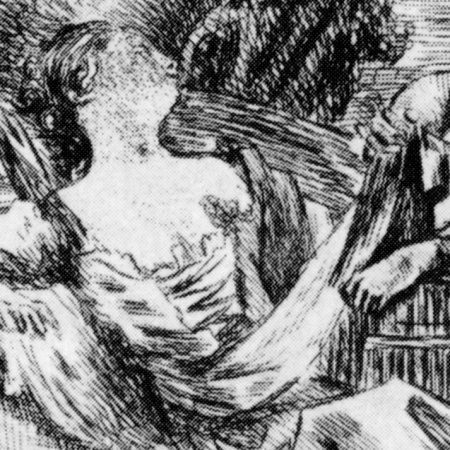
3. Version of 1759, in the Louvre Engraved by J. J. Flipart, engraving announced in 1766, cote Bnf Estampes Dc 8b Fol. image no. 18. Untitled, dedicated to Mme la duchesse de Gramont. Compare with "La jeune nourice", a young girl at her window feeding chicks with a stick. Engraving by F. A. Moitte after Greuze; from the cabinet of M. Gougenot, Conseiller au Grand Conseil Honoraire de l'Académie Royale de Peinture et de Sculpture. Cote Bnf Estampes Dc 8b Fol (vol.3 of Greuze's collection of prints), n° 5. This engraving is followed by another, probably its counterpart, "La petite mere", depicting a little girl with puppies.
Technical Data
Notice #001067