FR
FR
 EN
EN
The village tune - Greuze
Notice précédente Notice n°38 sur 52 Notice suivante
Autre numéro d'inventaire : MR 1774
Description
Booklet from the 1761 Salon:
"By Mr. Greuze, Chartered.
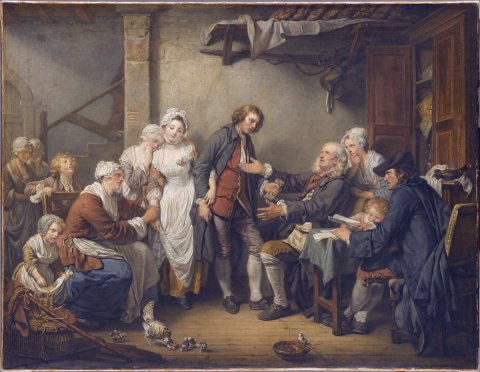
100. Un Mariage, & l'instant où le pere de l'Accordée délivre la dotage à son Gendre.
This painting belongs to M. le Marquis de Marigny. It is 3 feet 6 inches wide by 2 feet 6 inches high. "
Commentary by Grimm and Diderot:
" During the last ten days of the Salon, M. Greuze exhibited his painting of Le Mariage, ou l'instant où le père de l'accordée délivre la dotage à son gendre. This painting is, in my opinion, the most pleasant and interesting of the entire Salon; it was a prodigious success; it was almost impossible to get close to it. I hope that engraving will soon multiply it to satisfy all the curious. But before I tell you what I think, I'm going to transcribe M. Diderot's sentiment here, along with the sketch he drew of this charming painting.
He's the one who's going to speak. He's the one who's going to speak.
At last I've seen it, this painting by our friend Greuze; but it wasn't without difficulty; it continues to draw a crowd. It's of a Father who has just paid the dowry for his daughter 7. The subject is pathetic, and one is won over by a gentle emotion when looking at it. I found the composition very beautiful: it's the way it must have been. There are twelve figures; each is in his place, and doing what he must. How they all link up! How they undulate and pyramid! I don't care about these conditions; however, when they occur in a piece of painting by chance, without the painter having thought of introducing them, without him having sacrificed anything to them, they please me.
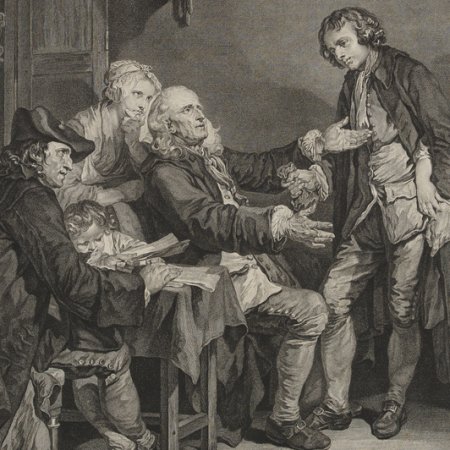
To the right of the viewer is a tabellion seated at a small table, his back to the viewer. On the table, the marriage contract and other papers. Between the tabellion's legs, the youngest child in the household. Then, following the composition from right to left, the eldest daughter stands, leaning on the back of her father's armchair. The father seated in the armchair. In front of him, his son-in-law stands, holding the bag containing the dowry in his left hand. The granted one, also standing, one arm passed limply under that of her fiancé; the other arm grasped by the mother, who is seated below. Between the mother and the bride, a younger sister stands, leaning over the bride, and an arm thrown around her shoulders. Behind this group, a young child rises on tiptoe to see what's going on. Below the mother, on the front, a seated girl with small pieces of cut bread in her apron. Far left, in the background and away from the scene, two maids stand and watch. On the right, a tidy pantry, with what is customarily kept in it, forming part of the background.
In the middle, an old harquebus hanging from its hook; then a wooden staircase leading to the floor above. In front, on the ground, in the empty space left by the figures, close to the mother's feet, a hen leads her chicks to whom the little girl throws bread; a bowl full of water, and on the edge of the bowl a chough, beak in the air, to let the water it has drunk down into its crop. That's the general layout. Now for the details.
The tabellion is dressed in black, with colored breeches and stockings, a coat and flap, and a hat on his head. He looks a bit mattish and quibbling, as befits a peasant of his profession; it's a handsome figure. He listens to what the father says to his son-in-law. The father is the only one who speaks. The rest listen and remain silent.
The child between the tabellion's legs is excellent for the truth of his action and color. Uninterested in what's going on, he looks at the scribbled papers, and wanders his little hands over them.
We can see in the older sister, who is leaning upright against the back of her father's armchair, that she is bursting with pain and jealousy that her younger sister has been given precedence over her. Her head rests on one of her hands, and she glances at the bride and groom with curiosity, sorrow and wrath.
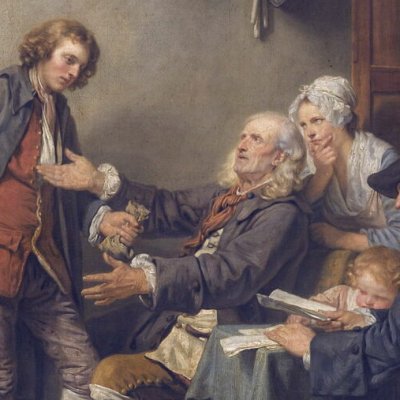
The father is an old man of sixty. The father is an old man of sixty, with gray hair, a handkerchief twisted around his neck; he has an air of bonhomie that pleases. Arms outstretched towards his son-in-law, he speaks to him with a heartfelt effusion that enchants; he seems to be saying: "Jeannette is gentle and wise; she will make you happy; think of making her own..." or something else about the importance of the duties of marriage... What he says is surely touching and honest. One of his hands, seen on the outside, is tanned and brown; the other, seen on the inside, is white; this is nature's way.
The fiancé is a very pleasant figure. His face is tanned, but his skin is white; he leans a little towards his father-in-law; he pays attention to his speech, and looks penetrated by it; he is well turned out, and wonderfully dressed, without going out of his way. I say the same of all the other characters.
The painter has given the bride a charming, decent and reserved figure; she is wonderfully dressed. This white canvas apron couldn't be better; there's a bit of luxury in its trim; but it's an engagement day. You have to see how true all the folds of all the clothes on this figure and the others are. This charming girl is not straight; but there is a slight, soft inflection in all her figure and limbs that fills her with grace and truth. She is pretty indeed, and very pretty. A throat that's not visible at all, but I bet there's nothing there to lift it, and it's self-supporting. No more to her fiancé, and she wouldn't have been decent enough; no more to her mother or father, and she'd have been a fake. Her arm is half passed under that of her future husband, and the tips of her fingers fall and press gently on his hand; it's the only sign of tenderness she gives him, and perhaps without knowing it herself; it's a delicate idea of the painter.
The mother is a good peasant woman in her sixties, but in good health. With one hand, she holds her daughter's upper arm; with the other, she clasps her arm above the wrist: she is seated; she looks her daughter up and down; she finds it hard to leave her; but the match is a good one. Jean is a good boy, honest and hard-working; she has no doubt that her daughter will be happy with him. Cheerfulness and tenderness are mingled in the face of this good mother.
As for the younger sister standing next to the bride, embracing her and grieving on her breast, she's quite an interesting character. She's really angry at being separated from her sister, she weeps; but this incident doesn't sadden the composition; on the contrary, it adds to what is touching about it. There is taste, and good taste, in having imagined this episode.
The two children, one of whom, seated next to the mother, is amused by throwing bread at the hen and her little family, and the other of whom rises on tiptoe and stretches his neck to see, are charming; but especially the latter.
The two maids, standing at the back of the room, nonchalantly leaning against each other, seem to be saying, in attitude and face: When will it be our turn?
And that hen, who has led her little family on a wild goose chase. And this hen, who has led her chicks into the middle of the scene, and who has five or six young, just as the mother at whose feet she seeks her life has six or seven children, and this little girl who throws bread at them and feeds them; it must be said that all this is charmingly appropriate to the scene, the place and the characters. It's an ingenious bit of poetry.
The father is the main eye-catcher; then the husband or fiancé; then the granted, the mother, the younger or older sister, depending on the character of the viewer; then the tabellion, the other children, the maids and the background. A sure sign of good order.
Teniers paints a truer picture, perhaps. It would be easier to find the scenes and characters of this painter; but there is more elegance, more grace, a more pleasant nature in Greuze. His peasants are neither coarse like those of our good Fleming, nor chimerical like those of Boucher. I believe Teniers to be far superior to Greuze when it comes to color. Moreover, he is a great landscape painter, a great painter of trees, forests, water, mountains, thatched cottages and animals. Greuze can be criticized for repeating the same head in three different paintings. The head of the Father paying the dowry and that of the Father reading Scripture to his children, and I believe also that of the Paralytic. Or at least they are three brothers with a strong family resemblance.
Another flaw. Is this elder sister a sister or a servant? If she's a servant, she's wrong to be leaning on the back of her master's chair, and I don't know why she envies her mistress's fate so violently; if she's a child of the house, why this ignoble air, why this neglect? Happy or unhappy, she had to be dressed as she should be at her sister's engagement party. I can see that people are mistaken, that most of those who look at the picture take her for a servant, and that the others are perplexed. I don't know if this sister's head isn't also that of the Laundress.
A very witty woman recalled that this painting was composed of two natures. She claims that the father, the fiancé and the tabellion are indeed peasants, country folk; but that the mother, the fiancée and all the other figures are from the Paris market. The mother is a fat fruit or fish merchant; the daughter is a pretty bouquetière. This observation is at least fine; see, my friend, if it's right.
But it would be much better to overlook these trifles, and rave about a piece that presents beauties on all sides; it's certainly Greuze's best work. This piece will do him credit, both as a painter skilled in his art, and as a man of wit and taste. His composition is full of wit and delicacy. His choice of subjects shows sensitivity and good morals.
A rich man who would like to have a fine piece in enamel should have this painting by Greuze executed by Durand, who is skilled, with the colors that M de Montamy has discovered. A good copy in enamel is almost regarded as an original, and this kind of painting is particularly intended for copying.
M. Diderot is right, we can't rave enough about this charming painting. I have not seen one more pleasant, more interesting, and whose effect is sweeter. O how beautiful and touching simple morals are, and how little wit and finesse are compared to them! That's why the Ancients will always be the charm of all people of taste, of all honest and sensitive souls. I asked Greuze what M de Marigny had done to God to own a painting like this one.
If you have read Gessner's Idylles from Zurich, of which we have long been promised a translation, you will be able to form an idea of Greuze's genius. They both have exquisite taste, infinite delicacy, infinite wit - in other words, no more than is needed to bring out all the details, but with a measure! Never too much, never too little. You can't look at Greuze's old man without tears welling up in your eyes. What a good father! How worthy he is of the sweetness he feels at this moment! His son-in-law is filled with gratitude; he's very touched; he'd like to say thank you. The father certainly says to him: "My son, don't thank me for the money; it's for my daughter that you should thank me; she is far dearer to me than anything I own." This good father is right. What father wouldn't be vain of such a daughter? After him, Greuze must be the most flattered; she is in truth a sublime figure in her genre; it's not much for her to be the prettiest creature in the world; her innocent graces are not the most seductive thing about her; but how can I paint for you all that is going on in her soul, at the moment of this revolution, so desirable and so dreaded, that is going to take place in her whole life? Only a man of genius could have found such a delicate and true attitude. Tenderness for her fiancé, regret at leaving her father's house, the movements of love fought by modesty and modesty in a well-born girl; a thousand confused feelings of tenderness, pleasure and fear that rise up in an innocent soul at the moment of this change of state, you read all this in the face and attitude of this charming creature. It would take me pages to give you a very imperfect idea. How could the painter convey so many different, delicate feelings in just a few brushstrokes? The only thing I would have liked, perhaps, is for him to have given the fiancé a little more kindness, not that false, detestable kindness of Boucher's, but that naive, true and touching kindness that a man like Greuze is well qualified to find. Her fiancé is a handsome boy; he's certainly still an honest one; but with that in mind, it's hard to see that he's worthy of such a wife. But who indeed could be worthy of her? He alone, with all the advantages of fortune, with a simple, elevated and honest soul, could put all his glory and happiness into possessing, respecting and adoring the most lovable creature in the universe. Greuze has made, without suspecting it, a Paméla, this is her portrait, trait pour trait. " (Salon de 1761, CFL V 97-104)
2. Exhibited at the Salon of 1761 only a few days before the exhibition closed.
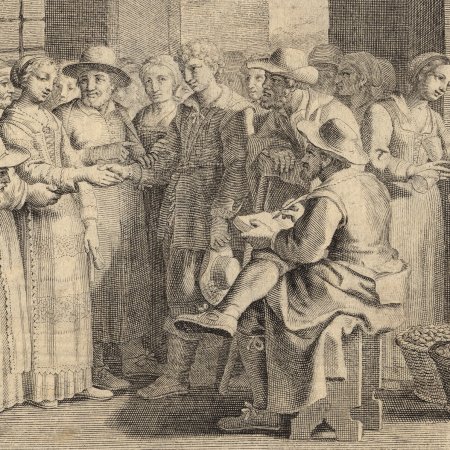
3. The painting was engraved by Flippart. This engraving was exhibited at the Salon of 1771. 1st state, pure etching before any letter and before the vignette in the margin, cote Bnf Estampes AA5 Flipart, cliché 83C115253; final state, finished plate, with the letter, the vignette remaining in the pure etching state, same cote, cliché 83C112970 and 83C115252. n°143 Inventaire des Fonds Français. Engraved by Lanta, Bnf Estampes AA5 Greuze call number, plate 77C84000. Engraved by Jazet, with, to the left of the staircase (to the right in the engraving), behind the arched opening, a dining room with a table set for the banquet, plates and bottles laid out on a white tablecloth, a servant bringing a dish, followed by a young valet. Cote Bnf estampes Dc 8 Fol., folio 46. Compare with La Demande en mariage by Grenier, cote Bnf Estampes AA5 Grenier, cliché 82B94549.
Technical Data
Notice #001073