FR
FR
 EN
EN

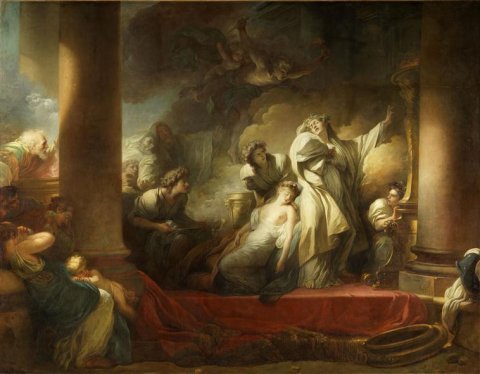
Coresus and Callirhoe - Fragonard
Notice précédente Notice n°95 sur 103 Notice suivante
Description
Booklet from the 1765 Salon :
"By Mr. Fragonard, Accredited.
176. The high priest Coresus sacrifices himself to save Callirhoe.
This painting belongs to the King and is intended to be reproduced as a tapestry in the Royal Manufactory of Gobelins. It is 12 feet 6 inches wide, by 9 feet 6 inches high. "
Deloynes 8, 107. Critique des peintures et sculptures de messieurs de l'Académie royale. L'an 1765. (anonyme sl), p. 30.
"By Mr. Fragonard, Accredited.
A painting depicting the High Priest Coresus sacrificing himself to save Callirhoe.
It is one of the most beautiful of the Sallon, & has attracted the unanimous suffrage of connoisseurs. What action and fire in this High Priest! What an expression of sentiment in this [31] woman: everything in it is eye-catching, and deserves the highest praise.
This painting is composed with fire; the expressions are noble: one admires the suave & understanding of the chiaroscuro: one would only desire a little more truth. This author deserves high praise: he promises to one day become one of the greatest painters. He has a lot of fire, genius & very-happy dispositions. "
Mercure de France, October 1765, p. 164-166 :
"The happy genius who influences our French school seemed to hasten to repair or at least soften his spertes, by producing in broad daylight the talent of M. Fragonard. A painting depicting the High Priest Corésus immolating himself to save Callirhoë, was the piece presented by this candidate for approval by the Académie. We know that not only did he win all the votes, but that M. le Marquis de Marigny, always attentive to the encouragement of Artists, retained this painting for the King's account. This piece appeared to be a phenomenon of progress, worthy of being exhibited at the moment to the onlookers, under whose eyes it remained for some time. It is the same as the one seen at the Salon.
The composition alone of this painting is important for its richness, its sharpness, & one might say for a kind of majesty that reigns in the order ; but what makes it even more remarkable, is a kind of magic of painting, a use of light & dark, a harmony of tones that produces an effect of which one cannot give very precise ideas. It seems that this young Artist has made of all the genres, of all the manners of the most excellent masters, a manner uniquely his own, & which cannot be assimilated to any of those known. We are not foolhardy enough to try and explain where this suave quality comes from in Mr. Fragonard's brushwork, which flatters and satisfies the eye so pleasantly, this sharpness and decisiveness of the objects, despite a kind of vapor that seems to be somewhat diffused over the general tone of the painting.
The figure of Callirhoé is a very good example of the artist's ability to capture the essence of his work. The figure of Callirhoe is of great beauty; at first glance, one can see the fainting state, the pallor & the first horrors of death that are painted on the face of Coresus in the instant he has just struck himself. Allow us to comment, from our own experience and that of all those who have seen this painting, on the ambiguity that the effeminate nature of Coresus's head throws into the depiction of the subject. This equivocation is also maintained by the shape of the clothing worn by this high priest, whose puffy drapery over his chest prevents his waist from showing the distinction in age and sex that would be appropriate between a high priest of Bacchus and the young, beautiful princess he was about to immolate. The inattention of propriety which sometimes renders the best-known subjects inexplicable enigmas, is doubtless a fault which the best Painters are not always careful enough to avoid, but it takes nothing away from M. Fragonard's merit in the essential parts of his art. "
2. Commissioned for the Gobelins manufactory in 1765 for the Amours des dieux hanging. Presented by Fragonard as an accreditation piece to the Académie on March 30, 1765.
3. Engraved by Jacques-Claude Danzel in 1773. For column framing and overall composition, compare with J.B.M. Pierre's drawing, Aman et Mardochée (Louvre, inv. 32395), inspired by J.-F. de Troy (Louvre, inv. 8214).
Technical Data
Notice #001099