FR
FR
 EN
EN
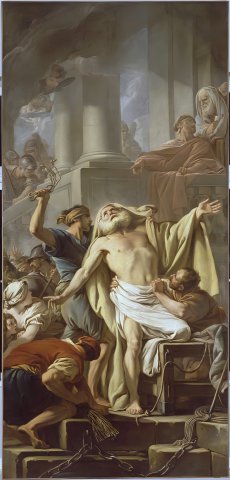
The flagellation of Saint Andrew - Deshays
Notice précédente Notice n°19 sur 52 Notice suivante
Description
Booklet from the 1761 Salon :
"By Mr. Deshays, Assistant to Professor.
29. Saint André brought by Executioners to be tied on an easel & to be whipped there. Painting fourteen feet high by six wide."
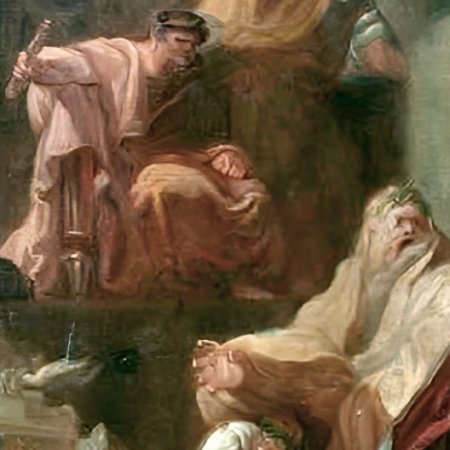
Egeus, proconsul of Achaia, sitting in court, has Andrew flogged for not wanting to sacrifice to idols.
Diderot's commentary:
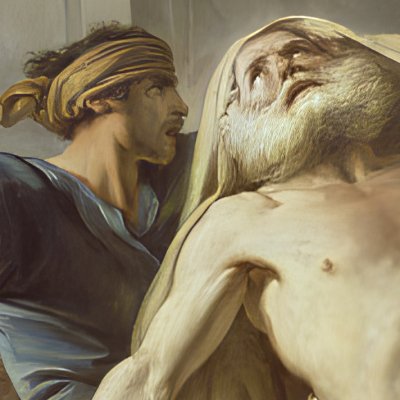
" His Saint Andrew has one knee on the easel, he climbs on; an executioner embraces him by the body, and drags him with one hand by his drapery and the other by his thighs; another strikes him with a whip; a third binds and prepares a bundle of rods. Soldiers clear the crowd. A mother, closer to the scene than the others, worriedly watches over her child. The child's fear and curiosity are plain to see. The saint's arms are raised, his head bowed and his gaze turned heavenward; a bushy beard covers his chin. Constancy, faith, hope and sorrow are fused on his face, which is simple, strong, rustic and pathetic. A heavy drapery thrown over the top of his head falls over his shoulders. The whole upper part of his body is bare in front: flesh, wrinkles, stiff, dry muscles, all the marks of old age. It's impossible to look for long without being terrified by this scene of inhumanity and fury. All the figures are large, the color true; the scene takes place beneath the tribune of the praetor and his assistants. To the right of the viewer, the praetor in his tribune with his assistants; below, an executioner and the easel; towards the middle, on the other side of the easel, the saint standing, leaning on the easel with one knee; behind the saint, an executioner beating him with rods; at his feet, another executioner tying a bundle of rods; behind these two lictors, a soldier pushing back the crowd; this is the machine. After that, you have to see the details, the heads of these satellites, their actions, the character of the praetor and his assistants; the whole figure of the saint, the whole movement of the scene. Ma foi, ou il faut brûler tout ce que les plus grands peintres de temples ont fait de mieux, ou compter Deshays parmi eux. " (Salon de 1761, CFL V 70)
2. Commissioned in 1753 for the church of Saint-André de la Porte aux Fèves in Rouen. Seized during the Revolution; acquired by the Rouen commune in 1792.
3. Engraved in 1761 by Philippe Parizeau; sketch in the Bayerishes National Museum, Munich; drawing by Gabriel de Saint-Aubin in the margin of his copy of the 1761 Salon booklet.
The Musée de Rouen contains three large canvases from the church of Saint-André de la Porte-aux-Fèves, Rouen : Saint André conduit au supplice, le Martyre de saint André and Saint André mis au tombeau.
Technical Data
Notice #001123