FR
FR
 EN
EN
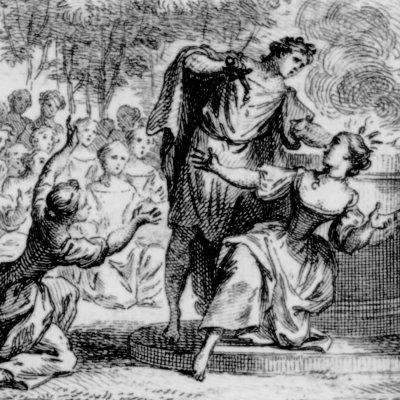
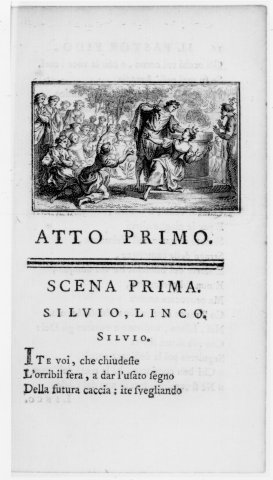
Aminta sacrifices herself & saves Lucrina (Pastor fido, act I, Prault, 1766) - Cochin
Notice précédente Notice n°3 sur 7 Notice suivante
Description
"Every year, the people of Arcadia sacrificed a young local girl to Diana, whom they worshipped; the Oracle had long advised them to do so, in order to put an end to the evils they were afflicted with. The same Oracle, consulted since then about the end of their miseries, had answered:
"Your evils will only end, when love unites two Rejects of the Gods, & when the generosity of a faithful Shepherd erases the crime once committed by a perfidious Nymph."
Struck by this prediction, Montan, Priest of the Goddess and descendant of Hercules, succeeded in making Silvio, his only son, promise to marry the Nymph Amarillis, also the only daughter of Titire, who in turn related her origin to the God Pan. But no matter how hard the two Fathers tried, they could not bring the marriage to fruition; young Silvio's only passion was hunting, and he shunned anything that might make him sensitive. Amarillis, however, was tenderly in love with a shepherd named Mirtil, who believed himself to be the son of Carino, a shepherd from Arcadia, but who had long been living in Elide. Amarillis loved Mirtil no less, but she dared not reveal her love to him, because she feared the effect of the law, which condemned all unfaithful Nymphs to death. Corisque seized this opportunity to lose the Nymph, whom she had not forgiven for loving Mirtil; she hoped that after the death of her Rival she would triumph more easily over the constancy of the Shepherd, with whom she herself had fallen in love; she did so much by her lies and deceit, that the two Lovers, unwary and driven by motives quite different from those attributed to them, found themselves in the same cave. A Satyr denounces them, they are caught; Amarillis, who cannot justify her innocence, is condemned to die. Mirtil, who believes her guilty and knows that the Law only condemns the unfaithful Nymph to death, nevertheless wants to save her and die in her place, taking advantage of the privilege of the same Law, which allows the Man to offer his life for that of the Criminal. He is led to the Altar by Montan, who, as Priest of the Goddess, performs the function of Sacrificer. Carino, who was looking for his beloved Mirtil, arrives to find him in a situation that astonishes and grieves him, for he loved him as much as if he had given birth to him. He endeavors to save her life, by proving that Mirtil, being a foreigner, cannot be sacrificed for another; but without realizing it, he gives reason to discover that Mirtil is the son of Montan himself. The True Father expresses the pain he feels at being Minister of the Law against his own blood; but the blind Tirenio, Prophet, comes to open his eyes to the interpretation of the Oracle's words. He shows that not only do the Gods not want this Sacrifice, but that this is the day marked by Heaven, to be the end of the evils afflicting Arcadia. The Oracle's words are compared with what has just happened, and it is recognized that Amarillis can only marry Mirtil. Shortly before, Silvio, while hunting, had mistakenly wounded Dorinde, with whom he was adored. This misfortune had softened the hardness of his heart, and by making him sensitive to the movements of pity, had made him tender. As the wound was not fatal, and Amarillis became Mirtil's wife, Silvio also married Dorinde. In this moment of unhoped-for happiness, Corisque returns, asks for and receives the forgiveness of the Lovers who have become Husbands; she shows her gratitude for the grace granted her, and resolves to change her life. (Argument from Pasto fido in Jean-Luc Nyon's edition, Paris, 1759, Italian text and French translation by Antoine Pecquet)
The scene portrayed by Cochin is in a way the preliminary to this narrative, its primitive scene: it is the punishment for the "crime once committed by a perfidious Nymph ", Lucrine, saved in extremis by her lover Aminte, just as Mirtil will offer to die for Amaryllis. The story of Aminte and Lucrine is told by Ergaste to Mirtil in the second scene of Act I:
"I'm going to recount to you, from the very beginning, the deplorable story of our misfortunes ; it could soften, I don't say men only, but even the hardest castes. At a time when young priests were still being admitted to the holy priesthood and the Temple, a distinguished shepherd named Aminte, who was then exercising the priesthood, loved Lucrine. This Nymph was a miracle of beauty and grace, but a monster of infidelity and inconstancy. For a long time she responded to the Shepherd's sincere and pure love, or at least the perfidious one gave every apparent sign of it, and while there was no Rival, she flattered the hopes of the unfortunate Aminte. But admire her fickleness! a vile Shepherd would not have noticed her sooner, than, unable to resist the first glances or the first sighs, she gave herself over entirely to new loves, before Aminte could have had the slightest suspicion of perfidy. Merriment and estrangement were the first effects of this change; soon the ungrateful woman no longer wanted to listen to him or see him. Judge by your own example whether this unhappy lover gave himself up to weeping and wailing.
MIRTIL
Yes, without a doubt, this is the greatest of all evils.
ERGASTE
When Aminte had used tears, prayers and sighs in vain to win back Lucrine's heart, he turned to the great Goddess. Diana, he said, if ever, with a pure heart and an innocent hand, I burned perfumes on your altars, avenge my flame betrayed by the deceitful caresses of a perfidious Nymph. The Goddess was sensitive to the prayers and complaints of this faithful Lover, of this high Priest whose virtue was dear to her; the movements of her friendship only made her courtship more intense; she took up her fearsome bow, and hurled invisible arrows into the bosom of Arcadia, bringing certain death everywhere. All, without distinction of age or sex, perished without help, without pity: remedies and escape were equally useless; the doctor, trying to cure the sick, died before him. In the midst of such great evils, the only remedy left to expect was from the Gods: the nearest Oracle was called in; his answer was all too clear, but even more disastrous and terrible. Diana," he said, justifiably indignant, "can only be appeased by the blood of the perfidious Lucrine, or of another of the country, offered for her, in sacrifice, by the hand of Aminte. The infidel, after useless tears, after vainly seeking help from her new Lover, was solemnly led to the sacred Altar. There, bending her trembling knees to the feet of this betrayed Lover, who had so uselessly followed her, she awaited only death at the hand of the irate High Priest: the intrepid Aminte, animated by anger, and seeming to breathe nothing but vengeance, draws the sacred sword, then turning towards the Victim, heaving a sigh, foreshadowing his own death: Lucrine, he cries out, may your misfortune make you know which Lover you preferred to me, and may this blow teach you which Lover you have abandoned. Instantly he strikes himself and plunges the sword into her breast: thus the Sacrificer falls Victim himself, into Lucrine's arms. Seized by a spectacle so cruel & so unexpected, she remains for a moment suspended between life & death, uncertain whether it is the iron or her own pain that pierces her heart? Barely had her senses returned, allowing her the use of speech: fidele & courageous Aminte, she said, pouring out a torrent of tears, Lover whom I knew too late, who gave me death by wanting to give me life, I must, by uniting myself eternally with you, make reparation for the crime I committed by abandoning you. No sooner had she finished these words, than she drew from the breast of her expired Lover the sword still stained and smoking with his blood; she pierced her heart with it, and let herself fall into the arms of Aminte, who was still able to feel the blow. Thus ended the two Lovers, deplorable victims of a perfidy without example & of an excessive love. " (ed. Nyon, Paris, 1759, p. 81-89)
1. Signed below the engraving, left "C. N. Cochin filius del. ", right "B. L. Prevost sculp. ".
Technical Data
Notice #001145