
 FR
FR
 EN
EN
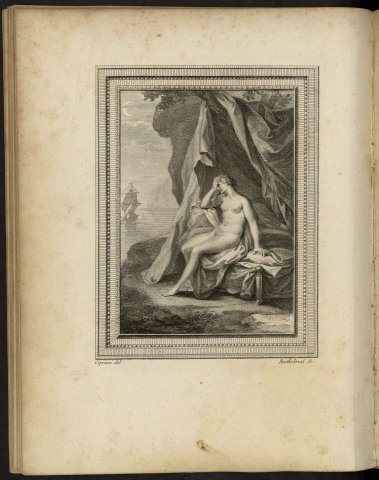
Olimpia abandoned by Bireno (Orlando furioso, Brunet 1775, c.10) - Cipriani
Notice précédente Notice n°20 sur 92 Notice suivante
Description
Bireno, who prefers the daughter of his former jailer Cimosque to his heroic young wife, abandons Olimpia on an island, taking advantage of the fact that she has fallen asleep after making love.
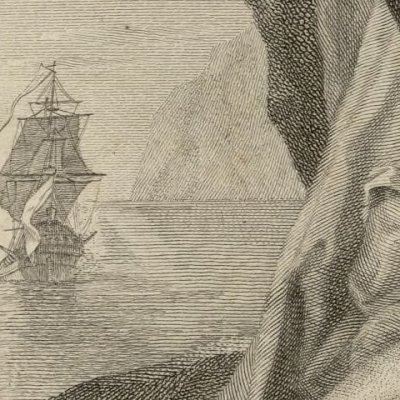
The limited space of the stage is defined by the drapery that has served as Olimpia and Bireno's tent for the night. The half-light against which Olimpia's white body stands out contrasts with the brightness of the distance in which Bireno's ship is moving away to the left. Olimpia is alone, but the veiled crescent moon in the upper left mirrors Olimpia's face, buried in her right hand as a sign of despair.
The moment depicted is the moment when Olimpia, having just awakened, notices that Bireno is no longer beside her: with her left hand, she has felt the empty spot on the bed, before turning to get up (str. 21). She hasn't yet seen Bireno's vessel, which is hidden from her by her right hand and the bed's curtain, but her face shows that she can already guess at his misfortune. It's a striking moment, in which the designer suggests both what happened before, the night with Bireno, and what will happen afterwards, when Olimpia discovers that the ship is gone.
Note the nail in the bottom left-hand corner by which the bed curtain is secured to the floor. This little nail is a counterpart to the wooden ball at the foot of the bed, and organizes the line of flight for the eye, from right to left. The sinking into the distance is at the same time a shift in time, towards the future.
Olimpia presses her right palm against her head, shielding her gaze with her hand. This screen, which forms part of the scenic device, is doubled by the drapery that falls behind her, and, behind her again, by the promontory where she will soon rush to plead with the ship to turn back (str. 34). Olimpia's arm, the drapery of the tent and the promontory, imperfectly superimposed to represent the layering of time, separate the restricted, intimate space of the tent on the right from the vague space of the sea on the left.
1. Top center: "CH. X. Pag. 165". Signed lower left "Cipriani del.", right "Bartholozzi sc."
2. Engraving taken from the Baskerville/Molini edition, Birmingham and Paris, 1773, where it bore the following title: Che debo far ? che poss'io far qui sola ? / Chi mi da ajuto, oimè, chi mi consola ?
3. Based on Ariadne auf Naxos.
Technical Data
Notice #001150
