FR
FR
 EN
EN
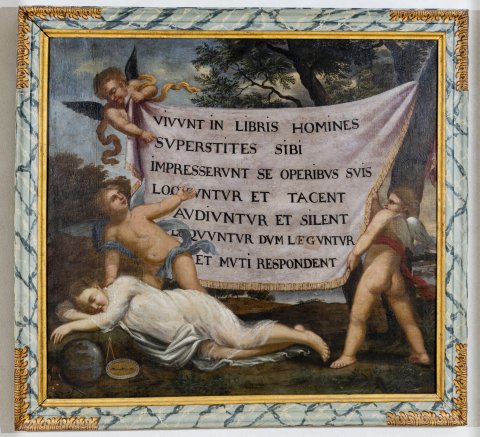
The awakening of Intelligence through the silent world of books - Anonymous after Christophe Tassin
Description
This allegorical painting commissioned by Inguimbert for his library is intended to explain the function of a library, and more generally the function of books: books awaken intelligence and enable us to understand the world. Before books, intelligence, shown here in the left foreground, sleeps. After reading, it opens up to the contemplation of nature. The device of the painting images what all reading experience is: reading, like the putto on the canvas, lifts the veil that covers nature and allows access to its truth.
The sheet is stretched between two branches on the right and the putto above on the left. It unfurls the text of a frontispiece, which could be the frontispiece of any book. Care must be taken not to over-translate the Latin text, which develops a common paradox: books are mute, yet they speak. The point here is not to celebrate the immortality that writers acquire through their books (a single possessive in the Latin text, and no reference to death), but to celebrate reading: a library is a silent place, and yet it sounds of many words.
The spectator is invited to lift the veil of the frontispiece and enter the paradoxical world of the library, conceived as a gateway to the world at large. This passage takes place in stages, guided by the putti.
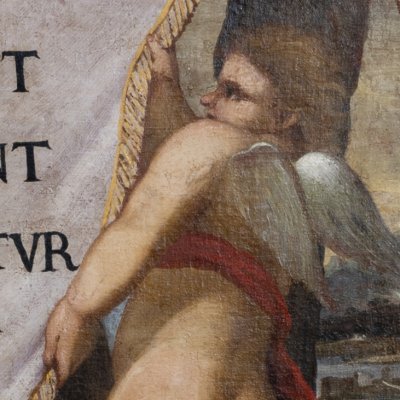
Top left, the putto of sleep shows the word superstites: "Through books, men are superstites, they survive." The eternity of books still represents the state of dormant intelligence. The second putto, below, shows the word loquuntur: "Loquuntur et tacent: they speak even though they seem to be silent." This is what the awakening putto reminds the sleeping intelligence, whose shoulder he pats to awaken it. Intelligence is endowed with a number of attributes: the globe for world knowledge, the compass and compass for circulation around the globe, the square for science. Finally, on the right, the third putto sketches the movement of raising the sheet. It accompanies the reader through this passage: the veil covering nature will be lifted thanks to reading, and the reader will gain access to its vision. This third putto shows respond: it announces the book's mute response to the reader's questions about nature.
Nature overflows the drap-frontispiece: it is represented at the top by tree branches, at the bottom by the riverbank and birds, on the right by a fortified town on a river island.
- On the sheet stretched by the putti, we read:
Vivvnt in libris homines
svperstites sibi
impresservnt se operibvs svis
loqvvntur et tacent
avdivntur et silent
loqvvuntvr dvm legvntvr
et mvti respondent
Men live in books:
surviving themselves,
they imprint themselves in their works.
They speak and they remain silent,
they are heard and they remain silent.
They speak as they are read
And, though mute, they respond.
Technical Data
Notice #025366