
 FR
FR
 EN
EN

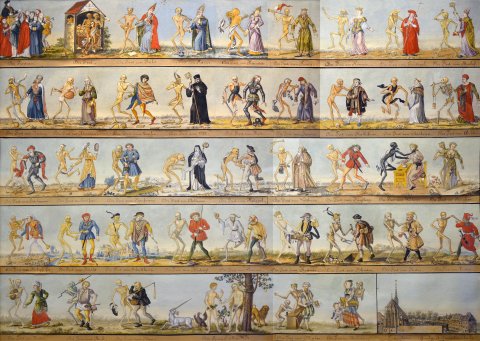
Basel Dance of Death (watercolor copy) - Feyerabend
Description
The original danse macabre was painted on the inner wall of the lay cemetery of the Preachers' Convent in Basel around 1440, measuring 2 m high by 60 m long. Its author was Konrad Witz or a pupil of his school.
The composition's starting point was a sermon, its end point, the Fall and the Last Judgment.
The fresco survived the iconoclastic crisis of 1529, but was in need of restoration. In 1568, the Basel Council commissioned Hans Hug Kluber to renovate it and bring it up to date. The preacher was given the features of Basel reformer Johannes Oekolampad, the figures were dressed according to the fashion of the time, the skeletons were painted more anatomically and, at the end of the frieze, Kluber added his portrait and that of his family, surrounded by two skeletons. From 1614 to 1616, Emanuel Bock, one of the sons of the painter Hans Bock the Elder, again restored the Danse macabre, but modified the painting less profoundly. Only the fleshy, puffed-up faces seem to be in his hand.
immediately after this restoration, Matthäus Merian the Elder drew the Dance of Death and reproduced it on copper plates, accompanied by rhymes. To turn it into a book, he broke down the frieze into individual scenes. The book was printed in 1621 by Johann Jakob Merian; two further editions followed in 1621 and 1625, by Matthäus Mieg. But it wasn't until Matthäus Merian the Elder revised the copper plates and the 4th edition was published in Frankfurt am Main in 1649 by his father-in-law Johann Theodor de Bry's publishing house that the painting became famous throughout Europe. After Merian's death, new editions followed, notably in 1696 and 1698 with original plates, in 1744, 1756, 1786 and 1789 with copied engravings, and in 1830 by the von Mechel brothers. Merian's plates from the new 1744 edition are on display at Basel's Kunstmuseum.
From 1657 to 1658 and in 1703, the fresco was again restored, but in the 18th century, it fell into oblivion along with the entire cemetery. From 1770 to 1773, at the request of the City of Basel, Emanuel Büchel produced a copy of the dance and verses in pen, brush and watercolor. He bound these copies into an album in which each page depicted a pair of dancers accompanied by the corresponding verse.
The wall and the image deteriorated more and more, and on August 5 and 6, 1805, the fresco was destroyed. Basel art lovers rescued 23 image fragments and 3 text fragments. Over time, 19 of these were returned to the public domain. They are now on display at the Basel Historical Museum.
Technical Data
Notice #025590