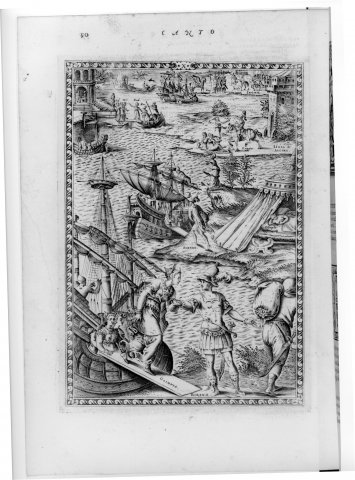
Bireno brings Olimpia down (Orlando furioso, Franceschi 1584, c.10) - G. Porro
Notice précédente Notice n°10 sur 46 Notice suivante
Description
In the foreground, Bireno helps Olimpia disembark from the boat that is taking her and Cimosco's daughter from Dordrecht to Antwerp. A servant on the right is carrying items needed to set up the tent (str. 17). Cimosco's daughter, who remains on the boat on the left, looks at the viewer with a knowing glance.
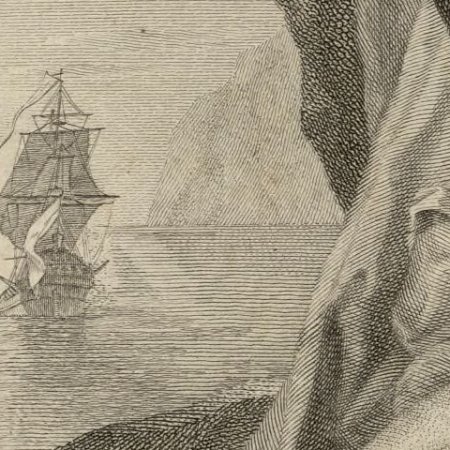
In the background, leaving Olimpia asleep in the tent, Bireno climbs back onto her boat. The sailors lower the sails to set off again (str. 19). Above, at the tip of the island, Olimpia, who discovers that she has been abandoned, laments as she watches the boat disappear, at the far left of the engraving (str. 34).
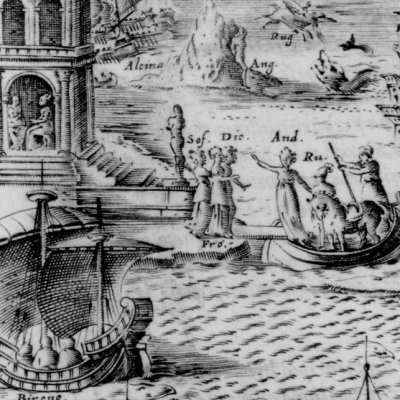
The upper quarter of the engraving alone concentrates all the subsequent events of the canto. On the right, on the part of the island occupied by Alcina, Ruggiero passes near a tower at the foot of which three young girls are resting, trying in vain to stop him (stanzas 36-42). On the left, Ruggiero, holding his horse by the bridle, lands with the boatman's boat on the part of the island that still belongs to Logistilla, where he is welcomed by four allegorical ladies, Andronica (valor), Fronesia (wisdom), Dicilla (modesty), and Sophrosina (chastity) (str. 52). In the upper left corner, Logistilla welcomes Melissa and grants her prayers (str. 65).
At the top, after a territorial separation marked by the sea, on the right, Ruggiero finds Rinaldo in England and shows him his hippogriff (lines 74-91). On the left, Ruggiero attacks the orca (stanzas 101-106), in front of the rock where Angeliqca is tied up, on the island of the Ebudians (note the finesse of the detail: behind the orca's head, above the engraving, its tail emerges). Further to the left, the disaster of Alcina's fleet actually belongs to an earlier episode (stanzas 53-56).
In this canto, rich in twists and turns, Girolamo Porro clearly wanted to focus on the episode of Olimpia's abandonment. We have already noted elsewhere his tendency to favor the opening episodes (the courtyard of the inn for canto IV, Ariodante revealing himself before the King of Scotland for canto VI, Ruggiero unveiling the shield of Atlante for canto VIII, Orlando in the Saracen camp for canto IX). Here, starting from the opening scene of canto X, the engraving unfolds a three-part action corresponding to the three main levels: first, Olimpia's landing on the island, then Bireno's flight, and finally Olimpia's despair as she watches the ship disappear on the horizon. The rest of the story and the canto are confined to a distant landscape, which tends to become the vague space against which a chosen moment stands out, a restricted space of the scene itself, even if this scene still unfolds in three stages.
These three moments, separated here, constitute the pregnant moment of the classical scene: the scene itself, Bireno's flight, is caught between a before, the arrival on the island, and an after, Olimpia's despair on the promontory. This before and after, which are relegated to the vague space, allow for the maintenance of a narrative virtuality in the staging. See, for example, the engraving after Cipriani in the Brunet and Plassan editions.
Ruggiero's journey from Alcina to Logistilla is shown here from right to left and not from left to right as in the Valgrisi edition, which is more respectful of the allegorical significance of the direction of travel. The inversion is probably due to the fact that G. Porro used Dosso Dossi's finished engraving as a model for his drawing, which was then reversed when printed from the copper plate. Similarly, the ship that lands on the desert island, on the right in the Valgrisi edition, is on the left here, Olimpia' tent, on the left in Valgrisi, is on the right here, and Olimp on her promontory, facing right in Valgrisi, faces left here.
3. For this canto, Girolamo Porro departs significantly from the engraving in the Valgrisi edition. It is no longer just a question of proportions or meaning. Although the respective positions of the boat and the tent are reversed, the engraving can still be read from left to right in the foreground. In the Valgrisi edition, which often telescopes the beginning of the canto, Bireno's betrayal occupies the foreground, whereas here, the landing on the island is given priority as the starting point of the narrative. The face-to-face confrontation between the two palaces, Logistilla and Alcina, is maintained, but reversed (Logistilla moving to the left in defiance of symbolic conventions) and completely distended.
Technical Data
Notice #003019