
 FR
FR
 EN
EN
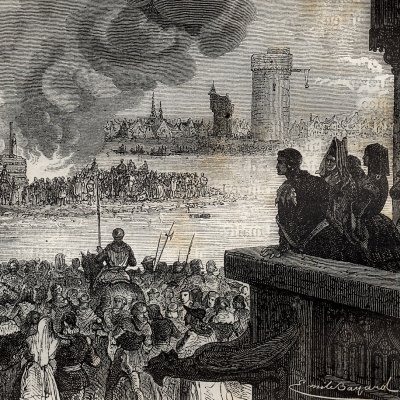

Jacques de Molai at the stake (H. Martin, Histoire de France, 1886) - Bayard
Notice précédente Notice n°73 sur 117 Notice suivante
Description
“Grand Master Jacques de Molay and the three principal dignitaries of the Order [of the Knights Templar] in France had been held in the king’s prisons for more than six years when the pope finally appointed a commission to try them.
The commission had the four prisoners brought to the square in front of Notre-Dame Cathedral in Paris. They first repeated their confessions, and their sentences were read, condemning them to life imprisonment. But then Grand Master Jacques de Molay and one of his companions recanted their confessions and declared that they had confessed only to escape torture, and that they and their order were innocent.
The papal commissioners, not knowing what to do, adjourned until the following day. But at nightfall, the king had the Grand Master and his companion taken to a small island in the Seine located west of the Cité, and there he had them burned together, without them having been condemned by any judge.
They endured death with such steadfastness, says the chronicle, that they left all witnesses to their execution in awe and astonishment (March 11, 1314).
This island, now joined to the Île de la Cité, occupied the site of the Place Dauphine and the pier where the statue of Henry IV stands. It was claimed that the Grand Master, from the top of his pyre, had summoned the king and the pope, within a short time, before the tribunal of God.
The pope died forty days later (April 20, 1314); the king, though still young, was not to live to see the end of the year.” (p. 331.)
- Signed lower left “G. BURGUN,” and lower right “Emile Bayard.”
- Chapter XXV, “The Successors of Saint Louis. Philip the Fair (1270–1344),” p. 329.
Technical Data
Notice #004654