FR
FR
 EN
EN
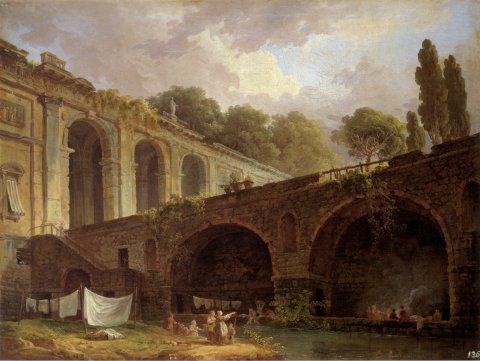
View of the Madame vineyard in Rome - Robert
Notice précédente Notice n°65 sur 105 Notice suivante
Description
Booklet from the 1767 Salon :
"By M. Robert, Academician.
101. [...]
110. Two Paintings of the same size : one representing a Waterfall falling between two Terraces, in the middle of a Colonnade ; the other a View of the Vigne-Madame, in Rome.
111. Two other Paintings ; one, a Bridge, under which we see the Sabine Campaigns, 40ieuses from Rome ; the other, the Ruins of the famous Portico of the Temple of Balbec, in Heliopolis.
. These four Paintings are approximately 1 foot 1to inches wide, by 1 foot 5 inches high. "
The Villa Madame, built for Princess Marguerite de Parma in the mid-16th century on a hill in the Roman countryside, is depicted here ruined and almost abandoned.
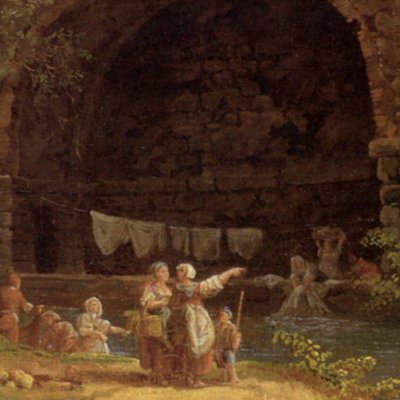
The space of the painting is divided into three levels: below, the ornamental pool has been transformed into a washhouse and colonized by washerwomen with their children. In the middle, the terraced garden runs diagonally across the composition, with its half-destroyed balustrade, repaired in places by a wooden embankment. At the top and to the left, the loggias are open, with large arcades interspersed with pilasters, originally topped by statues: only one survives, with a section of balustrade.
The geometrical structure of this space, with its large arcades, has been preserved.
The geometrical structure of this space is given by the architecture: the pool, the terrace, the loggias. The point of view chosen by H. Robert, from below and to the right, allows him to achieve a particularly original X-shaped construction, which eliminates right angles and erases the building's classical stiffness.
The three levels of the space correspond to the three levels of the building.
The three levels of space correspond to three modes of supplementation: the overflow of social life downstairs, with the intrusion of the washerwomen and their exuberant sociability, supplementing the aristocratic life to which this villa was originally dedicated; architectural bricolage in the middle, with the installation of a wooden banister and a parapet on the terrace to replace the ruined buildings; plant invasion above, with Virginia creeper and brambles colonizing the stone and adorning it in place of the destroyed statues and missing flower basins.
Hubert Robert imagines the ruin: the villa was never in this state. He also imagines the statue on the roof.
2. This painting has a counterpart, "La Cascade tombant entre deux terrasses, au milieu d'un colonnade ", also at the Hermitage. The two paintings are grouped together in n°110 of the Booklet.
Technical Data
Notice #000878