FR
FR
 EN
EN
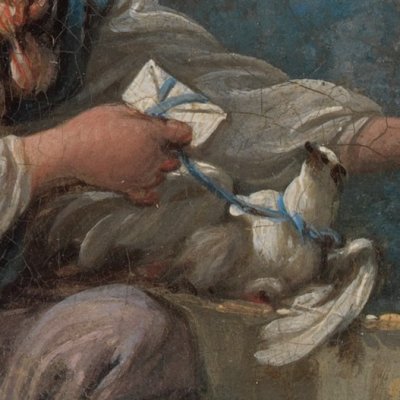
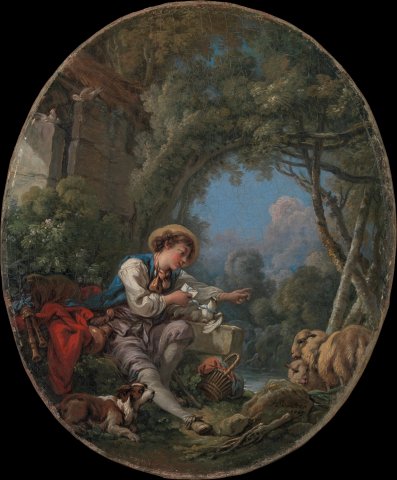
Mail Departure (Four pastorals) - Boucher
Notice précédente Notice n°19 sur 103 Notice suivante
Don de Mrs Joseph Heine en mémoire de son mari I.D. Levy, 1944
Description
Booklet from the 1765 Salon :
"By Mr. Boucher, First Painter to the King, Rector.
8. [...]
11. Four Pastorales, two of which are oval, under the same numero.
These paintings are about 15 inches high, by 13 wide. "
Mercure de France, October 1765, p. 152 :
"By a natural consequence of the spirit which had directed the exhibition of the pieces of the late Mr. Vanloo, one had put in the same place several pieces of Mr. Boucher, his successor in the place of first Painter of the King, called to this honor by the general wish of the connoisseurs, & almost designated by the celebrity of his name.
A considerable illness, followed by a very long convalescence, having prevented M. Boucher from taking on major works, this year we have seen from him only gallant subjects, such as Jupiter transformed into Diana to surprise Calisto. Angélique & Médor (7), pastorales (8) of a greater form than the preceding ones. A painting about two and a half feet high and two feet wide, depicting a woman tying a letter to a pigeon's collar, was also included. In these various pieces, we recognize the fertile genius of this century's finest painter. Always fertile in ways to diversify a gallant and witty idea in a thousand more pleasing ways than the others, this Artist only appears pleasing to vulgar eyes, while through the art of his design, the charm of his work and the graces of his brush, he astonishes and captivates connoisseurs and painters, whom he is always admired by.
It is the latter, in particular, who have sensed the importance of the artist's work. -It is particularly the latter who have felt all the merit of six other small pastoral paintings, in which the Painter has taken pleasure in representing the ancient custom of using pigeons to carry and bring back letters. These paintings are a kind of prodigy of art for the finesse of the touch, for the preciousness of the finish, without softness, without dullness; on the contrary, everything sparkles with strength and grace. It's hard to imagine how an artist accustomed to working only in the grand manner has managed to reduce himself to this other genre, without his brush becoming any less broad or free. Nature is undoubtedly embellished by this painter down to the freshness and brilliance of landscapes, but it is not altered. It is, so to speak, another principle of light, purer and more radiant, which makes him see it, and under whose aspect he presents it to us. Those who, through prejudice, believe that M. Boucher's coloring is too brilliant to be always in harmony, have only to consult the paintings by him that exist after several years, and they will be obliged to agree that what they thought was paillotter (to use the ordinary term) has become the model of the most perfect union of tones. What happens invariably cannot be the effect of hsard, it must therefore be that of an understanding particular to this Painter, in the use of colors. A more recent experiment would serve to destroy this prejudice (if it could exist). Several small landscapes by the famous M. Vernet had been placed among these small pastorals; this ensemble formed, as it were, a collection of precious diamonds in the midst of a great treasure trove of riches. Certainly, no one would deny Vernet's works the purest truth of imitation. A number of connoisseurs have found that, at a certain distance, the stableaux of these two great masters produce a harmony of color as pleasing as it is brilliant. As they drew closer together, the distinction between their styles became apparent, but the principle of truth was always the same. In all the arts, great men reach beauty and truth by different paths.
(7) Oval boards about two feet high by one and a half feet wide, from the cabinet of M. Bergeret de Grancour.
(8) Boards seven feet six inches high by four feet wide.
Mathon de la cour, Lettres à Monsieur ***..., 1765, p. 12-13 :
"M. Boucher, who has just succeeded to the position of Premier Peintre, has given several paintings. One represents Jupiter transformed into Diana to surprise Calisto. The other, Angélique & M&dor. Then there are eight Pastorales and a Landscape. In these Pastorales, the painter has taken pleasure in retracing the ancient custom of using pigeons to carry letters. Sometimes he has painted a Shepherd or a Shepherdess attaching a bill to the neck of a pigeon; sometimes a Shepherdess extending her hand towards her little Passenger, with the most tender and impatient air. This presents the imagination with gallant ideas. M. Boucher is one of the most ingenious and fruitful artists ever. But he is criticized for compositions too full of objects, mannered coloring and neglect of chiaroscuro. Instead of beautiful nature, he sometimes paints embellished nature. The shepherds in his Pastorales resemble those of Fontenelle. "
1. Signed and dated lower right on a stone : "f Boucher | 1765 ".
2. Gift of Mrs. Joseph Heine, in memory of her husband, I. D. Levy (1944)
.
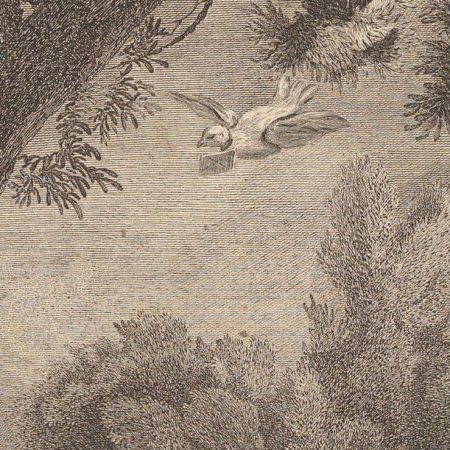
3. The painting was engraved by Jacques Firmin Beauvarlet, perhaps in 1769. See Louvre, Département des arts graphiques, Réserve Edmond de Rothschild, Portefeuille 443, 19051 LR/ Recto; Bnf Estampes, RESERVE EF-26 (3)-FOL .
Technical Data
Notice #001211