

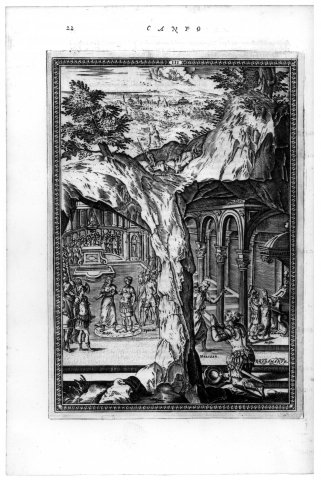
Bradamante enters Merlin's cave (Roland furieux, 1584, ch3) - G. Porro
Notice précédente Notice n°3 sur 46 Notice suivante
Description
While Girolamo da Porro adopts the general layout of the woodcut in the Valgrisi edition, he radically alters the interior of the grotto and brings the demands of perspective to the heart of the composition. The borrowings from 1562 are less visible in this engraving than in the others of the series: the upper part is still occupied by the opening episode, Pinabel's betrayal, and the closing one, Mélisse's recommendations to Bradamante to find Roger. The direction and distribution of characters between right and left has been reversed, as is often the case when one engraving copies another. Pinabel flees to the right in 1562, to the left in 1584. Bradamante is in the foreground, center left in 1562, right in 1584. Merlin's tomb is on the left in 1562, on the right in 1584. Bradamante's posterity scrolls to the right in 1562, to the left in 1584; the demons to the left in 1562, to the right in 1584.
The desire to produce a perspective effect in the grotto led Girolamo Porro to depict the interior of the grotto not from the front, but from the side: the right wall becomes the essential wall. Girolamo would make the same choice and transformation for Alcine's palace in Canto VII and Tristan's castle in Canto XXXIII.
Unlike the 1562 engraver, Girolamo Porro is concerned with the rock covering Merlin's grotto in front of us, preventing us from seeing inside: for this reason, he has depicted a strip of rock in the center of the engraving, and artificially opened two virtual windows for us to look through: the space of the grotto thus becomes a stage space, separated from the spectators by the "fourth wall" of the Italian theatrical stage. The steps on which Bradamante kneels and prays provide a transition between the space where we, the spectator-readers, find ourselves and the restricted space of the stage proper, raised on a platform.
Merlin's tomb is no longer treated as a separate chamber, like the "secret chamber" described in Ariosto's text. The cavern is a single space, treated in the manner of Italian Renaissance churches: the tomb is set into the nave wall, separated from the central bay only by an airy colonnade. Bradamante's posterity runs from the apse, around the altar and along the left wall of the nave, symmetrically to the tomb.
Girolamo Porro invites us to explore the space of this cavern-church in two stages: first, we enter with Bradamante from the right. Mélisse leads us to Merlin's tomb. Then we leave Mélisse and Bradamante inscribed in the pentacle in the center of the church. Clockwise, we then follow first the demons on the right, then Bradamante's posterity, from Roger's immediate descendants at the head of the procession to the present-day heirs at the back of the apse. Our gaze moves in the opposite direction of the procession, as the narrative presents as a projection into the future (Bradamante's posterity) what is in fact a retrospection of the past (Hippolyte d'Este's ancestors).
In the upper part of the engraving, the opening and closing episodes are not divided right and left as in 1562, but one behind the other: the medieval system of spatial bipartition no longer applies. Unfolding in time is identified more and more rigorously with sinking into perspective depth.
1. The engraving is numbered III in a small medallion at the top center of the border. Top left, page number, 22 and CANTO [TERZO, right page]. On page 23, we read the following argument: "Tornata in se la bella Bradamante Troua Melissa in questa grotta; et ode Le molte che da lei felici piante Uscir doueano, & ogni guerrier prode. S'informa poi, per far vane d'Atlante L'arti, che'l fuo Ruggier le tien con frode, Con qual maniera al vil Brunello tolga L'anello, onde il fu' amante, e gli altri sciolga."
Technical Data
Notice #001300