
 FR
FR
 EN
EN
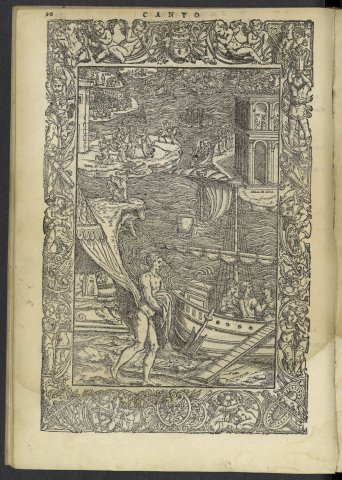
Bireno betrays Olimpia, Ruggiero at Logistilla (Orlando furioso, Valgrisi 1560, c.10)
Notice précédente Notice n°11 sur 47 Notice suivante
Description
In Canto IX, Olimpia sacrifices her family and kingdom to save Bireno, who is being held prisoner by King Cimosco in Dordrecht, Holland, by imploring Orlando's help. But Bireno falls in love with Cimosco's daughter (X, 10), who is promised to his brother.
The foreground of the engraving depicts Bireno's betrayal. Taking Olimpia and Cimosco's daughter with him, Bireno returns from Holland, where he was a prisoner, but his ship is shipwrecked on a desert island (st. 16). On the right of the boat are Bireno (BIR) and two women. Olimpia (OL) on the left, her arms crossed over her chest and her head bowed, is in a modest and chaste position. Bireno has his back to her and is coveting Cimosco's daughter.
Bireno had a tent pitched on the island and pretended to fall asleep with Olimpia. On the left, Olimpia, asleep and trusting (OL), does not see that Bireno, in the center, is putting on his clothes and boarding his ship, abandoning her on the island. In a contradiction characteristic of narrative compositions, Bireno's ship in the foreground on the right represents both the moment of arrival on the island (the three protagonists are still on board) and the moment of departure at night, surreptitiously and without Olimpia.
In the background on the left, Olimpia, abandoned on the island, gestures wildly, imploring the boat that has left her behind to return (st. 23).
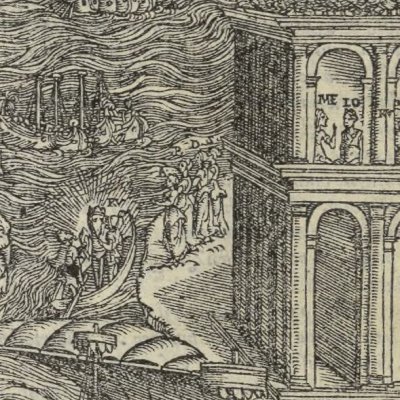
With the third plan, the story changes (st. 35). Facing each other are the island of Alcina (ISOLA DI ALC.) and the island of Logistilla (ISOLA DEI LOGI.), the fairy of lust and the fairy of reason (in fact, in the text, these are two parts of the same island, separated on one side by a gulf and on the other by an uninhabited mountain. See VI, 45). From left to right, Roger (RV) flees Alcina's palace on horseback. Three of Alcina's attendants try to delay him by tempting him with the pleasures of the banquet (st. 36). Without stopping, Ruggiero embarks with his horse on the boat of an old boatman (st. 43) and confronts Alcina's ships (two ships above him) with his magic shield (represented by the rays of light around the boat, intended to dazzle and destroy the enemy; st. 49) and lands on the island of Logistilla, where he is welcomed by four ladies, Andronica, Phronesina, Dicilla, and Sophrosina (st. 52; A., P., D., S.).
On the right, on the first floor of the palace, Ruggierp (R repeated on the column by RV) finds Astolfo (A) with Logistilla (LO; st. 64). The fairy Melissa (ME), who has restored Alcina's prisoners to their human form and brought them to Logistilla, asks her for help and protection for the two knights (left window, st. 65). On the roof of the palace, we can see the vegetation of the hanging garden (st. 61), in the style of Logistica's palace in Hypnerotomachia Poliphili.
Above, on the right, Logistilla's fleet sets fire to Alcina's fleet in the center, which flees alone in a boat (AL; st. 54) toward its island. On the far left (under the banner of Alcina's palace), Ruggiero (RV), holding the hippogriff by the bridle, completes his journey around the world and arrives in England (INGH, st. 72), where he joins Rinaldo (RIN, slightly above), sent by Charlemagne, and reviews the troops who will come to reinforce the defense of Paris (st. 74). Roger demonstrates his hippogriff to the amazed soldiers, then leaves for Ireland (RV; st. 91).
At the top, from the left towards the center, Ruggiero flies over the coast of Ireland (IRLAN on the left), from where he sees Angelica (ANG.) tied to a rock on the Isle of Tears, inhabited by the Ebudians (EBV; st. 93). In the center, from his hippogriff, Ruggiero is unable to kill the orc with his spear (st. 101).
Ruggierp therefore entrusts Angelica with Melissa's magic ring and dazzles the orc with Atlante's shield. But he still cannot kill the orc. Angelica then begs Ruggiero to leave the unconscious orc, to free her and take her away. Taking Angelica on his back, Ruggiero flies to Brittany on his hippogriff: their arrival in Brittany is depicted in the upper left corner of the engraving; Ireland is shown as Brittany... Faced with the naked Angelica, Ruggiero is overcome with a furious and guilty desire.
The overall composition of the engraving is tripartite: the island where Bireno abandons Olimpia marks the lower territory, dedicated to the ultimate counter-performance that is betrayal. The middle section is occupied by Alcina's island, divided into two islands whose spatial distribution is symbolic: on the left, Alcina's island is the island of temptation and pleasures, allegorized by the three young women who surround Ruggiero and try to keep him there with food. On the right, the island of Logistilla is the island of reason and virtue, allegorized by the four young women with Greek names who welcome Ruggiero. The boat in which Ruggiero reveals Atlante's shield, between these two islands, represents the balancing act, the suspense between values and counter-values. The symbolic re-founding on the right is not chivalrous, but humanistic: it is reason, not chivalry, that Logistilla embodies, giving Ruggiero a harness to tame the hippogriff, an allegory of the taming of passions by reason. At the top, England, Ireland, and Ebudio constitute the third territory, the return to chivalry, centered on two performances: Rinaldo's review of the troops, a mandatory passage in epic literature (even if Ariosto attaches more importance to banners than to warriors, to the meaning of images than to the evocation of names), and Ruggiero's fight against the orc.
1. Gravure en verso, sur page de gauche. Numéro de page en haut à gauche, 90, En-tête centré CANTO [DECIMO, p. 91].
3. Franceschi représente non le retour furtif et honteux de Biren, mais sa descente du bateau, ostensiblement galante : il donne la main à Olympe. Le retour de Biren est relégué au second plan.
Technical Data
Notice #001308