
 FR
FR
 EN
EN
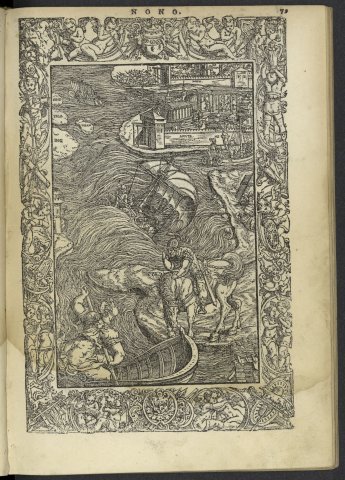
Orlando learns the story of the killer whale (Orlando furioso, Valgrisi, 1560, canto 9)
Notice précédente Notice n°10 sur 47 Notice suivante
Description
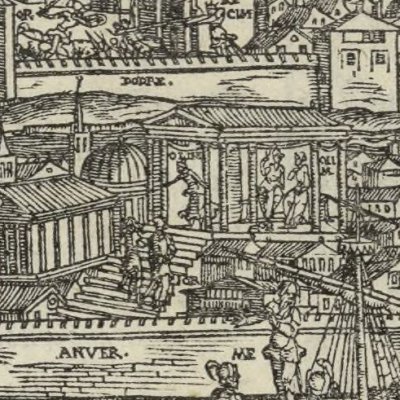
In the center right, we can see the sleeping Moorish soldiers, whom the loyal Ortando has spared (IX, 3-4). In the foreground, Orlando (OR.) reaches “the river that separates the Normans from the Bretons” (the Cuesnon, IX, 8). A young girl in a boat speaks to him, while remaining at a distance (str9): she will only help him cross the river if he agrees to fight the Ebudians. Orlando therefore embarks at Saint-Malo (in the center, on the left, StMA, str15). But the wind blows him to the right, so that he lands at Antwerp (ANVER. on the wall, and str17). An old man welcomes him (ME, for Mezzo, the intermediary, cf. str49, or by mistake for VE, vecchio, as in G. Porro's engraving?).
Inside the city, behind the walls, the old man leads Orlando to the steps of the palace, at the top of which Olimpia welcomes them (OLIM., but her name only appears in stanza 84). On the right, she seats her guest and tells him her story (str22-57): she loved Bireno, Duke of Zeeland, but Cimosco, King of Frisia, wanted her to marry his son Arbante. While Cimosco held Bireno prisoner, she married Arbante and murdered him on her wedding night (to be linked to the biblical story of Judith?). Orlando promises to make a detour from his mission against the Ebudians and rescue Bireno.
(Note the structure of the canto: the beginning reprises the narrative of the previous canto, Orlando's quest; the middle section relaunches the narrative with Olimpia's programmatic account, comparable to Astolfo's account to Rugggiero in Canto VI, Melissa's to Bradamante in Canto VII, and the narrator's account of the Ebudians in Canto VIII; the end of the canto offers a chivalrous combat that completes the epic ritual, but always in an offbeat way.)
At the top of the engraving, in the center, Orlando sails with Olimpia to Dordrecht in Denmark (DODRE., str61).
He challenges Cimosco to single combat, but Cimosco treacherously surrounds him at the gates of the city (str65). Wielding Durandal, Orlando (OR.) crushes his attackers and enters the city. After a chase through the streets of the city, Cimosco resorts to his terrible weapon: a rifle (str74). The king, recognizable by his crown, fires from the right (RE CIM.). Orlando faces him with his shield and sword raised (OR.). The horse is collapsing, hit by the rifle (str76). It is probably Orlando again who is depicted between the knight and the king (just above the inscription DODRE.): now on foot, he approaches Cimosco to split his head open.
Once freed, Bireno decides to leave with Olimpia, taking Cimosco's daughter hostage: he wants to conquer Zeeland, also known as the Kingdom of Friesland, shown at the top left of the engraving (ZILAN., str87). Orlando, taking with him only the arquebus to throw it into the sea, sails to Ibernia or Ireland (IRLA.), where he must join forces with the king against the Ebudians, whose island is shown just above (EBUD). Orlando is shown throwing the gun overboard.
The last two stanzas of the canto return to Holland, to Dordrecht, where the marriage of Olimpia and Bireno is celebrated: canto X will recount the failure of this marriage...
Here we find the tripartite composition characteristic of the narrative engravings in the Valgrisi edition: at the bottom, the face-to-face encounter between Orlando and the maiden in the boat is a counter-performance, as the maiden only grants Orlando passage in order to divert him from his quest (compare with the engraving in the Franceschi edition). In the center, the boat caught in the storm (note the “hairy” rendering of the waves, a feat for wood engraving!) appears as a sketch of the suspense and reversal characteristic of the intermediate territory of the engraving. At the top, Orlando's victory over Cimosco and, on the left, the rifle thrown into the sea, celebrate the reestablishment of epic values.
1. Gravure en recto, sur page de droite. Numéro de page en haut à droite, 79. En-tête centré [CANTO, p. 78] NONO.
Technical Data
Notice #001309
