FR
FR
 EN
EN
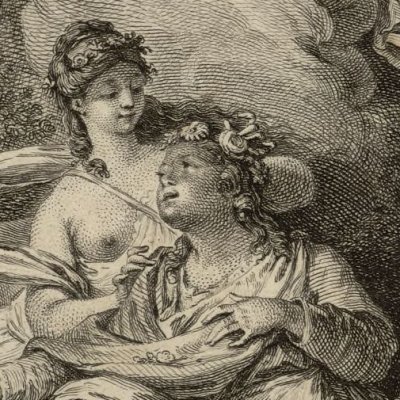

Ruggiero in Alcina's arms (Orlando Furioso, Brunet 1775, c.7) - Moreau le jeune
Notice précédente Notice n°14 sur 92 Notice suivante
Description
It seems here that the theme of Ruggiero in Alcina's palace has been contaminated by that of Rinaldo in Armide's gardens, borrowed from Tasso. Indeed, Ruggiero and Alcina are usually depicted in the fairy's palace, not in a grove; they normally speak in each other's ears, playing the game of secrets, instead of here subjugated Ruggiero submitting to his mistress's gaze, in the manner of the subjugated Rinaldo imagined by Tasso.
Moreau le Jeune takes full advantage of the classical scenic device, contrasting the foreground with the stage proper, whose restricted space is delimited below by the stream, above by the cloud where the putti frolic, and in the background, to the left, by the musicians who accompany the actors' performance, as if we were attending an opera aria. The musicians occupy a vague space, open to the distance, creating an indefinite depth. Between the two spaces, the young girl's back, immersed in the half-light, creates an abyss of the performance screen, already represented in the foreground by the stream. In str. 52, Melissa, disguised as Atlante, waits for Alcina to leave Ruggiero, who has settled "lungo un bel rio che discorrea d'un colle" (along a beautiful stream running from a hill, str. 53). But there's no trace in the engraving of an ambushed Melissa! And what is that book under Ruggiero's legs? Is it Alcina's book of enchantments, a clue to the viewer that all he sees is an illusion of the senses?
- Signed and dated lower left in frame "J. M. Moreau del. 1771 (?)", right in frame, "B. L. Prevost Sculp."
- Engraving taken from the Baskerville/Molini edition, Birmingham and Paris, 1773 where it bore the following title: Stava Ruggiero in tanta gioja e festa.
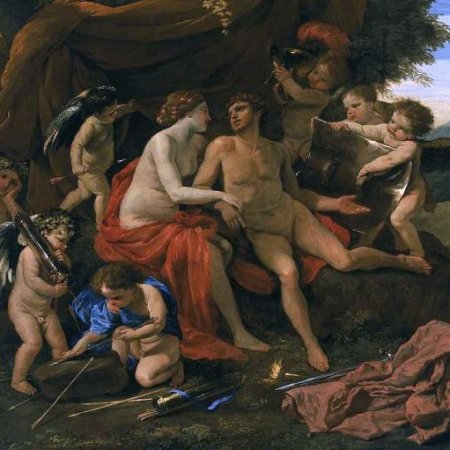
- Compare with depictions of Rinaldo and Alcina in Alcina's palace: painting by Rutilio Manetti, drawings by Fragonard (see links). The absence of Melissa in ambush in this engraving by Moreau le jeune is all the more strange as it would further strengthen the parallel with the scene in Canto XVI of Tasso's Jerusalem delivered, which is obviously inspired by this episode: In Tasso's work, Carlo and Ubaldo (//Melissa) are hidden witnesses to the seduction of Rinaldo (//Ruggiero) by Armida (//Alcina), who has kidnapped him from his island in the middle of the Atlantic to prevent him from serving Godfrey's Crusader army, which is besieging Jerusalem. In Tasso, Carlo and Ubaldo are sent by Godfrey to bring Rinaldo back to battle, just as in Ariosto Melissa is sent by Bradamante to bring Ruggiero back to her. In each case, the messengers shame the young man for his effeminate attire, arousing in him a virile protest and a surge of virtue... From the 17th century onwards, the representation of the couple formed by Ruggiero and Alcina, Rinaldo and Armida, or even Mars and Venus (see Boucher's engraving for Ovid's Metamorphoses, Bannier ed., very similar to ours), or Venus and Adonis, has tended to constitute an iconographic topos in which the characters are interchangeable. The topos is based on the inversion of codes: dominating posture for the young woman, who dominates and envelops a luxuriously dressed young man who has put down his arms both literally (they can sometimes be seen at his feet) and figuratively (gaze suspended from the superior gaze of the beloved woman, tunic loose and open, arms open and lowered, in a passive position).
Technical Data
Notice #000988