The great novelistic innovation of the sixteenth century is not immediately visible : after the creative explosion of the medieval novel, the Renaissance seems to experience a time of crisis and retreat. Chivalric adventures and allegorical quests were continued, rewritten and adapted. The novel feeds on a vein that is running out of steam.
The novelty seems to lie above all elsewhere, not in the renewal of forms, but in the technological revolution represented by the invention of the printed book : the great prose cycles written on " matière de Bretagne " were printed in the fourteenth and fifteenth centuries Latin and Greek romances were translated and printed ; what Montaigne refers to as " fatras de livres à quoy l'enfance s'amuse " (Essais, I, 26), the Tristans and Lancelots, thanks to these editions, are revised, melted down, rewritten. The sweet idyll then invaded the ancient webs of gesture and quest : witness the Amadis from Spain and Portugal that Herberay des Essarts began translating in 1540, and which constitute one of the most popular novelistic creations of the sixteenth century.
The adaptation to print of this cultural heritage strongly marked by orality, the widening of the audience, the growing divorce between the feudal values embodied in the chivalric adventure and the world of the readers bring about a major crisis in novelistic representation. This crisis manifests itself in two ways : through recourse to parody ; through the invention of the novelistic scene.
Since Mikhail Bakhtin's work on Rabelais, the major importance of parody in Renaissance novelistic creation has been well established. To Gargantua and Pantagruel (1535, 1532), we must add Ariosto's Italian parodic epic, Le Roland furieux (Venice, 1532) and, in Spain, Cervantes' Don Quixote (1605-1615).
The invention of the stage is less well known. It is strikingly evident in a work whose impact was immediate and European : La Jérusalem délivrée by Tasse (1581). Le Tasse, like Ariosto, whose heir he was, did not write a novel as such, but an epic in verse, strongly imbued with Virgilian and Homeric reminiscences. Yet it's not antiquity that provides the theme for these epics, but the Crusades and with them the whole medieval world of chanson de geste and the novel of chivalry.
This universe, as we've said, suddenly becomes remote. The genius of Ariosto and Tasso, far from erasing this distance, consisted in exploiting it: the Crusade, seen from the 1500s, is a tableau, and an ineffable one at that. We gorge ourselves on superheroes, incredible magicians and sublime princesses. The epic becomes picturesque. Ariosto parodies it, Tasso aestheticizes it.
We begin by showing how the text of La Jérusalem délivrée is seen as spectacle. The invasion of theatrical metaphor to designate what is manifested in the narrative, the insistence on the gaze cast by and on the characters, are not new novelistic themes it's the very model of novelistic creation that is radically transformed. The novel is no longer based on chivalric performance, but on the theatrical space of the stage.
The theatricalization of the novel presupposes the use of new imaginary structures. The bipartition of medieval agonistic space becomes inoperative as soon as chivalric performance is no longer the structuring principle of the narrative. In the second part, we show how the space of the novelistic scene is constituted on the basis of the screen device developed by Italian Renaissance artists to model linear perspective. The invention of the novel scene is fundamentally linked to the invention of perspective.
But this new space is only gradually and partially taking hold. We'll take two main examples:
Western
In Canto xiii, the enchanted forest is both the ancient site of wonder and the modern stake in technical triumph. It is the domain of witches and the haunting of spirits ; but it also provides the wood for the siege machines, which will ensure a primarily technological victory for modernized knights. The forest's ambivalence is reflected in its spatial configuration. At first, it presents itself as a concentric device, the aim of which is to penetrate the heart of the forest, as in medieval quests. But the quest must soon be thwarted by reason: there's nothing marvelous to be found at the center of the forest. The knight's triumph is therefore a triumph of reason, which consists in refusing the quest and proclaiming its diabolical inanity. Another device is put in place, based on the metaphors of envelope and garment. The trees of the enchanted forest envelop simulacrum spirits. Striking the trunks with the sword, wounding, tearing these envelopes, reveals, behind the marvelous simulacrum, the rational nothingness of technical reality : there is only wood there, only material for making machines.
.
The second example is in Canto xvi, where this device evolves further. Charles and Ubalde must reach Renaud, imprisoned by Armide in his castle. At the outset, the concentric structure of the quest is obvious: a whole series of obstacles must be overcome to reach Renaud, without whom the Crusade cannot be won. But it is Renaud's gaze, and his gaze alone, that will deliver him from Armide. Renaud's gaze must not only tear open the envelope of illusions in which Armide holds him, but confront the spectacle of Armide weeping and detach itself from this spectacle : here the screen device is established, based on the cut, but also on the competition between a disqualified discursive logic and a now triumphant iconic logic.
.
I. When combat becomes spectacle : the theatrical metaphor
The theatrical metaphor appears numerous times in the Jerusalem Delivered, identifying the epic action with a spectacle (spettacolo)1. The space of the knightly confrontation, during the ultimate clash of Argant the Infidel and Tancrède the Crusader in chant xix, is itself compared to an amphitheater2. In Canto xx, Soliman, contemplating the Crusaders' victory in Jerusalem from the last tower resisting them, mirò, quasi in teatro od in agone (73, 5), " regardé comme au théâtre ou au tournoi ".
The spectacle as withdrawal
But it's in chant vii, at the moment when the infernal castle of the sorceress Armide appears before the eyes of the knight Tancrède, that the identification of the place of performance with the theater stage is made explicitly for the first time :
apparìr tante lampade d'intorno
che ne fu l'aria lucida e serena. Splende il castel come in teatro adorno suol fra notturne pompe altera scena, ed in eccelsa parte Armida siede, onde senz'esser vista e ode e vede. (vii, 36, 3-8.)
So many lamps appeared around
that the air became bright and shining.
The castle shone as if in a sumptuous theater,
in the midst of the magnificence of the night, a scene of the grandest kind .
and in the highest place Armide sits,
from which, without being seen, she hears and sees.
Not only is the château compared to a stage, but with the evocation of Armide's ambushing eye, this scene is caught between two gazes.
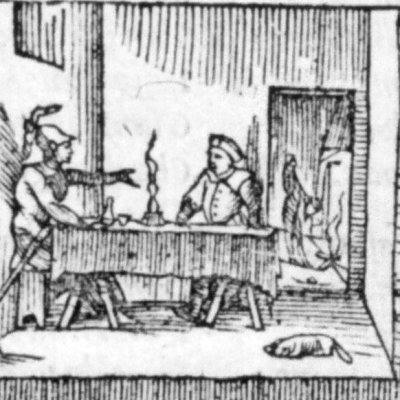
Figure 1 : L'Arioste, Roland furieux, chant XXVIII, Venise, F. Rampazetto, 1570, in 4°, F° 177r°. Bibliothèque municipale de Toulouse, Fac 2975, city cliché. Rodomont, King of Algiers (seated helmeted, left) is traveling south from France to Africa. On the way, he is welcomed at an inn. His host tells him stories about the infidelity of women. Although absent from the image, the woman is the object of the representation. The image is framed by the double curtain of a tent, which etymologically designates the stage on which it opens: stage comes from the Greek skènè, tent, and, in biblical Greek, tabernacle. The limited space of the inn, whose fourth wall has been removed, is seen by breaking in. The open door at the back establishes the geometric depth of the scene.
The scenic device here is indeed a trap of the gaze, the spectator's gaze entering the castle theater only to be captured by the eye of the machinatrice3. The agonistic face-off of medieval performance is succeeded by the face-off of the eye and the gaze.
In chant xiv, the word scene reappears, to designate as in chant vii Armide's stalking, this time trapping not Tancrède, but Renaud, whom she wants to kill to deprive the Crusaders of the help of the only knight through whom they could triumph and take Jerusalem. Armide conjures up a mermaid simulacrum to charm the young man in front of the river:
Così dal palco di notturna scena
o ninfa o dea, tarda sorgendo, appare. (xiv, 61, 1-2.)
As from the dais of a nocturnal scene,
Nymph or goddess, slowly emerging, she appears.
Armide has prepared a spectacle for Renaud that will turn against her : setting her gaze on the sleeping ephebe (str. 66), she in turn remains suspended (s'arresta sospesa) from the vision she has nevertheless constructed herself. The visual device, insofar as it establishes a face-off between the gaze and the closed eye, offers in its very dissymmetry the possibility of a reversal destined to become the essential spring of the scene.
In Canto xv, Charles and Ubalde disembark on Armide's island to search for Renaud, trapped by the magician's charms. The entire island becomes a scenic device before their very eyes:
At the end of song xv, Charles and Ubalde disembark to search for Renaud, captive to the charms of the sorceress.
Tacciono sotto i mar securi in pace ;
sovra ha di negre selve opaca scena
e'n mezzo d'esse una spelonca giace, (xv, 43, 1-3)
Below are silent the calm and still waves
Above is an opaque stage wall made of black forests
And in their midst is a grotto.
The passage is particularly interesting because it allows us to understand and visualize exactly what Le Tasse means by scena. Of course, the scena is the forest that must be penetrated to recover Renaud, prisoner of Armide's charms in a sense, it thus designates the entrenched place of the medieval quest, which here has become the gaze-trap that builds up from song to song in La Jérusalem délivrée. But the scena here is above all the Latin scaena revealed by the Virgilian intertext summoned by Tasso for this description4, i.e. the backdrop, the stage wall in front of which one plays. The island is a stage, because it suddenly presents the traveler-spectator from the sea with an extraordinary backdrop, a theatrical landscape. The first line of stanza 43 extends the horizontality of the sea; the second, the verticality of a screen, of which the audience is a part. /// the darkness clearly indicates that it is there to intercept the light, to cut off the field of vision.
The semiotic cut
The scene offered to the gaze refers less and less to the face-to-face of medieval agonistic performance to be constructed more and more systematically as a trap, but also above all as a screen device where the gaze is led to a mysterious beyond. We had already been confronted, in chant xiv, with the scenic play of the siren trapping Renaud at Armide's instigation. Canto xv repeats the same spectacle, for Charles and Ubalde. But the trap and mirages of wonder no longer operate, and an economy of lack is established:
.
e 'l crin, ch'in cima al capo avea raccolto
in un sol nodo, immantinente sciolse,
che lunghissimo in giù cadendo e folto
d'un aureo manto i molli avori involse.
Oh che vago spettacolo è lor tolto !
ma non men vago fu chi loro il tolse.
Così da l'acque e da' capelli ascosa
a lor si volse lieta e vergognosa. (xv, 61.)
Her hair, which she had gathered at the top of her head
in a single knot, she untied it at once.
This hair, falling abundantly and full-length downwards, wrapped
wrapped a golden mantle around the soft ivories of her body.
Oh, what a charming sight to behold!
But no less charming was the one that replaced it.
Thus hidden by the water and by her hair
she turned to them, blushing and happy.
The spectacle of the cloak of hair replaces the spectacle of the naked mermaid. The screen of modesty anticipates the refusal of the two knights, who will continue on their way without falling into this trap of desire. The show stages the screen of desire, an unveiling that is at the same time a withdrawal, an exposure that turns into a recession. The scenic cutout is no longer simply a cutout of a performance space it constitutes the performance as a cutout :
E se di tal dolcezza entro trasfusa
parte penètra onde il desio germoglie, tosto ragion ne l'arme sue rinchiusa sterpa e riseca le nascenti voglie. (66, 1-4.)
And if from such sweetness a part
diffuses within and penetrates where desire buds,
at once reason, entrenched in its weapons,
extirpates and cuts off incipient appetites.
The cloak that cuts off the view of the mermaid's naked body is matched by the repressive power of reason. The image could not be more concrete, evoking the budding erection severed by the weapons of the mind. The cut-out that forms the basis of the visual field of the show is, at the same time, the castration on which the new symbolic order is built, the humanist reason that dispels the ghosts of medieval wonder and paves the way for the victory of the Crusaders. Something fundamental is at work here: the identification of the gaze, desire and the cut constitutes the new semiotic structure from which all representations, all meanings will be derived: Tasso's riseca establishes the semiotic cut.
The show is thus ordered from then on as a play of the hidden and the shown, as can be seen again in song XVIII. Renaud, back with his people before Jerusalem, enters the forest, whose spells must be broken in order to use its wood to build the siege machines. The vision of the enchanted forest unfolds before him. The dancing nymphs emerge from the trees that seem to give birth to them: the vision is a reversal of an inside into an outside. The fairy-like farandole, a moment earlier enveloped in the trunks, is then transformed into a garland that girdles the hero, who himself has become the center of a vision that envelops him (punto rinchiuso entro il suo giro, 28, 4). The cloak device inaugurated by the display of Armide's siren is turned on its head and made more complicated as, concurrently with the theatrical metaphor, the /// model of painting is summoned:
Quai le mostra la scena o quai dipinte
tal volta rimiriam dèe boscareccie, nude le braccia e l'abito succinte, con bei coturni e con disciolte treccie, tali in sembianza si vedean le finte figlie de le selvatiche corteccie ; (XVIII, 27, 1-6)
As we show on stage or as well admire
in painting the wood goddesses
with bare arms and short dresses,
with beautiful cothurns and untied braids,
so in simulacra one could see the feigned
wild bark girls.
It's precisely the hero's awareness that he's only witnessing a spectacle, that he's only facing a painting, that constitutes the performance. Triumphing over the enchanted forest means downgrading its wonders to the level of simulacra, in other words, introducing a break between the spectator and the spectacle. The optical break introduced by the spectator's distance from the spectacle conjures up the envelopment of the farandole of mirages, in which Tancredi had allowed himself to be ensnared. More precisely, the cut is superimposed on the envelopment to layer and leaf through the different levels of this field of the gaze that is being constituted: the imaginary dimension of the scopic envelopment, of this entrapment of a fascinated eye, is succeeded by the symbolic dimension of rational distancing, through which consciousness comes to culture: the mirage is no longer a dangerous spell but a beautiful work of art. The marvel then becomes an object of stage and painting, and the woodland goddesses emerge from the savagery of natural, real bark to enter the artifice of representation.
II. Perspective as a device of interposition (Brunelleschi, Alberti)
We can see from the combination of references to spectacle, theater and the stage that punctuate the text that a logic of scenic device is set up in a quite concerted way in La Jérusalem délivrée. The theatrical spaces that punctuate the poem are ordered by a gaze cast upon them from the outside. This gaze constitutes the scenic space as both a place of exposure and withdrawal, expressing a paroxysm and concealing a trap. This ambivalence of the scenic device is carried, worked by a whole game of cutting, which not only delimits the restricted space of the stage, but crosses it to play out the underside of a trap, the reverse side of a machination, or the forbidden charm of a naked body.
There is therefore a depth to the scene, and it is this depth that constitutes it as a device. Yet this depth, this cut-out, only becomes possible in the text since the invention by Italian Renaissance artists of the new linear perspective : the cultural device of the stage and the imaginary structures it induces thus appear conditioned by the scientific discovery of perspective.
Bronelleschi's experiment
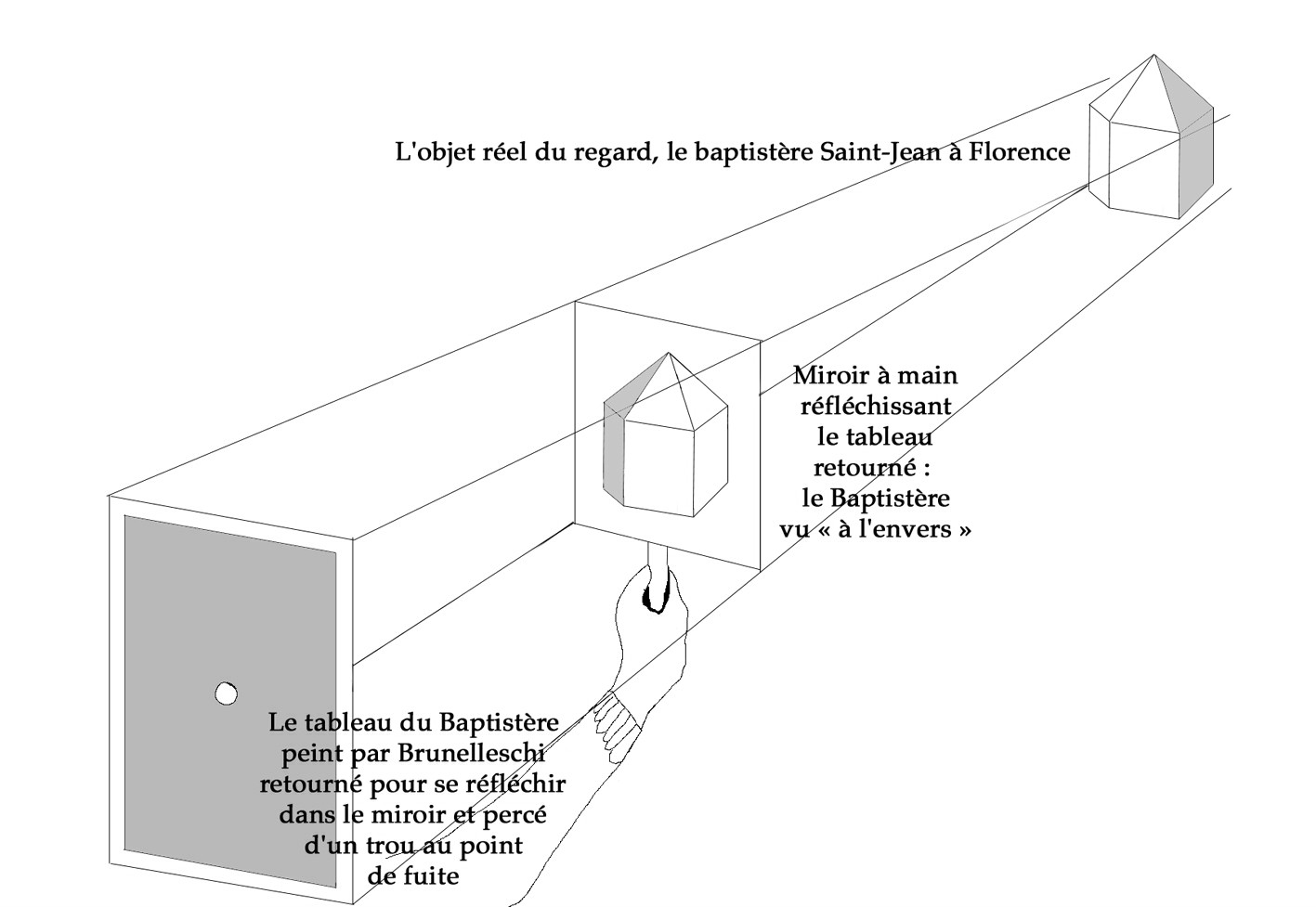
At the beginning of the fifteenth century, the Florentine architect Brunelleschi's work on perspective remained famous not least because of an experiment he carried out in Florence, recounted by his biographer Manetti. He painted the Baptistery, meticulously studying the rendering of surfaces so that the illusion of perspective would be perfect on the canvas. At the vanishing point on the canvas, he drilled a hole. He then placed a spectator in the exact spot from which he had observed and painted the Baptistery, and had him place the upside-down painting against his face, so that one of his eyes could observe the real Baptistery through the hole. Then, interposing a mirror between the Baptistery and his eye, the spectator reflected the image of the painting onto that eye. Removing and replacing the mirror, he could see the real Baptistery and the painted Baptistery alternately through the hole. The story goes that the illusion of perspective was such that, with or without the mirror, on the painting or in the real world, the eye saw the same image. /// thing.
This experiment posed a thousand technical problems on which Renaissance painters and scholars wrote extensively. What interests us here is this completely mad device that now orders perspective vision :
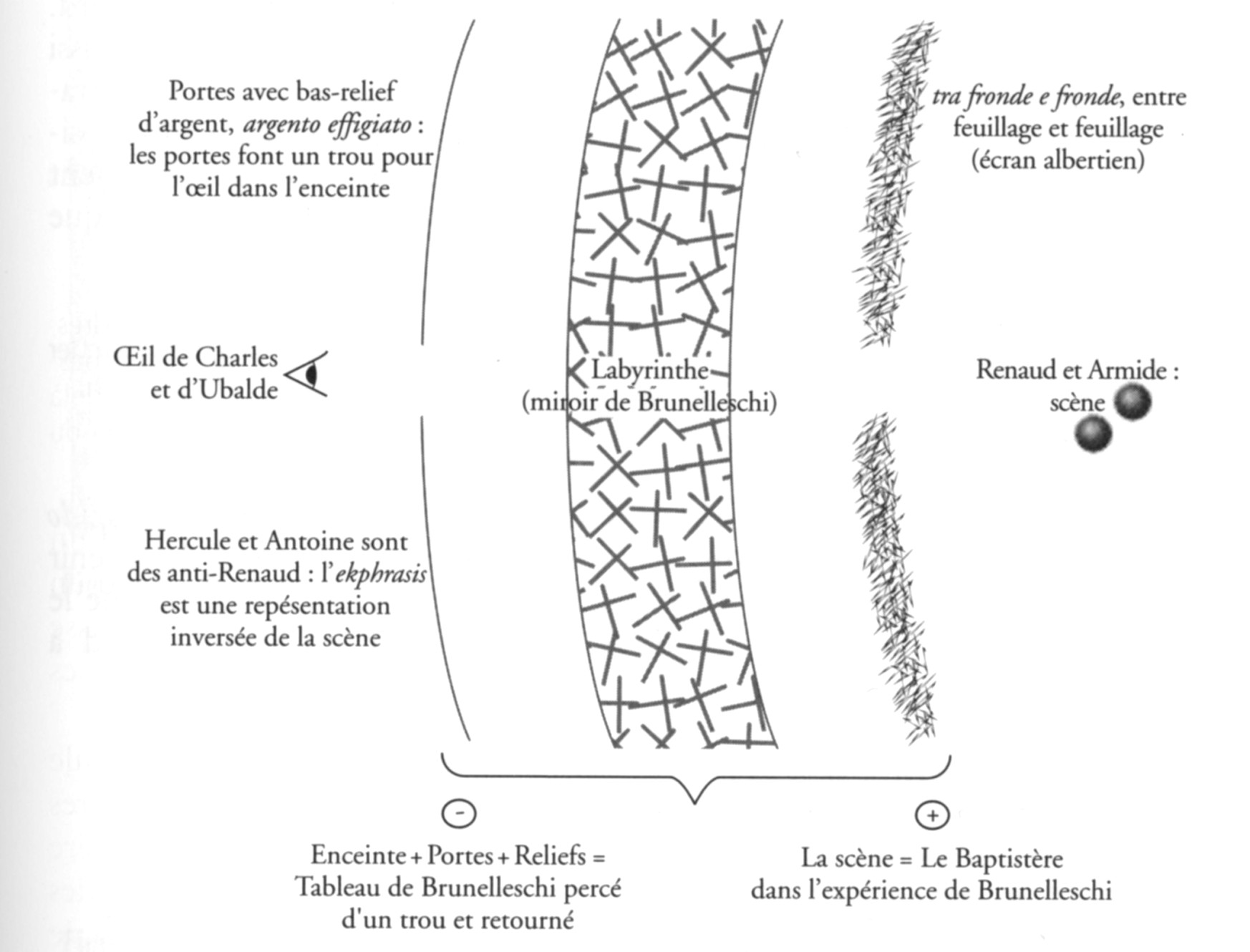
Figure 2 : Brunelleschi's experiment
Firstly, vision is validated by the back-and-forth of the mirror the object appears and disappears the mode of being of the visible becomes appearance-disappearance. The scene can only be understood and circumscribed by the interposition of the mirror, i.e. by the experience of a cut in the field of the gaze. This break enables us to verify perspective, establish depth of field and validate the arrangement of objects, their size and their respective distances on the canvas. What is verified belongs to geometry, and for this reason constitutes the geometrical dimension of the representation device.
Then, we can only see the painting from behind, through the mirror interposed between the eye and the object, between the viewer and the Baptistery. Vision presupposes an intrusion. The image it captures is somehow trapped by the device. The pictorial scene functions as a trap for the gaze. After the time of verification comes the moment of fascination, of the enjoyment of illusion, when the geometrically established distance is abolished in contemplation. The painted simulacrum fascinates, attracts and immobilizes the eye, petrifying the viewer. The pleasure of the eye is at stake here in what is irreducible to the other senses, the scopic dimension of the representation device.
Finally, to look at painting, you have to turn it upside down. What, from nature to canvas, makes a painting, this passage from the scene to be painted to the painted scene is marked by reversal, inversion and, in the etymological sense of the term, revolt. This reversal not only affects the experiential device, it also affects the image itself. The illusion was perfect in Brunelleschi's experiment only because the Baptistery is an absolutely symmetrical building. In reality, in the mirror, the viewer sees on the right what is on the left, and vice versa. The image of the Baptistery in the mirror is inverted in relation to the image of the real Baptistery. This reversal is highly symbolic. What's at stake in this experiment is a radical revolution in the way representation works. By relying on perspective, painting is now ordered in relation to the real world unlike the medieval icon, it no longer represents, immediately at least, the Idea, the Divinity, symbolic values. It is only in a second stage, through the play of the device, that it catches up with and recovers this lost symbolic dimension. The reversal of the image represents this catching-up. It technically transforms the imitation of nature into a vision of the spiritual, intelligible world. The painting is then understood as a sign, losing its visible pictorial materiality to make a sign and, through the hole in its core, open up the device. Here, beyond the visible, the symbolic dimension of the representation device takes shape.
This complicated device, which constitutes the image from a double occultation, the double reversal of canvas and mirror, theatricalizes what, since the Byzantine iconoclastic crisis (IXe century), in Catholic culture, the biblical prohibition of representation and its conjuration by the cult of images5. The device of the pictorial scene puts this prohibition into abyme by making the space of representation a space that is seen only in the fiction of having been previously turned upside down and obscured. At each level of the device, the interposition of the /// mirror plays a fundamental role, either as an apparition-disappearance, or as the return of a fascinating spectacle, or as the reversal of a reversal. This strange, circumvented device is, so to speak, naturalized and systematized by Alberti in his treatise De pictura.
Alberti's intercisio
Alberti begins by defining what he calls the triangle, then the visual pyramid :
" the rays stretched between the eye and the surface seen come together very promptly, penetrating the air and other porous and diaphanous bodies until they encounter a dense or opaque body " (i, 5, 81).
" sight is achieved by means of a pyramid of rays " (visum per pyramidem radiosam fieri, i, 7, 87).
It doesn't matter whether the eyes throw the rays, as Petrarch and the neo-Platonists thought, or whether the objects reflect the rays of sunlight back to the eyes, as modern dioptrics would establish. Alberti doesn't decide6, but his description of the rays does indicate a direction, from the tip of the pyramid, which is the eye, to the objects that, for the eye, make up the picture. The pyramid takes on consistency only from what it passes through, porous materials, diaphanous vapors and veils, until it comes up against the opacity of the object. This interposition of materials, vapors and objects in the pyramid that the eyes open before them at random in space is destined to become the essential phenomenon, and hence the fundamental structure, of vision. Vision is born of that which cuts the visual cone; vision is now fundamentally defined as a cut.
.
" it will necessarily be necessary for [the painter] to cut at some point this visual pyramid (pyramidam visivam perscindi) in order to represent with lines and paint the contours and colors as this cut will give them (intercisio). If this is indeed the case, those looking at a painted surface will believe they are seeing a certain section (intercisionem) of the pyramid. The painting will therefore be a section of the visual pyramid " (i, 12, 101).
The painter's choice of pictorial scene artificially fixes on canvas the cut, the intercisio of the visual pyramid, the same cut that eyes naturally experience at every moment, in a hazardous and precarious way, when they encounter an object and stop on a surface to look at it.
Alberti distinguishes, in the visual pyramid, three kinds of rays, which enable him to account for the three levels of the visual device.
Outer rays delineate the contours of objects, and thereby measure quantities. They establish the interval between two points and, from there, the respective distances between objects. External rays constitute the geometrical dimension of the gaze (i, 6, 83-87).
The middle rays are compared to chameleons, which " take on the color of things so that hunters have trouble discovering them ". Carriers of flesh, of color, and instigators of the trap in which the gaze is misled, the rays of the middle constitute the scopic dimension of the gaze (i, 7, 89).
Finally, the central ray, the chief of the other rays (dux radiorum), decides the angle of attack, the point of view from which the object to be painted, the scene, will be considered. It modifies appearances and contributes to the " certitude de la vue " (ad certitudinem visus) in other words, it is through the ray that the scene is framed and becomes legible. The central ray thus constitutes the symbolic dimension of the gaze, i.e. that which, in the gaze, determines the meaning of the object, the scene looked at (i, 8, 91).
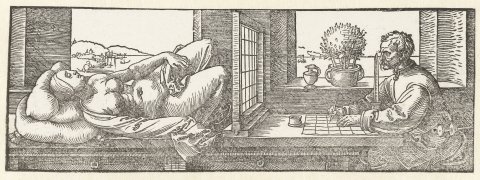
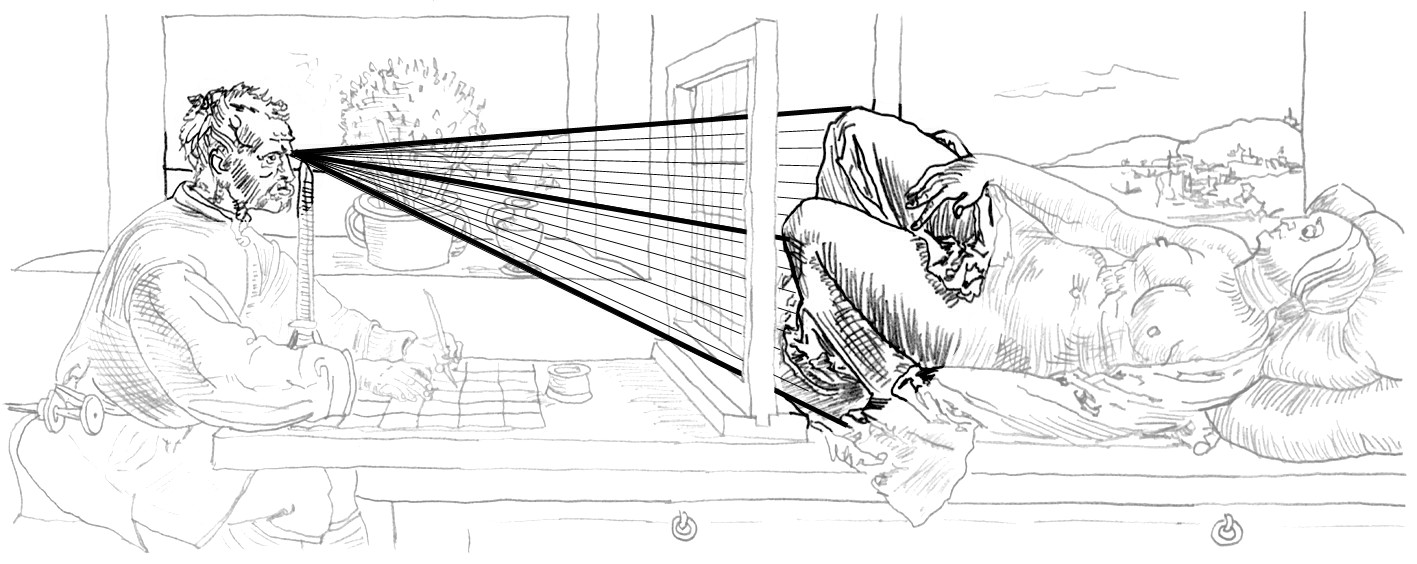
Figure 3 : Dürer, Artist drawing an elongated /// reclining woman. In 1525, Dürer published Instructions sur la manière de mesurer à l'aide du compas et de l'équerre in Nuremberg. The engraving was added to the 1538 edition
Figure 4: Outer rays, middle rays, central ray according to Alberti's theory.
So it's the intercisio, the interposition, that models for Alberti vision as a natural device accommodated by the eye on the things it looks at. But the same word intercisio also designates in Alberti's text the intersector, i.e. the instrument that provides the painter with a technique to materialize this cut-out and render perspective (II, 31, 147). The intersector is a wooden frame stretched with a very fine, squared fabric, which the painter places between his eye and the object or scene to be painted. He then transfers, tile by tile, the lines he distinguishes through the veil of the intersector onto the paper of the squared canvas that will become his work. The interposition of the intersector, in an apparently very different context, repeats the inaugural gesture imagined by Brunelleschi, the interposition of the mirror between the real scene and the painted one. The device of representation becomes a device of interposition.
Les écrans du Tasse : Armide aux pieds de Godefroi
If we now consider the way in which the gaze is staged in La Jérusalem délivrée, we see the pervasiveness of these technical models in the poetic representations imagined by Tasse.
In Canto iv, the sorceress Armide, sent by the powers of Hell, appears in the camp of the Crusaders, who are besieging Jerusalem with the intention of sowing discord. Armide's appearance is the occasion for a spectacular exposition, which first focuses the gaze on this dazzling woman, cutting through the crowd of soldiers to reach Godefroi, and then on Armide's eye, reddened and lowered (30, 3), stealing away to better ensnare the men fascinated by her appearance in a trap of desire.
.
A l'apparir de la beltà novella
nasce un bisbiglio e 'l guardo ognun v'intende sì come là dove cometa o stella, non più vista di giorno, in ciel risplende ; (IV, 28, 3-6)
At the appearance of this extraordinary beauty
is born a murmur and everyone directs his gaze there
as if there were a comet or a star
resplendent in broad daylight in the sky.
Passing herself off as a Syrian princess, Armide comes begging for help and protection to reclaim her usurped kingdom. The aim is to detach some of the Christian forces from Jerusalem and ensnare the knights she has seduced on the road to Damascus7.
Armide must cross the camp to get to Godefroi's tent. Her performance will be a supplication to the enemy one thinks here of Priam's prayer at Achilles' feet, claiming Hector's body for burial at the end of The Iliad. Priam too must cross the Greek camp to reach the tent of his son's murderer. But Hermes spreads sleep over the camp guards (xxiv, 445), and Priam's journey is made stealthily through the night. In La Jérusalem délivrée, by contrast, the magician takes full advantage of the visual effect her arrival produces. Priam's nocturnal journey is contrasted with Armide's epiphany.
Armide makes a spectacle of herself. The convergence of attention on the visual spectacle with which she regales the troops delays her speech. Armide's speech is a decoy, not only because it is artificial, but also because it is not the essential means of deception. Nor does it convince Godefroi, who refuses to help the supposedly grieving princess. The speech merely prolongs the poignant spectacle of this shattered beauty. Armide is a tableau, and a fearsomely effective one at that, attracting all eyes and crystallizing all desires. Here, visual communication supplants communication through speech, short-circuiting the hierarchical path: discord can now begin its devastating work...
The scene is ordered according to a field of view that shifts it in relation to the discourse it is supposed to frame. We have seen how, geometrically, the gazes circumscribe a space centered on the incandescence of the scenic object, of this Armide compared to a comet. But the object itself is characterized by cutting, and installs a dynamic of the screen :
Parte appar de le mamme acerbe e crude,
parte altrui ne ricopre invida vesta : invida, ma s'a gli occhi il varco chiude, l'amoroso pensier già non arresta, ché non ben pago di bellezza esterna ne gli occulti secreti anco s'interna. (iv, 31, 3-8.)
A part appears from her virgin and firm breasts,
a part, it is a jealous garment of others that covers it :
jealous, but if it closes the passage to the eyes,
it doesn't stop the amorous reverie,
who, hardly satisfied with outward beauty alone,
still penetrates hidden secrets.
Incessantly, the text returns to this device that halts the eye's journey while exciting its desire to pursue further. The veil, the garment, sometimes open, sometimes closed at the whim of the wind (30, 1) set up in front of the eye a beat, a palpitation that transforms the scenic object into a pulsating thing that can only be grasped by breaking in, by transgressing a ban.
Come per acqua o per cristallo intero
trapassa il raggio, e no 'l divide o parte, per entro il chiuso manto osa il pensiero sì penetrar ne la vietata parte. Ivi si spazia, ivi contempla il vero di tante meraviglie a parte a parte ; poscia al desio le narra e le descrive, e ne fa le sue fiamme in lui più vive. (iv, 32.)
As through water or through intact crystal
passes the ray, without producing either division or cutting,
so inside the closed cloak8 reverie dares
to enter the forbidden part;
there it floats at leisure, there it contemplates the truth
of so many wonders part by part
then she brings them back to her desire and describes them,
and turns them into brighter flames within him.
The screen device is clearly that of a ray passing through a translucent surface : the white cloud and transparent veil (iv, 29), the water and crystal (iv, 32) are all poetic transpositions of Alberti's intersector. The obsessive repetition of the term parte, used sometimes as a verb, sometimes as a noun, clearly marks that what is at stake here is of the order of cutting. The scenic object is la vietata parte, i.e. that which in space is cut out, retrenched as forbidden.
III. A pre-scenic space : the forest of chant XIII
We saw in the previous chapter how the performance of the medieval novel tended to shift from the conquest of the marvel, the stakes of chivalric combat, to the investment of the place, the object of the quest. This place is the focus of the allegorical novel of the Gothic Middle Ages, /// is identified from the Renaissance onwards with the scenic space of theatrical performance. Thus was born the novelistic scene proper.
La Jérusalem délivrée is marked by this transition from the entrenched place of allegorical performance to the exposed space of the novelistic stage. Tasse's epic aims at the occupation of the Place par excellence, the Holy Sepulchre in Jerusalem, as the first two verses announce from the outset:
La Jérusalem délivrée.
Canto l'arme pietose e 'l capitano
che 'l gran sepolcro liberò di Cristo. (i, 1, 1-2.)
I sing of the godly arms and the captain
who liberated the great sepulchre of Christ.
It's about adoring the great tomb, d'adorar la gran tomba (i, 23, 8), going to the city, chosen by Christ as his home, where he died, where he was buried, where then he resumed his bodily envelope, vèr la città, di Cristo albergo eletto, / dove morì, dove sepolto fue, / dove poi rivestì le membra sue (iii, 5, 7-8).
The quintessential grail of the last great medieval novelistic cycles, this empty place, marked contradictorily as it should be by decay and sublimation, delivers the overall architecture, the pretext of the work. But everything is actually played out below it, in the intermediary places that must be occupied in the course of the work. The occupation of place is the poetic springboard of La Jérusalem délivrée.
Chant ii consecrates the decay of the medieval place of allegorical quest : Ismen, the magician advisor to the king of Jerusalem, has the miraculous icon of the Virgin transported to the great mosque, where it mysteriously disappears. The poem will never reveal what became of this icon. What is signified here is the end of the era of wonders, the definitive disappearance of the things of the tale. Places will henceforth be empty. It is therefore as places, and not for what they contain, that they will henceforth assume their symbolic function.
Place as engulfment : Armide's castle and the shepherds of Arcadia
In contrast to narration, place becomes the structuring principle of writing, as marked by the highly concerted arrangement of locations within each song. If we follow the narrative flow of song vii, it appears completely disjointed: the princess Herminie, who has escaped from besieged Jerusalem in the middle of the night by taking Clorinde's armor, has not been able to rejoin the knight Tancrède, whom she loves. Pursued by the Crusaders at daybreak, she has taken refuge in the delightful countryside, where she leads the melancholy but gentle existence of a shepherdess. Meanwhile, Tancrède, who has gone in search of Renaud, is trapped in Armide's castle, which closes in on him and holds him prisoner9. Herminie and Tancrède don't meet; it's not until Canto xix that Herminie finds and rescues Tancrède, left for dead by Argant on the edge of the forest.
.
What orders chant vii is not even the face-to-face confrontation of the two characters : Herminie flees, Tancrède is in search of Renaud they don't go towards each other, nor do they oppose each other. The articulation is indeed played out at the level of places the beginning of the song is inhabited by the pastoral locus amœnus where the luminous radiance of the feminine blossoms, and which is preserved and designated by the settings that circumscribe it, those improbable Norman forests and hedgerows of Palestine.
Facing these enchanting places stands the horrifying, infernal site of Armide's machinations, an obscure, impenetrable château set on a putrid lake, then a château-nasse where the knight, likened to a fish, enters never to leave. The château itself presents itself contradictorily as the double face of Armide; it is the cloaca, the abject hole of archaic feminine indifferentiation, /// and the ceremonial stage, that sublime seduction of the theatrically exhibited female body.
Song vii thus exposes the fundamental reversibility of the scenic place : the sublime prestiges of the object of the desiring gaze turn there in horror of entrapment and scopic neantization. Herminie in her bocage and Armide in her château are the same device, and summon the same spring for the eye, precipitated to its doom by a spectacle that annihilates it, drawn irresistibly towards this feminine hole in representation.
.
Place as vague space
Chant xiii, too, is ordered around two opposing representations of place : first it's the forest, enchanted by the magician Ismen to prevent the Crusaders from coming there to take the wood needed to build the siege machines then comes the spectacle of drought in the Crusader camp, which annihilates the gaze :
ne' cosa appar che gli occhi almen ristaure (56, 2)
no thing appears that can nourish at least the eyes.
The prestiges of the forest, which clutter the eyes with simulacra, are succeeded by canicular nothingness, where the gaze dies and abolishes itself. Fascination and annihilation are once again opposed as the two contradictory tendencies of the same scopic dynamic. In this pair of forces constituting the scene's scopic spring, the forest is the site of a regressive fascination that represents resistance to technology, symbolized by the Crusaders' wooden tower. At the same time, it provides the material for the technical development without which the Crusaders cannot win. Occupying the forest thus becomes an essential prerequisite for investing in the city.
This place is first defined in Chant xiii by the indeterminacy, the indecision of the light that inhabits it, preventing the delineation of clear contours :
è luce incerta e sclorita e mesta
quale in nubilo ciel dubbia si vede se 'l dì a la notte o s' ella a lui succede. (xiii, 2, 6-8.)
The light is uncertain, faded and sinister
as in a cloudy sky one doubts whether one sees
day following night, or it succeeding it.
Mixing, which always designates the camp of the Infidels, here affects not only light and contours, beyond any geometric circumscription, any inscription in a visual pyramid mixing also dissolves time, in the indistinction of night and day. The place is thus a vague space in a vague time10.
Through this vagueness, the place escapes the gaze. It constitutes the offstage :
Ma quando parte il sol, qui tosto adombra
notte, nube, caligine ed orrore che rassembra infernal, che gli occhi ingombra di cecità, ch'empie di tema il core ; (3, 1-4)
But when the sun departs, here at once stretches the veil
of night, clouds, darkness and horror
that seems of Hell, that clutters the eyes
of blindness, that fills the heart with fear.
The place lies below the gaze. It is the uncertain mass of the forbidden, which must be crossed, conjured to access the visible. Because it offends sight, place constitutes the screen of the optical device. It produces fallace imago, a deceptive image. It is the limit of the horrifying and the visible, the edge of abjection.
In this space without distance, without geometric depth, without objects, this literally abject space, any cut, any cutout is sacrilegious :
Così credeasi, ed abitante alcuno
dal fero bosco mai ramo non svelse ; ma i Franchi il violàr, perch'ei sol uno somministrava lor machine eccelse. (5, 1-4.)
Such /// were the beliefs and no inhabitant
had ever plucked a branch from the terrible wood .
but the Franks violated it, because it alone
could supply their high machines
.
Here begins the transgression. The forest is no longer that vague space of the knightly journey, which escapes performance and confusingly ties agonistic sequences together without ever participating in them. It's no longer a question of crossing the forest, or even accessing a particular fountain, clearing or castle within it. It's the forest as a circumscribed totality that needs to be possessed, reduced to inert matter, to the pure technical functionality of building material. The alta foresta of stanza 2 here becomes fero bosco : while, from a womb offered to infamous fornications, the forest threatens to erect itself into a tower to force the siege of Jerusalem, the gender of the forest changes from feminine to masculine.
The gradual transformation of the forest into a scenic space thus results in an upheaval of its imaginary status. A logic of severance is put in place: the Crusaders come to cut wood; against them, Ismen magically entrenches the forest, cutting off its access. The Crusaders seek to erect a siege tower; Ismen, against them, erects the enchanted cypress, against which Tancrède fails.
.
The trunk to be sliced appears as the ultimate stake in the performance in the forest, a stake that crystallizes and condenses all the others. Tancrède cuts into the trunk (41) without daring to cut it down when Ismen's spell causes him to see the blood of a human wound instead of the gash in the wood, and he thinks he hears the pleading voice of his beloved Clorinde (42), the very one he has just ignorantly killed in battle (xii, 69). Canto xiii does not complete the performance, which only Renaud proves capable of completing. But this gesture of the sword against the trunk becomes a kind of emblem of what is being set up in the song. Phallic cutting and erection succeed the disquieting wave of the forest-belly, at the very time when, in the face of the old gaze that marveled at the things of the tale, the new cut gaze is set up, with its screen device and geometric depth.
Striking the place of forbidden : Ismen's gesture
The advent of the cut presupposes a radical transformation in the nature and status of the novelistic place. Song xiii stages this semiological transformation. The old status of the Place should not be identified with what is presented in the text as the camp of the old and false religion, and contrasted with the camp of the Crusaders, which would be the camp where the scene emerges as a new semiological device. The entire text, the entire story at stake here, is inhabited by this passage and shaped by the contradictions it raises. The circumscribed, exposed space of the stage preserves the memory, the imprint of the entrenched space of the allegorical quest. This imprint manifests itself as a haunting, as the spectre and conjuration of an ancient ban. The stage exhibition transgresses this interdict: the transgression is represented here by the double gesture of the Franks violating the forest and Ismen penetrating the magic circle.
.
Ismen's gesture of tracing a circle on the ground and then entering that circle is modeled on the ancient rites by which sacred spaces were delimited. Sacred meant untouchable, inviolable, forbidden. Le Tasse speaks further of il suol diffeso (26, 7), the forbidden ground.
But while Ismen's magic circle and incantations do indeed constitute the forest, in a way, as a sacred wood of ancient rites, the imaginary that is summoned for its representation is not that of the Greek and Latin poets. To enter the circle he has just traced, Ismen unlaces his shoes and puts down a bare foot (6, 1). The forest becomes his garment. From there, every tree trunk becomes the garment of an infernal spirit:
The forest becomes his garment.
Come il corpo è de l'alma albergo e veste,
Così d'alcun di voi /// sia ciascun legno, (8, 3-4)
As the body is the soul's sojourn and garment .
Let it be so with every tree trunk for every one of you.
This garment is a skin, a bodily envelope for spirits. Later, when Tancrède raises his sword against the trunk of the cypress, it bleeds : the gash becomes a wound. In the Renaissance, Le Tasse's audience couldn't help but think of Dante's Inferno and its forest of suicides, also set in a chant xiii turned into bushes, the suicides, when one of their branches is broken, let out, at the cut spot, words and blood at the same time (xiii, 43). More recently, Ariosto imagined one of his heroes, the knight Astolphe, changed by the magician Alcine into a talking myrtle, in canto vi of Roland furieux. Le Tasse takes up the same image, but inscribes it in a double dynamic of conjuration : the spirits haunting the forest are the malignant work of Ismen's conjuration, and they are destined to be conjured by the Crusaders. The place inhabited by the spectres, which he ghostly dresses, is what from the old world returns as a haunting on the Crusaders. The haunting of the Place expresses the bad conscience of modernity.
The transgression of the prohibition that strikes the place becomes constitutive of the representation and is identified with the new Law that it is a question here of celebrating, the Law of the Crusader camp, which Tasse identifies not so much with the triumph of Catholicism (he repented enough, throughout his life, of having missed this goal), but rather with the assumption of the modern subject, perceived as a man of technique and a man of desire : for it will not only be a matter of conjuring the forbidden forest to obtain the wood needed to build the machines it will also be necessary, in the face-to-face encounter with the enchanted tree, to confront the desire of the beloved, and by daring the gesture of the sword against the tree, to bring this desire to the dimension of cutting and castration.
The forest as a device : towards the stage
The generalization of the semiotic cut is what's at stake in the confrontation with the forest. In its symbolic dimension, this cut is represented by the cutting of the wood to ensure the Crusaders' military triumph; in its imaginary dimension, by the blow to be struck against the cypress tree, by which the knight must triumph over his desire by conjuring up the spectral image of the beloved woman who inhabits the trunk; and finally, in its scopic dimension, by the installation of the new field of the gaze and the conjuring up of its screens. In a veritable inner test of rational fortification of the " me ", it's a question of undoing the fallacious images to see only the matter of the wood :
Ben ha tre volte e più d'aspro diamante
ricinto il cor chi intrepido la guata ; (23, 5-6)
It takes triple and more than triple breastplate of hard diamond
around the heart to dwell fearlessly looking at it.
The ordeal is indeed that of a gaze to be assumed, of a confrontation by the eye with the horror of a place struck by prohibition and eliciting fallacious visions (fallace imago, 4, 5 ; quel simulacro, 36, 6) to evade the deployment of a geometrical, rational field of vision.
The forest is no longer exactly that concentric, fortified place within which the thing of the tale resides: the heart of the forest, the enchanted cypress, contains only illusions and deceptions. The cypress does not contain the Thing, but the revelation of its non-existence. The forest thus stages the death of the medieval novel, the decline of the quest.
But the forest isn't yet the scene's actual location either. The Other of the scene remains absent, and the gaze establishes itself in the place only to destroy the simulacra, to see nothing. If the cypress clearing where Tancredi enters is described as un largo spazio in forma d'anfiteatro, a wide space in the shape of an amphitheatre /// (38, 1-2), the amphitheater appears as a mixed setting, between concentric medieval space and classical theatrical space. But Tancrède does not dare to make the transgression that constitutes the stage. The stage performance, the accomplishment of the cut, does not take place: Tancrède wounds, but does not slaughter the cypress tree. However, the stage is set for a scene that comes later, when, in the same forest, Renaud slices down the myrtle tree in song xviii, in front of which Armide's simulacrum had interposed. The place is then no longer defined as anfiteatro, but as scena (xviii, 27, 1).
IV. The advent of the semiotic cut : Armide's garden (chant xvi)
Cant xvi opens with a description of the palace Armide has created on the Îles fortunées to house her love affairs with the knight Renaud, whom she has abducted :
Tondo è il ricco edificio
Round is the rich edifice...
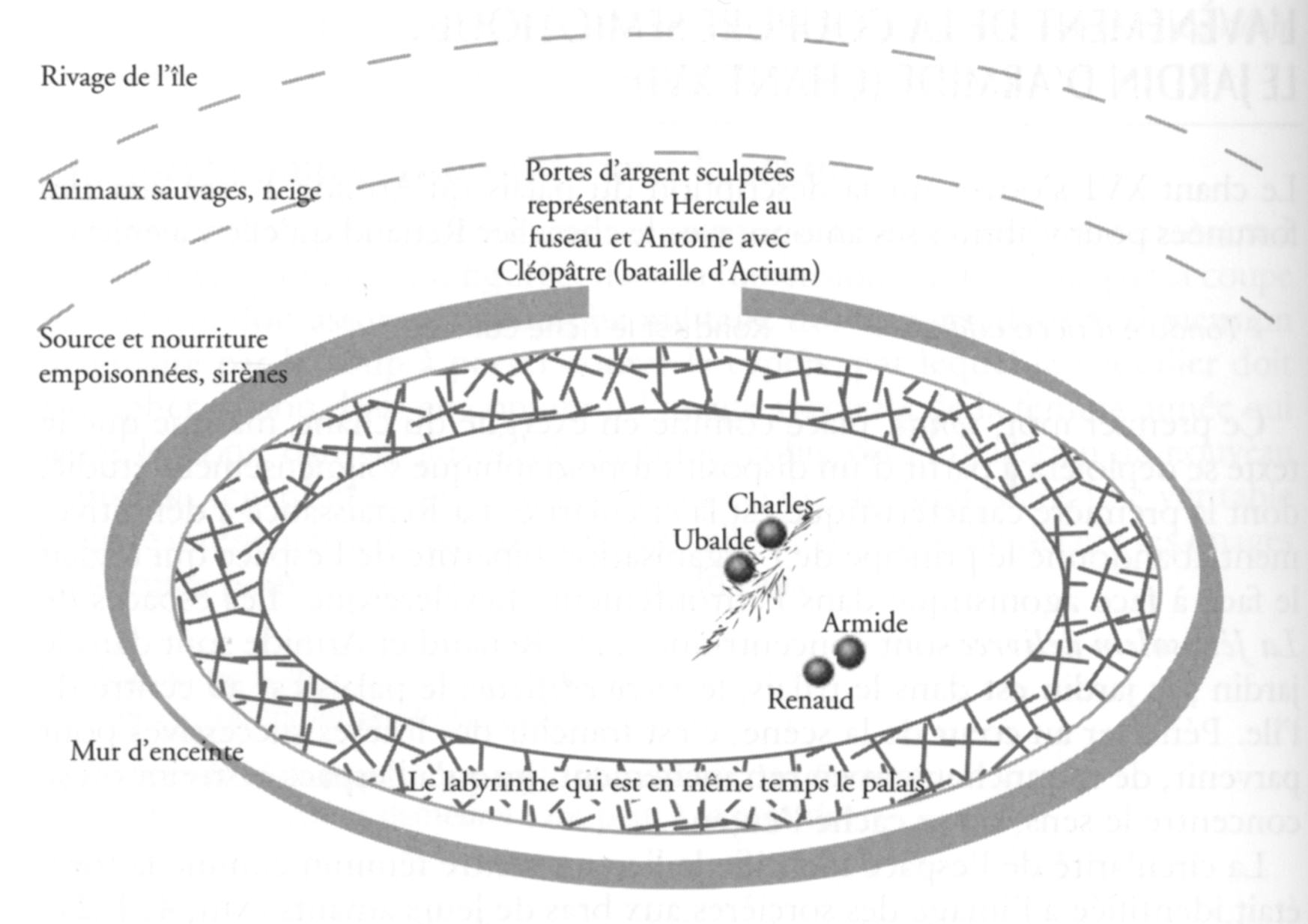
This first word, tondo, placed as if in exergue of the song, marks that the text will unfold from a carefully studied topographical device, whose first characteristic is circularity. The Renaissance definitively abandoned the principle of bipartite organization of space that regulated the agonistic face-off in knightly confrontation. The spaces in La Jérusalem délivrée are concentric here, Renaud and Armide are in the garden the garden is in the palace, the ricco edificio the palace is at the center of the island. Entering the heart of the scene means crossing successive edges to reach, from entrenchment to entrenchment, the restricted space where meaning is concentrated, where the stakes are hidden.
.
The circularity of the space identifies the place with the female womb as the forest was identified with the image of witches in the arms of their lovers (xiii, 4, 1-2) : the garden is nel più chiuso grembo di lui, at its most hidden from the bosom of the building. Grembo, the bosom, had already been used in Canto xiv by the Magician of Ascalon to designate the same place (quivi in grembo, xiv, 76). The " most hidden " itself happens to be quasi centro al giro, almost the center of the enclosure. Here, Tasso introduces a slight shift, the quasi's distance symbolically preparing the scene's shifted character.
The garden is inaccessible. The enclosure, the impenetrability of the scenic site signifies the prohibition of the gaze that protects it : we only gain access to the vision of the scene by breaking and entering.
The labyrinth
Figure 5 : Installation of chant xvi in the concentric arrangement of Armide's palace and garden
The garden is surrounded by a labyrinth, inosservabile e confuso ordin di loggie, an unobservable and confusing arrangement of galleries. In chant xiv, the magician of Ascalon, describing in advance to Charles and Ubalde the labyrinth they would have to pass through to recover Renaud and return him to battle, used the following words :
Dentro è di muri inestricabil cinto
che mille torce /// in sé confusi giri, (xiv, 76, 1-2)
The interior is girdled by inextricable walls
that twist within them a thousand confused turns.
It should be understood that this belt of walls constitutes the palace itself, with its loggie, its covered galleries, a palace that Tasso also refers to as l'intricata stanza (xiv, 78), literally the entangled room, i.e. the tangle of rooms. Canto xvi insists on the tortuous nature of the path through these rooms : quel fallace ravolgimento impenetrabil (xvi, 1), such a deceptive and impenetrable convolution, la torta confusione del labirinto (xvi, 35), the tortuous confusion of the labyrinth. The labyrinth surrounds the scene itself with an unobservable space, a space where the linearity of the quest's path blurs, flips into the compactness of a network of entrails. Still unobservable, but already confused, the labyrinth figures the limit of text and image; it steps out of the linearity of the quest, confusing it in its ravolgimento, but leading towards the visibility of the scene, towards its heart open to observation.
This boundary is the work of the devil, i demon fabri l'ordiro (xvi, 1), the worker demons ordered it. To take this path is to experience the muddled, the confused, the mixture, the very mixture that designates the camp of the Infidels. The motif of mixture, which recurrently refers to the camp of the besieged, is omnipresent in Chant xvi. First, the oblique paths of the labyrinth (oblique vie, xvi, 1) are represented by the oblique banks of the Meander (rive oblique e incerte, xvi, 8) where Antony takes refuge. The labyrinth, as we have seen, is an ravolgimento impenetrabil the Meander, for its part, has inextricably entangled paths, inestricabili conserte (xvi, 8).
But the dazzling beauty of the garden, which contrasts with the diabolical horror of the labyrinth and turns scopic abjection into fascination, only amplifies this motif of mixture : art and nature, the cultivated and the neglected are mixed there, sì misto il culto è co'l negletto (str. 10). A magical air makes the trees bloom at all times, mixing flowers and fruit, barely formed fruit and fruit already ripe : e mentre spunta l'un, l'altro matura (ibid.). The seasons are thus blended. Then birdsong mingles with the murmur of the breeze (str. 12). This song immediately becomes the speech of the parrot11, the bird of bariolure par excellence, di color vari, str. 13.
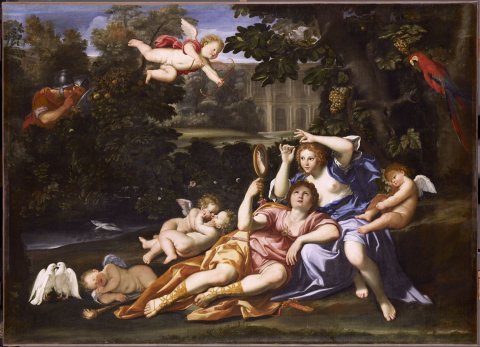
Figure 6 : Le Dominiquin, Renaud et Armide, circa 1620-1621, Paris, Musée du Louvre. This is one of the few representations of the scene in which Armide's palace is curved to surround the garden. A scrupulous illustrator, Le Dominiquin also depicted the reverdie parrot in the upper right. On the left, Charles and Ubalde, with a finger over their mouths to signify trespassing.
Finally, Armide's belt, which circumscribes her body even when she is naked (str. 24), indicating once again that the woman's body is the enclosure and delimits the Place, the belt itself is a quintessence of the mixed.
Diè corpo a chi non l'ebbe ; e quando il fece,
tempre mischiò ch'altrui mescer non lece. (24, 7-8.)
There she gave body to what has none ; and when she did,
she mixed consistencies that no one else is allowed to mix.
This girdle, which Tasso imagines after that of Homer's Aphrodite (Iliad, xiv, 259-269), is made of all of the /// expressions, of all the affects of the desiring body:
fuse tai cose tutte, e poscia unille (25, 5)
she melted all these things and then she put them together.
The doors
As they enter the palace grounds, Charles and Ubalde gaze longingly at its carved gates, which allegorically represent the subject of the scene to come : Hercules dressed as a woman and turning the spindle at Iole12, then Antony cowardly dragged away by Cleopatra in flight from Octavian, the future Augustus, point by anticipation to the feminization of Renaud trapped by Armide's love in his garden.
The description of the gates is a piece of eloquence and pageantry, a ekphrasis, i.e. literally a description of art that detaches itself from the narrative to shine with an autonomous brilliance. Here, Tasso takes up a rhetorical tradition whose most famous ancient examples were the descriptions of the Homeric shield of Achilles and the Virgilian shield of Aeneas. Virgil had imagined, on the shield, the picture of the battle of Actium, whose verses13 Tasso, with a few cuts, sometimes translates literally. The evocation of Actium, one of the most famous passages in the Aeneid, was a dedication to Augustus, the poem's glorious recipient. Here, Tasso suggests identifying Renaud in Armide's arms with Antony trapped by his love for Cleopatra ; but he also gives, through this prestigious Virgilian reference, the sign that we are approaching an exceptional moment in the poem, and perhaps, in a way, a point of culmination : Renaud will triumph over Armide, Le Tasse's victor comes from Virgil's vanquished, just as Virgil's hero, Aeneas, comes from Homer's vanquished, the Trojans.
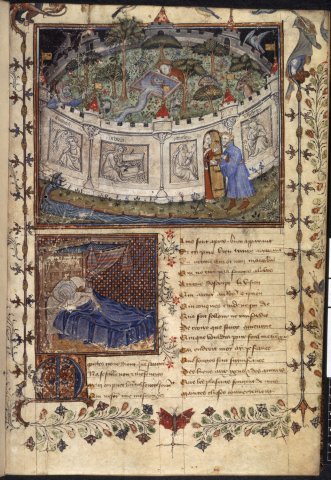
But Tasso's model, when describing these gates, is not the only ancient ekphrasis. The enclosure of Armide's castle evokes the image chambers of medieval literature, which transpose onto their walls the story of their knights' service of love ; but it is above all inspired by the allegorical gardens of the late medieval novel. In Le Roman de la rose, the Verger de Déduit14 is enclosed by walls on the outside of which are depicted the vices that are banished inside. The images of the enclosure screen the wonder entrenched within.
Figure 7 : Le Verger de déduit after the Roman de la rose, Paris, circa 1400. London, British Library, ms. Egerton 1069, folio 1 recto. The vices carved in low relief on the walls are, from left to right, " Convoitise " (desiring beyond the curtain), " Avarice " (stirring the gold in his chest), " Envie " (pointing) and " Tristesse " (face buried in his cloak).
The shift from the old chivalric performance to this new iconic device results in an eroticization, a transgression, a passivation of heroic action. A work of reversal is at work, linking the images of the enclosure to the real scene beyond the gates, to the real face-to-face meeting of Renaud and Armide in the garden. The carved silver of the gates, effigiato argento (xvi, 2), is the image that screens the amorous duo in the garden. The generic image of Hercules and Antoine, the cultural screen interposed between Charles and Ubalde on the one hand, and Renaud and Armide on the other, in the manner of the reflection of the painted Baptistery interposed between the viewer's eye and the real Baptistery in the /// device devised by Brunelleschi. As with the image of the painted Baptistery, the sculpted effigies on the doors are seemingly identical repetitions of what's going on inside. Hercules and Antoine are truly undone in the images that represent them on the doors, while Renaud, in the scene to come, will emerge precisely from this mirage of love and reclaim his warrior virility. The ekphraseis of the entrance represent states the scene in song xvi precipitates a reversal of situation.
Figure 8 : Comparison of the crossing of doors in chant xvi and Brunelleschi's experience.
L'intercisio albertienne
Through these doors and labyrinths, the screen device is literarily constituted, superimposing and thereby identifying what happens in the story with an image, i.e. a painted or sculpted representation. The allegorical dimension of this superimposition or identification will historically fade. Literature will retain only the Albertian intercisio, that break between eye and object that Tasso reproduces in the garden :
Ecco tra fronde e fronde il guardo inante
penetra e vede, (17, 5-6)
Here between foliage and foliage the gaze [of Charles and Ubalde]
penetrates and sees15.
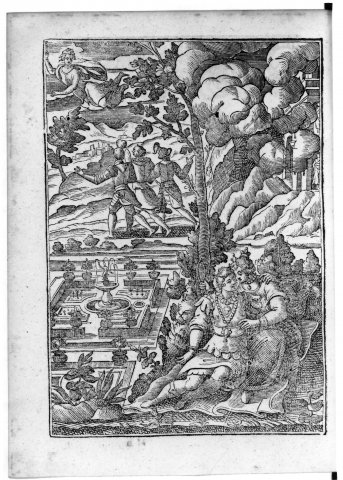
Figure 9 : Illustration of chant xvi in the Padua edition, P. P. Tozzi, 1628. Woodcut by Francesco Valesio (signature V. F. on some of the engravings in the series), of an earlier design although the edition is more recent. The narrative elements are arranged in a square, and the whole does not constitute a scene. Bottom right, Renaud in Armide's arms; left, the garden, disassociated from the loving couple who, in the text, are there; top left, Charles and Ubalde lead Renaud off the island, with Fortune in the air showing the way; top right, Armide's palace disappears into the clouds. The image does not respect any of the three unities of time, place and action.
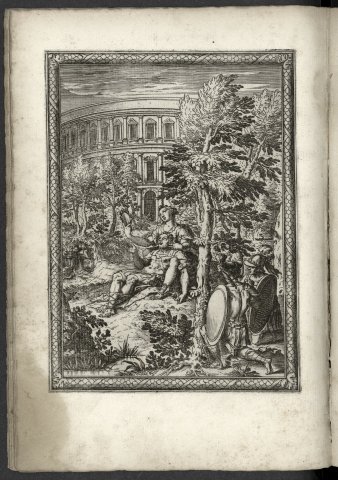
Figure 10 : Renaud and Armide spied on by Charles and Ubalde. Copper engraving by A. Caracci (?) after the drawing by Bernardo Castello illustrating chant xvi in the edition of Gênes, B. Bartoli, 1590, in-4°. Photo Bnf, Rés Y3551A. The voyeuristic gaze of the two knights delimits the scene, whose restricted space is circumscribed by the tree and the palace, which becomes a backdrop. The palace is curved in reverse : it doesn't surround the garden, but rather functions as a backdrop curtain, as the show's moving set.
The natural screen of foliage repeats and blurs the cultural screen of the silver doors. The modern, purely geometrical device takes over from the old. /// allegorical device. All that remains of the system of concentric circularities is the cut between the subject of the quest and the object of the gaze. The cut structures the vision as a screen device, but also orders the content of the scene: internalizing the cut, the scene represents Renaud's symbolic castration. Renaud is placed beneath Armide, in a passive feminine position: Sovra lui pende, she bends over him, literally she hangs over him (str. 18). The text insists on the symbolic inversion represented by this position :
L'uno di servitù, l'altra d'impero
si gloria, (21, 1-2)
He is to serve, she is to command .
let her glorify herself.
Instead of a sword, Renaud carries a crystal mirror, un cristallo lucido e netto (xvi, 20). It's not a speech that persuades Renaud to return to battle, but the vision of his reflection in the diamond shield that the magician of Ascalon has entrusted to the two messengers and that Ubalde hands to Renaud.
Egli al lucido scudo il guardo gira,
onde si specchia in lui qual siasi e quanto con delicato culto adorno ; spira tutto odori e lascivie il crine e 'l manto e 'l ferro, il ferro aver, non ch'altro, mira dal troppo lusso effeminato a canto : guernito è sì ch'inutile ornamento sembra, non militar fero instrumento. (30.)
He turns his gaze to the shining shield
where he sees in it what it is and with what
refinement he is adorned he breathes
all the perfumes and voluptuousness, in his hair, in his clothes.
And he looks at his sword, his very sword to say nothing of the rest
is effeminate at her side by too much luxury:
It's so ornate that it seems a gratuitous decoration
and not the cruel instrument of war.
The scene represents the stripping away of Renaud's virility. We access it through the cut formed by the screen of foliage to see the sexual cut that strikes the devirilized knight. But the complex interplay of glances between Charles and Ubalde is also significant. Armide seduces in song xvi in the same way as she did when she first appeared before the Crusaders in song iv. Armide fascinates because she manifests herself as an undulating to-and-fro between appearance and disappearance, as a nudity before which the veil is interposed and no longer interposed.
.
Ella dinanzi al petto ha il vel diviso,
e 'l crin sparge incomposto al vento estivo ; (18, 1-2)
She has before her breast a veil that divides,
and her dishevelled hair spreads in the summer wind.
The division of the veil puts into abyme the intercisio of the Albertian screen constitutive of vision as representation. But this divided veil, associated with the undulation of hair in the wind, is immediately characterized by its mobility : through it, at the whim of the breeze, nudity is uncovered and covered, the intercisio is made and unmade.
From the crystal of Narcissus to the diamond of otherness
Associated with this fundamental mobility of the visual pyramid, which destabilizes the geometrical foundation of the gaze, is the trembling radiance of its luminous appearance : the light, uncertain radiance of sweat on the flaming face, like the shimmer of water on contact with the ray of light.
langue per vezzo, e'l suo infiammato viso
fan biancheggiando i bei sudor più vivo qual raggio in onda, le scintilla un riso ne gli umidi occhi tremulo e lascivo. (18, 3-6.)
She becomes languid with annoyance and the drops of sweat16,
whitening, make her fiery face brighter
like a ray on the wave a laugh flickers inside her,
lascivious and trembling in her /// wet eyes.
Fascinated Renaud annihilates himself in this contemplation : si consuma e strugge, he consumes and dissolves himself (str. 19). Armide elicits scopic petrification she immobilizes her prey in this vision at once sublime in beauty and horrifying because it empties and kills. She then hands Renaud the mirror he carries in place of the sword :
ella del vetro a sé fa specchio, ed egli
gli occhi di lei sereni a sé fa speghi. (20, 7-8.)
She makes the mirror a mirror for herself, and he,
of her limpid eyes, he makes a mirror for himself.
The heart of the scene is not the exchange of glances, the meeting of eyes, but the specular doubling of a vision of the self. The other of desire is instrumentalized as a mirror of the self. This narcissistic gaze at the center of the garden transposes a topographical feature of the Verger de Déduit, whose description opens Le Roman de la rose : at the center of the orchard of all pleasures flows the fountain of Narcissus17. Narcissus is evoked by Tasso during the amorous surprise that strikes Armide in front of the sleeping Renaud in chant XIV : e 'n su la vaga fronte pende omai sì che par Narciso al fonte (xiv, 66, 7-8), and she leans over his charming brow, so that she now resembles Narcissus at the fountain.
But this crossing of narcissisms is dissymmetrical : if Renaud reflects himself in Armide to dissolve in it, Armide denies Renaud by interposing the mirror between her and him. After the silver gates at the entrance to the château, after the foliage at the entrance to the garden, this mirror, which makes the other see a " soi " in the center of the stage, recalls Brunelleschi's experience once again and initiates the screen device.
Figure 11 : after Tiepolo, Charles and Ubalde surprise Renaud and Armide, 1755, oil on canvas, 187x260cm, Art Institute, Chicago. The château is deliberately pushed into the distance, and the garden is dissociated from it. The screen device triumphs once and for all, with this wall that divides the canvas horizontally in two: the spectators stand beyond, the show unfolds in front. Charles is the beardless young man on the right, Ubalde is the older knight.
The set-up is asymmetrical, as the garden is not exactly in the center (ch'è quasi centro, which is presque the center, str. 1) : the scene introduces an imbalance that is offset by the appearance of Charles and Ubalde in the eyes of Renaud, who remains alone. Renaud can then look at himself (str. 30) in the diamond shield given by the magician of Ascalon (xiv, 77) Renaud's gaze becomes the exact symmetrical (i.e., inverted structure) of Armide's gaze in the crystal mirror. The dynamic of the scene thus passes through the face-to-face confrontation of the two mirrors, first the crystal sword-mirror where the scenic stakes of jouissance are concentrated, then the diamond mirror where jouissance and the scene are undone so that the agon can resume, so that Renaud can return to the fight.
.
The first mirror is that of the face-to-face encounter with the Thing of the tale it reflects without break or interruption the pure brilliance of wonder, the fusional simulacrum of narcissistic jouissance. Renaud sees himself as Armide sees herself in her mirror, characters and places merge into a single skein of jouissance.
The second mirror is that of the conjuration of the Thing : Renaud's gaze experiences the cut, since in his effeminate get-up he doesn't recognize himself. To look at oneself in the mirror-screen of the cut is to see oneself as Other, and to experience distance from the object. Through this gaze, Renaud strips himself of what he establishes as Other within himself18. /// The outcome of the scene is the destruction of the " thing " :
squarciossi i vani fregi e quelle indegne
pompe, di servitù misera insegne ; (34, 7-8)
he tore down the vain ornaments and those unworthy
magnificences, insignia of miserable servitude.
Renaud's liberation comes through renunciation of jouissance, i.e. the reversal of symbolic castration, no longer suffered as enslavement to Armide's jouissance, but willed and assumed as renunciation of desire. This inner reversal of the cut instituted by the screen will constitute one of the essential elements of the classical scene.
Armide's separation
After Renaud's glance at the diamond shield worn by Ubalde, Canto xvi sets up a second face-to-face between Renaud and Armide, as the knights leave the Îles Fortunées for Jerusalem to fight. Armide tries one last time to hold on to Renaud. On the shore of departure, this scene after scene completes the deconstruction of the visual device that triumphed at the heart of the garden. The gaze is no longer fixed. First Renaud turns his back on Armide:
- then Armide turns his back on Renaud.
e 'l vide (ahi fera vista !) al dolce albergo
dar, frettoloso, fuggitivo il tergo. (35, 7-8.)
and she sees him (ah, cruel sight !) turn a back
to their sweet retreat.
Renaud looks away, refuses his gaze, stripping Armide's speech of the visual efficacy of the device in which it has hitherto taken place. Armide's speech first blocks19, then renounces its magical efficacy and power of fascination, the reverse of which is then unmasked: it is no longer the suave Armide who is silent, but the foul mouth of a Thessalian witch (37, 2). When the hold ceases, the seductive screen of hair, of indentation, turns into the abject hole of horrifying femininity.
Armide's speech, like the forest of spells, then becomes natural and vulnerable again. Henceforth, it will no longer be a question of the images Armide makes, but of the naked picture she offers of herself : we move from magical evocation to natural representation, from incantation to imitation.
Then Ubalde conjures Renaud, as if in a final test, to face Armide's gaze and word :
Qual più forte di te, se le sirene
vedendo ed ascoltando a vincer t'usi ? (41, 5-6.)
Who will be stronger than you if, seeing
and hearing the sirens, you have learned to overcome them ?
Paradoxically, it's the farewell with Armide that establishes the true face-off between the two lovers, each now seeing in the other, not the narcissistic mirage of themselves, but the irreducible strangeness that separates them. Renaud's eye learns to ward off scopic petrification, and confronts the Other insofar as he is the forbidden gaze, insofar as Armide represents what must not be looked at. The ordeal of the stage is the ordeal of this interdict:
The ordeal of the stage is the ordeal of this interdict.
Lui guarda e in lui s'affisa, e non favella,
o che sdegna o che pensa o che non osa. Ei lei non mira ; e se pur mira, il guardo furtivo volge e vergognoso e tardo. (42, 5-8.)
She looks at him and fixes herself in him and not a word,
either disdain, reflection or fear.
And he doesn't look at her ; or if he does
he turns a furtive, ashamed and hesitant gaze.
Here we see the reversal of fascination into scopic abjection already observed in chant vii20.
Figure 12 : after Tiepolo, Renaud abandons Armide, 1755, oil on canvas /// canvas, 187x260cm, Art Institute, Chicago. The rock and broken column on the left form the stage wall in front of which Armide occupies the restricted space of lamentation. On the right, detached against the vague background of the distance, Renaud's gaze is thwarted, barred by Charles's gesture indicating Fortune's boat.
But this time the reversal is the stake in an exercise in mastery and, by extension, symbolic surpassing. Armide's long speech, which echoes her speech to Godefroi's army in chant iv, is no longer the deceptive speech which, like the gaze and like the place, held the knights captive trapped in their own desire for themselves. Instead, it becomes the unmastered fragment of a discourse of love that is coming undone.
In chant iv, Armide's speech to Godefroi was intended to perpetuate the visual spectacle with which she regaled the eyes of the Crusaders if this speech was programmed to fail, in its very failure, confronted with the success of the spectacle, it was to stir discord among the Christians.
Contrary to the contrived supplication of chant iv, Armide's speech in chant xvi is sincere : the rhetoric of painful submission to the enemy is the same ; but it is a real passion that now carries her.
While the prelude to the speech opens in the manner of an operatic aria, eloquent silence then painful lament in support (42 and 43), the speech is gradually invaded by the screen device : Armide describes herself exposed as a trophy (48), then serving as a shield (scudo, 50) to the chevalier the screen turns around, no longer a garment before a woman's flesh, but becomes a wall of female flesh before the body of the beloved man. Armide figures herself as a body traversed by enemy weapons, per questo sen, per questo collo ignudo (50, 3), through this breast, through this bare neck.
The screen cuts, it literally cuts off Armide :
Volea più dir, ma l'interruppe il pianto
che qual fonte sorgea d'alpina pietra. (51, 3-4.)
She wanted to say more, but his sob interrupted her
like a spring rising from an alpine rock.
Armide has become this wall pierced by the spring, after having described herself as a body traversed by weapons : the imaginary of phallic penetration, which is at work here, cuts her off, but at the same time establishes the continuity of the same device between the images of the utterance and the device of enunciation. Armide then attempts to touch Renaud's body, to adopt the posture of a suppliant, in other words, to perform the ritual that underpins her performance. But she fails:
Prendergli cerca allor la destra o 'l manto,
supplichevole in atto, ed ei s'arretra, resiste e vince ; (51, 5-7)
She then seeks to take his right hand or coat
in a suppliant gesture, and marks her retreat,
resists and wins.
The scene thus culminates in the scandalous failure of performance, which is also a failure of touch. Between Armide and Renaud is established physically, visually, the break that the images of the speech and then the comparison of the rock had prepared.
Conclusion
By massively introducing theatrical metaphor into the text, La Jérusalem délivrée consecrates, as it were, the birth of the novelistic stage.
A restricted, cleaved space : the double cut
This scene is characterized first and foremost by the implementation of a visual device based on cutting. This cutout is first and foremost external : it isolates a restricted space from the scene itself in the middle of a vague space from which this scene is viewed.
But this forbidden gaze from the outside is itself modeled by the new apprehension of perspective and by the reflection /// theories developed by Renaissance painters on vision in general. Alberti envisaged vision as a cone whose apex starts from a single eye and whose base is constituted by a cutout in the real he imagined interposing, between the object to be painted and the painter's eye, a squared veil, the intersector, which would facilitate the reproduction of perspective.
.
This internal cut-out, which now models the field of the gaze, is reflected in the structuring of the romance scene : Armide only exposes herself in the Crusader camp half-hidden by a transparent veil Tancrède only thinks he sees Clorinde in the enchanted forest through the bark of a cypress Renaud and Armide only appear embracing to Charles and Ubalde behind the screen of a foliage.
From the place of the quest to the scenic space
But this new scenic device imposes itself neither immediately nor completely. It competes with the old device of the medieval quest, ordered according to a concentric space that must be penetrated to its heart to remove the object of the quest. The city of Jerusalem with its Holy Sepulchre, the forest enchanted by Ismen, Armide's castle where Tancrède is taken prisoner, Armide's island, all function as concentric places at the center of which lies the fulfillment of the epic performance. But this center is always disappointing the Sepulchre is empty, the tree in the heart of the forest contains only the ghost of the knight's desire to attack it, Renaud is not in the castle that Armide conjures up in Tancrède's eyes, the whole island of Armide is nothing but an illusion promised to disappear as soon as the heroes leave.
.
The screen of the gaze replaces the performance of the quest. The form of the screen device preserves its trace. It's still a question of entering a place, of occupying the place, but this dwelling is no longer so much physical as visual : the eye now accomplishes alone the journey once made by the knight.
The deconstructive function of the stage : subversions of performance
The generalization of the screen device in the novelistic scene and the transformation of the concentric place of the medieval quest into a contradictorily subtracted and exposed scenic place profoundly alter the work's relationship to speech. A visual communication is put in place that short-circuits discursive communication. Rituals, in which the spoken word traditionally plays an essential role, are parodied or defeated: images make sense against discourse. The battle becomes a virtual face-off with the simulacra of the enchanted forest (we're already thinking of Don Quixote in front of the windmills) Armide's first supplication in canto iv is disguised as a fashion show the second in canto xvi chokes on a sob.
.
The stage device, while it recovers some of the forms of medieval performance, does not therefore perpetuate the symbolic edifice it was intended to actualize. If the agon spoke the code, if the chivalric test expounded the values of chivalry, the stage is built in retreat, out of step, even in contradiction with this code and these values. The stage is born of this contradiction, which it will then work on throughout its history : in what it conveys of the imaginary and even in its spatial organization, it inherits the oldest, most archaic forms of representation ; but on the symbolic, ideological level, it carries at the same time the germ of the destruction of all the ancient codes that produced it.
.
Reason and technique as stage values
In fact, the stage brings technical rationality to representation as a value : the screen is a technical construction that frees the gaze from its imaginary articulations to bring it into the rationality of optical devices. At the same time, the technical mastery of the military art is the symbolic stake in La /// Jerusalem Delivered it's not so much with God's help as with the machines made in the forest that the Crusaders will triumph. But mastery of the forest is mastery of reason, since the forces that forbid access to it are nothing more than figments of the imagination. Conjuring simulacra means installing in vision the screen device, which separates the subject from the object and rationalizes their relationship.
.
The power of rationality, the efficiency of technique are the values carried by the scenic devices in La Jérusalem délivrée. They stand in opposition to the powers of artifice, brought to bear by the forces of evil and the strategies of discourse. The prestiges of rhetoric sustain the old world, which the work undoes. Through this distribution, the stage, which paradoxically appears today as the quintessence of textual efficiency, will be led to deconstruct all discursive logic and to refound, through images, the symbolic edifice of our culture.
.
Renaud contre Tancrède
La Jérusalem délivrée is therefore a work in motion, a kind of gigantic staging of the cultural shift from the end of the medieval civilization of the spoken word to the dawn of the modern civilization of the image. Perhaps this shift is characteristic of all great works. In any case, we find here a structure, a confrontation already encountered in Perceval.
Tancrède opposes Renaud as Gauvain opposes Perceval. Tancrède is the perfect knight of the old world : respecting all the rules of ancient chivalry, he is the champion of the medieval duel, and he fails virtuously in all things. Tancredi kills Clorinde in combat, but is exhausted in the face-off with Argant and nearly dies.
Renaud on the other hand, is the man of all transgressions. He carries the ignorance of rules that is the hallmark of modernity. Renaud begins by killing Gernand, his ally, in defiance of all the rules of chivalry. Renaud is the champion of the modern melee, and he triumphs thanks to the very fragility of his virtue. Renaud triumphs over the enchanted forest, spares Armide and takes Jerusalem from battle.
It is not through his valour, but through his weakness, that Renaud proves himself superior to Tancrède. This weakness is put to the test in the eyes: first subjugated by Armide, Renaud undergoes the trap of the gaze and locks himself in her dreams; he then triumphs over the tableau of Armide in mourning; he finally dispels the simulacrum of Armide in the enchanted forest. Renaud's triumph consecrates the epiphany of optical rationality.
Tasso's stanzas 42 and 43 repeat verses 159-168 from the first canto of the Eneid : " There is in a deep bay a place ; an island forms a port by the interposition of its sides (objectu laterum) on which all the waves coming from the open sea break and split into two reduced undulations. On either side, vast cliffs and twin promontories launch their threats against the sky. At their vertical (sub vertice) the sheltered waters are silent; above, the stage wall made by the thick forests (silvis scaena coruscis) and the dark woods whose shadows seize with dread stand threatening (imminet). Opposite, beneath the promontories that /// a grotto inside, fresh waters and seats carved out of the rock this is the home of the nymphs. " Note that Tasso did not place the grotto in the same spot as Virgil. In Virgil's case, the grotto turns its back to the sea, which really does protect it from the waves of the open sea, whereas in Tasso's it faces it, to constitute, if viewed from the sea, a fully visible theatrical backdrop.
One wonders whether this hesitation, then this epistemological reversal in the conception of vision, is not one of the causes of the modeling of the painting as the intersection of two optical cones : the one coming from the eye, the one coming from the object.
In Italian, there's a play on the word vago, which first means charming, seductive. The vague space is both the space that escapes the law of the Crusaders and the space where the lure of desire is played out (le streghe ed il suo vago, xiii, 4, 1 ; vaga fronte, xiv, 66, 7 ; vagheggiarsi, xv, 23,2 ; vago spettacolo, xv, 61, 5 ; vago volto, xvi, 22, 1-2).
Here, Tasse confuses Iole with Omphale he had already alluded to Hercules as the victim of love at the moment when Armide suppliant before Godefroi seduced the whole army (iv, 96, 6).
The device had been inaugurated in chant xiv, in the tale of the Magician of Ascalon. There, he recounted how Armide had waited and ambushed Renaud, out of sight, qual cauta cacciatrice (xiv, 57, 1), like a cunning huntress.
Le Roman de la rose, vv. 1429-1611, pp. 112-121. The fountain mirror is the trap that reveals to the narrator the rosebushes enclosed by a hedge : this reflection delivers the object of the quest.
Le Tasse for this entire episode may have drawn inspiration from Roger's adventures on Alcine's island, in chants vi and vii of Roland /// furious. We find the same description of the lustful étrientes of the magician and the bewitched knight in Ariosto. It's not a mirror, but Bradamante's magic ring that allows Roger to see Alcine's true face as trash (feccia), spoiled fruit (putrido e guasto), ugly, old, brute (str. 70-72). The wonder of the tale accomplishes the performance in Ariosto, where, in Tasso, the technical device of the mirror produces its effect.

 FR
FR
 EN
EN