
 FR
FR
 EN
EN

We end up forgetting that the notion of the novelistic scene implicitly contains a theatrical metaphor : something in the novel, at a given moment, opens up the space of a theatrical stage.
The theatrical metaphor is totally absent from Chrétien de Troyes' novels, and the word " stage " does not appear1. In a way, then, it is by anachronism that we designate this or that passage in the medieval novelist's work as a scene.
However, the posterity of Perceval authorizes us to do so at least twice : the moment when Perceval, invited to the castle of the fisher king, sees the bleeding spear and the grail pass before him, has indeed been received in our culture as an original scene of the novel, a kind of imaginary matrix from which to write continuations and adaptations of the first Perceval. The grail theme is found again in Julien Gracq's Le Roi pêcheur (1949). The other moment is when Perceval contemplates a flock of wild geese caught in the glare of freshly fallen morning snow. A hawk swoops down and shoots one of the geese. Perceval approaches on horseback and sees the snow stained with three drops of blood, red on white like the lips and face of his friend Blanchefleur. The three drops of blood would serve as the matrix for Jean Giono's Un roi sans divertissement (1947)2.
Each of these moments is characterized by the exceptional nature of the place (the Fisher King's mysterious dining room, a snowy landscape) and, even more so, by the magnetic intensity of the vision, which fascinates the hero and, at the same time, meduces him: Perceval, the great questioner who speaks out of turn, remains silent before the mystery of the grail and does not question his host he remains pensive before the drops of blood and refuses to listen to King Arthur's messengers who have come to fetch him.
The vision and the place open up the novelistic scene. But it's something else that, in Chrétien de Troyes, motivated them. The grail, like the drops of blood on the snow, must be grasped at the boundary between a medieval practice of the novel that gave rise to them, and an origin of the modern scene that diverted and then ignored these practices. Here, we attempt to show what detour led literature to this advent of the stage. These meanders of literary history are important: if, fundamentally, the stage transgresses a literary and social code, if the stage is the moment of the irruption of reality into literature, if the stage deconstructs, undoes the structures of the novel, it owes it to these medieval origins.
.I. An adventure novel
In legend, the knight is defined as one who, traveling the indefinite space of the world, is in search of adventures, i.e. encounters and battles through which he can affirm or confirm his worth as a knight. Adventure qualifies the knight. It reiterates and declines the qualities proper to chivalry. Adventure, then, before being read as a picturesque story, is first and foremost defined as performance, in the almost sporting sense of the term : to seek adventure, to accept its trials, is to compete for excellence, it is to strive to be the best.
But this excellence is not just sporting. Chivalric performance expresses the values of chivalry and, in so doing, constitutes the chivalric code, the symbolic code against which the whole novel unfolds. The succession of adventures allows us to go through the elements of the code, so that the story, in its entirety, amounts to this unwritten code, an ideal, implicit code, snippets of which we are reminded only as the narrative necessitates.
Confrontation and celebration : the two performances of storytelling
There are two types of performance, corresponding to the two phases of storytelling. /// novelistic sequence, or adventure : the time of confrontation with knightly ritual, and the time of celebration of ritual.
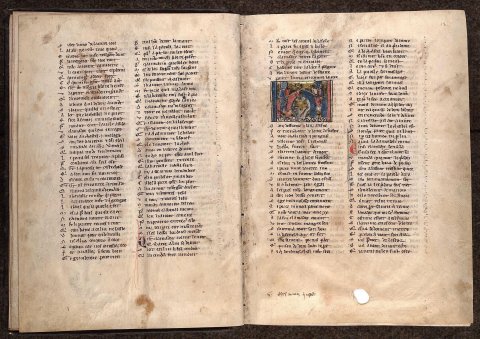
Figure 1 : Perceval fighting has a knight and has conquered him. This is the fight against Aguingueron. The crossing of the lances establishes the bipartition of the agonistic space. (F°15r°a.) Unless otherwise stated, the illuminations come from the manuscript in the library of the Faculty of Medicine in Montpellier, and date from the late thirteenth century. Legends in italics are those of the rubricator at the bottom of the manuscript pages.
The time of confrontation gives rise to the agonistic performance, i.e. the combat, the testing of the knight against another knight. The symbolic function of this agon is to put chivalric excellence to the test. Each time, this test manifests a new angle of chivalry, a different element of the code. We can speak of agonistic performance in episodes where Perceval confronts the chevalier vermeil (vv. 1020sq), Aguingueron (vv. 2120sq), Clamadieu (vv. 2593sq) ; where Gauvain finds himself facing Méliant de Lis (vv. 5426sq) or facing Greorreas' nephew (vv. 7199sq).
The time of knightly celebration, even if not devoted to combat, is also entirely ritualized : these are the evocations - however fleeting - of banquets, when Perceval arrives before Arthur " assis au mengier " (v. 860), when Gornemant de Goort invites Perceval to his table (vv. 1517sq) the frugal meal at Blanchefleur's (vv. 1876sq) takes the place, by default, of the banquet that the arrival of the boat at Beaurepaire (vv. 2504sq) ; when we're not eating, we're dancing, as Gauvain does with the damsels of the Château de la Roche de Sanguin, where he has triumphed over the bed of wonder (v. 8832).
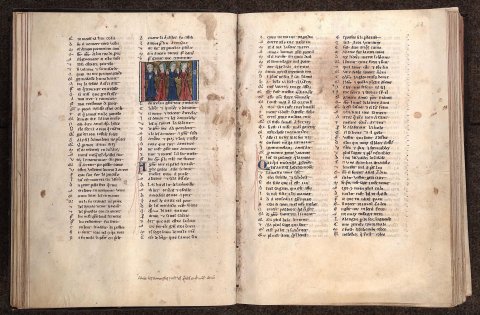
Figure 2 : Coment les damoiseles firent les queroles encontre monseignor Gauvain. The celebration of Gauvain's glory at the castle of the three queens after he has triumphed over the bed of wonder, is represented by an alignment of four figures. The apparent symmetry of the two damsels in the center is distorted by the asymmetry of the figures at either end. Gauvain on the left is on a floor, while the three queens are on a plain background. Furthermore, the alternating colors of the clothing (blue/red/blue/red) clash with the symmetries of the bipartite arrangement in Figure 1. (F°57v°b.)
To the revelry of the meal and the dance, we must add the rituals of homage and allegiance : Perceval is knighted by Gornemant de Goort (v. 1591), the Orgueilleux de la lande constitutes himself a prisoner to Arthur (v. 3946), Gauvain brings Perceval before Arthur (v 4477). Both the banquet and the tribute are no longer agonistic performances, but collective ones. The banquet tables, and among them the famous round table, mark the unity of this space, which contrasts with the bipartition of the agonistic space.
.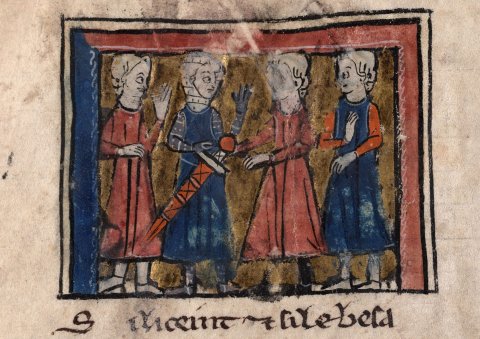
Figure 3 : How the prudhomme belts /// the sword to Perceval. Gornemant on the right hands the sword to Perceval, recognizable by the hauberts on his head. Unlike banquet scenes, the composition here focuses on the pommel of the sword, the "thing" of the performance. Symmetry is maintained, with the arm gestures of the two figures on the left, identical to each other, opposing those of the figures on the right. They symbolically signify the knighthood given (on the right, right hand on the heart, left hand down) and received (on the left, right hand on the sword, left hand up). The collective nature of the performance is shown by the unity of the background and the presence of four figures. (F°11v°a.)
This bipartition is represented clearly and consistently in the illuminations, by the symmetry of the crossed spears in combat, by the opposition of the colors against which the characters stand out, two different colors for the same place : the colors then do not describe reality, but the symbolic, stylized division of a space characterized primarily by face-to-face.
The pairing of agonistic and collective performance, of testing in the " battle3 " then of the celebration in the banquet of the values of chivalry ideally constitutes the novelistic sequence, or " adventure ".
To understand how these adventures work, we mustn't forget that we're not originally dealing with a printed book. Intended essentially for collective reading aloud, the novel still obeys, at least in part, a logic of orality. Although written and composed as a text, it remains imbued with oral cultures, both the folklore of fairy tales and the epic tradition of the chanson de geste. This is why we will refer to these ideal performances, which the novel puts to the test, hijacks and parodies, as the performances of the tale, thus identifying the tale in some way with a kind of legendary material that would pre-exist the novel4.
In this context, the ancient cultural heritage is not absent5, but appears completely reshaped by medieval practices of enunciation. The Aristotelian idea of a rhetorical construction, of a narrative architecture with dramatic progression to a denouement, is perhaps not the most operative to account for the workings of the medieval novel. If Perceval is learning to be a knight, it would be wrong to speak of an apprenticeship novel. On the other hand, Perceval's adventures are read from the very first Continuations of the novel, written after Chrétien6's death, as an initatic quest, a Christian search for the truth of faith, of which the grail is the ideal fulfillment. But both the apprenticeship and the quest give priority to the narrative structure of a text that we'd like to show here functions primarily according to a logic of performance. To understand what motivated the birth of the stage, we need to accept the initially paradoxical idea that narrative is not the novel's basic structure, but a spare mechanism, acquired after the fact and which never completely erased the original logic of performance.
.Even if it is identified with a path7, with what grows on the path8, adventure is therefore not narrative. Adventure is exactly the Greek tuvch, the chance encounter. " Chevalier m'a fait / Li rois, qui bone aventure ait " (vv. 1317-8), says Perceval to Gornemant, le roi m'a fait chevalier, qu'il ait bonne aventure, bonne /// luck to him. This good luck manifests itself in the encounter, is sought in the desire for the encounter : at the beginning of the blood on snow sequence, Perceval got up " Que querre et ancontrer voloit / Avanture et chevalerie " (vv. 4100-1), because he wanted to seek and encounter adventure and chivalry. The encounter is indeed the object of adventure it is in the encounter that chivalry is put to the test.
So it's not essentially a question of running a story from start to finish, sequentially linking events that lead the characters into a duration, a temporality that transforms them. In Perceval, the young man's story never ends, and the mystery of the grail is only very partially unraveled. The adventures of Perceval are followed by the adventures of Gauvain, with no clear logical link between these two parts of the text. The novel's incompleteness according to modern reading criteria is not only due to the fact that it stops in mid-sentence, so to speak, but above all to the precariousness of the narrative articulation between the two actions. There is indeed a connection between the two parts of the novel, but it's a symbolic connection before it's a narrative sequence.
The sequential breakdown of Perceval is what immediately strikes the reader and gives rhythm to the text. On the other hand, the articulation of the sequences between them is not always very explicit, and in any case requires in-depth analysis. This rhythm of reading allows us to identify an autonomous and recurring functioning of the sequence, an economy of adventure.
The novel thus ideally functions as a succession of adventures characterized by a knight's performance, and whose function is to speak the chivalric code. However, if the medieval novel were to function simply and solely on the basis of this summary scheme, it would be very poor. The novel reflects on its own functioning, experiments with its limits, and seeks to put its own principles into contradiction. The sequences in which this reflexivity manifests itself most forcefully are those that turn performance into counter-performance, so that, in a way, the whole of Chrétien de Troyes' work can be seen as putting the notion of adventure to the test. The stage was born of this testing.
Perceval's counter-performances
Chrétien de Troyes takes as the starting point for his latest novel an impossible situation : his hero not only isn't a knight, but has no idea what chivalry is. " Il ne set mie totes lois "(v. 230), he knows nothing of all our laws ; he acts " nicemant " (v. 665), niaisement, " Tant est nice et bestïaux "(v. 1249), so ignorant and boorish is he. He is immediately recognized as " Nice et sot " (c. 1313), ignorant and foolish9.
In the face-off, Perceval is first bewildered ; bewildered in the deserted forest (la gaste forest, v. 73) facing the five knights looking for five other knights and three maidens (v. 179) ; bewildered in front of the tent (v.602), then to the maiden with the ring (v.632) bewildered at court, first to King Arthur (v.858), then to the damsel who never laughs (v.991), but this time can't help laughing. The fight with the ruddy knight then constitutes, delayed and inverted, the agonistic performance that Arthur, in advance and as if bewildered, had consecrated. The fourth encounter is with Blanchefleur in the château de Beaurepaire (c.1753), also followed by several fights. Then comes the encounter, which stuns Perceval with shame, with the damsel in the tent (v.3629), mistreated by the Orgueilleux de la lande: this encounter completes the second sequence. Next, and this is the fifth appearance, comes the Fisher King and his /// castle (v.2988), who confront Perceval with the disconcerting vision of the spear and grail (vv.3130 and 3158). In the sixth sequence, Perceval is fascinated by the sight of the three drops of blood in the snow (v.4096) (v.4121). Finally, Perceval's face-to-face encounter with the pilgrims, whom he understands nothing, opens the seventh and final sequence of adventures devoted to him (v. 6143).
.Despite their binarity, the sequences in Perceval don't alternate agonistic performance and collective performance. This sequence constitutes an implicit, but almost always diverted reference : the meal of pies in front of the damsel in the tent (vv.698sq) does indeed precede the fight with the Orgueilleux de la lande, but is far from being a banquet, which in any case should follow rather than precede the agon ; the fight against the ruddy knight is preceded and followed by Perceval's admission to King Arthur's table ; but each time the banquet is disrupted, first by the theft of the cup, then by the irruption of the hideous damsel (vv.5542sq). Of the two meals that punctuate Beaurepaire's sequence, the first is characterized by the lack of food that blocks the celebration of joy, the second triggered by the arrival of the merchants' boat comes too early in the episode and is overshadowed by Clamadieu's challenge : instead of crowning and celebrating the agon accomplished, it precedes it insolently and as if gratuitously.
Heuristic dialogue and return to code
Frequently, moreover, performance is reduced to vision, to a face-to-face encounter with the unknown, with the object that represents this chivalric code that has become incomprehensible. This counter-performance is then framed, so to speak. It is the subject of a kind of heuristic dialogue, opposing a " il convient "10 to the " he doesn't know " introduction11 : Perceval's mother explains to him what the knights he has just met are and what chivalry is (vv. 345sq) ; the dialogue with the damsel in the tent (vv.3716sq), whom Perceval sees again and no longer recognizes because of her mistreatment at the hands of the Orgueilleux de la lande, explains why Perceval has behaved badly towards the damsel in the tent, and how he has broken the rules of chivalry the episode at Gornemant de Goort's is primarily a dialogue explaining how to use the weapons acquired in the fight against the Chevalier Vermeil the dialogue in bed with Blanchefleur (vv.1939sq.) introduces Perceval to the courtly ritual that obliges him to fight Clamadieu the dialogue with his cousin, the dead girl, explains to Perceval why he shouldn't have kept silent in front of the grail (vv.3368sq.) ; the dialogue with Gauvain (vv. 4634sq), then with the hermit (vv. 6289sq), have the same function of clarifying the code, and the relationship of past performance to the code, in the sixth and seventh sequences.
.The presence of these heuristic dialogues, these moments of framing the performance, is enough to indicate that the latter is no longer self-evident, that the relationship to the code and thus the very unfolding of the performance become problematic, critical. The dialogue is the sequence's reflexive moment, when the text becomes aware of the reversal of performance against code. The passage from performance to counter-performance is then revealed in its positive dimension of symbolic refoundation: it's not so much a question of deconstructing chivalry and its modes of representation as of founding, through parody, a new system of representation, in which the incomprehensible dimension of these reversed performances unfolds the positivity of wonder. The fact that Perceval doesn't know, the fact that what he sees can't be understood, becomes the foundation of the new representation. Interest then shifts from the agon itself to the place where the wonder unfolds, /// from content to container.
The timelessness of place
The place pre-exists the encounter and is characterized by its timelessness. The knights' pursuit through the vast forest, the geese flying over the snow, are presented to us as escapes without origin or end the tent in the forest, King Arthur's court are set in the precariousness and indeterminacy of an anhistorical time that escapes the narrative they were already there. As for the Fisher King's castle, it literally emerges from the earth at Perceval's eye, it emerges from the atemporality of the tale into the temporality of the face-to-face.
.Through the sequence, Perceval inscribes the timelessness of the place in time. The combat disappears in favor of vision, the confrontation and performance shifting from an agonistic space, cut in two and symmetrized in confrontation, to a scopic space, polarized around what is given to be seen and which fascinates. The eye takes precedence over the spoken word. What thus happens on stage lies on the edge of the extreme concentration of agonistic time and the dilation of an immutable ritual given to contemplation in the manner of an icon.
The grail episode questions this problematic atemporality of a place that is no longer exactly the place of performance, and tends to become a scenic place. The atemporality of the ritual with which Perceval is confronted becomes the essential spring of the sequence and at the same time constitutes its blind spot, that on which all at once there must be and there can be no question.
The character as deconstruction of the code
Perceval, who embodies absolute ignorance of the code12, is thus opposed to Gauvain, the hero of the second part of the novel, who embodies not only knowledge of the values of chivalry (And he fool, v. 5530 ; And messire Gauvains savoit, v. 6822), but the excess of adherence to a code whose outdated refinements turn against the very principle of chivalry, blocking the execution of the performance. Perceval, or the lack of chivalry, and Gauvain, or the excess of chivalry, paradoxically come together to criticize the performance framework for which they were created. The text's challenge is to criticize, that is, to mark the limits, to delimit the space of chivalry, that very space which, once circumscribed, will become the space of the stage.
Perceval is conceived by Chrétien de Troyes as the antithesis of Gauvain, who himself had appeared, in Le Chevalier de la charrette, as the antithesis of Lancelot : while Lancelot had disdained the glory of the spear13 and had ridden on the cart of infamy for love of Guinevere, Gauvain, seized with shame, was unable to do the same14. The shame that paralyzes the knight and corsets him in the demands of the code continues Gauvain in Perceval. If we consider that Lancelot, the queen's lover, constructs himself, for Chrétien, as the antithesis of Tristan, with whom his novels compete15, we see that all the main characters of the Champagne novelist are negations, or even negations of negation of the ideal knight imported from tales and songs. Just as the novelistic scene is born of the work of negativity performed on the medieval adventure, so the novelistic character, with that inner hollow of shame or ignorance that inhabits him, is fabricated from a work of negativity performed on the ideal heroes of legend.
We'll define Perceval's adventures as parodies of chivalric performance, parodies followed by a catch-up of the code. This very particular sequential structure, which seeks to turn the very economy of the novel of chivalry against itself, opens this /// that takes the place of a performance to something that is already a stage.
II. Strange objects
The adventure leads the hero towards a question, it camps him in front of a mysterious object. What is this thing? Why is the thing in the place, or more exactly why does it pass in front of the place ? This " why " is exacerbated in the quest for the grail.
" Qui estes vos ? " (v. 169), Perceval asks the first knights he meets. And before their spears :" Que est ice que voz tenez ? " (v. 185). Then before the shields : " Ce que est et de coi vos sert ? " (v. 208). Then comes the turn of the haubert : " Qu'est ce que vos avez vestu ? " (v. 255). All questions that condense into the last : " Qui vos atorna donc ensin ? " (v. 279), who thus equipped you, or in other words what is the symbolic key to what manifests itself to me incomprehensibly ?
In opposition to this shower of questions is silence before the grail, for Gornemant taught not to be " Trop parlanz ne trop noveliers " (c. 1607), not to speak and not to ask too much. Faced with the incomprehensible vision, " Si n'osa mie demander / Do graal cui l'an en servoit " (v. 3182), Perceval didn't dare ask to whom the grail was being brought. " Ne lor anquiert, ne le demande " (v. 3191), he doesn't ask them the question, he doesn't ask for it. How do we know the next day " De la lance por coi el saigne [...] Et do graal ou l'an le porte "(vv. 3337-9) ? Perceval's cousin, whom he meets on leaving the castle, immediately asks him : " Et demandates vos por coi / Elle saignoit ? " (v. 3490). Failing to ask the question : such is the sin (v. 3542, 4588, 4592). Perceval's oath is not to take possession of the grail, but to resolve this question, to know :
Tant que il do Graal savra
Cui l'en an sert, et qu'il avra
La Lance qui saigne trovee,
Tant que la verité provee
Li soit dite por qu'ele saigne16.
Perceval's silence marks, in what is to become the scene, the defection of discursive logics and the irruption of another logic, which we might define in the medieval novel as the logic of wonder. The first consequence of the defection of speech is the failure of performance. Indeed, Perceval's confrontation with the declensions of the chivalric code does not, strictly speaking, take place within the framework of chivalric performance, since Perceval is not a knight to begin with and is unfamiliar with the rules of chivalry. The novelist substitutes an imaginary framework for the symbolic one, based in reality on vision and place. Perceval is first struck by the light, by the brilliance of the place: dazzled by the brilliance of the weapons emerging from the vast forest like angelic apparitions (vv.125-9), the marvelous brightness of the damsel with the ring's tent (vv.610-2), the gleaming gold of Blanchefleur's hair (v.1772), the great brightness of the grail making the candles lose their lustre (vv.3164-7). Opposite him, Perceval perceives not the symbolic dimension of the ordeal, but first and foremost the incomprehensible presence of this marvelous, luminescent "thing", which, for him, is a tableau. The logic of wonder is at work.
The " thing " as wonder
At the base of Perceval is this kind of object that carries within it the indeterminacy of the " thing " : it's the grail. The grail is the " chose " of the tale : " Tant sainte chose est li Graals " (v. 6351) and, further on, " C'autre chose ne li covient ", for no other thing suits it /// (v. 6353). The word object, with what it implies of precise determination, of objective circumscription, is never used by Chrétien. In fact, it's the grail that posterity has selected and retained in Perceval ; but the novel contains many other " choses ".
There's a link between the " thing " that presents itself to the knight's view and the " wonder " that surrounds the adventure with its halo. The brilliance of the " chose " for the eye is particularly evident in the poetic interplay between the words vermeil and merveille, red thus becoming the color that relays and fixes the inaugural luminous surprise of the face-to-face encounter with the " chose ".
At the end of Erec et Enide, Erec reaches the orchard where the adventure of the Joie de la cour is to be attempted. A knight presents himself for battle, " Armed with ruddy weapons, / Who mout par ert granz a merveille "(p. 248, vv. 5891-5892), equipped with ruddy weapons, who was so great it was marvelous. In Le Chevalier de la charrette, the wife of the seneschal of Gorre gives Lancelot " les armes son seignor vermoilles / Et le cheval qui mervoilles / Estoitaux et forz et hardiz " (p. 658, vv. 5499-5500), her lord's ruddy arms, and the horse which to marvel was beautiful and strong and ardent. When Lancelot arrives at the Tournoi du Pire, the audience cries out : " Veez mervoilles / De celui as armes vermoilles " (p. 668, vv. 5861-5862), see the wonder of he who has the vermeil arms. The rhyme is repeated as it is in Perceval, on the arrival of Clamadieu, who constitutes himself a prisoner before Arthur : Aguinguerron " Son seignor tot de sanc vermoil / Vit covert ", sees his lord all covered in ruddy blood, " Et dit : Seignor, veez merveilles, / Li vallez as armes vermoilles ", Seigneur, voyez la merveille, le jeune homme aux armes vermeilles vous envoie un nouveau prisonnier (vv.2704-8). The spectacle of blood constitutes the wonder of the encounter17.
An omnipresent term in Arthurian literature, the marvel has only a distant relationship with the fantastic : we never question the (un)plausible, (over)natural, (un)real character of the marvel. The marvel does not play on the status of representation : it is there, must be there, cannot not be there in the novel.
The marvel is the visual effect of the " thing ", given to be seen as that about which the knight's knowledge is lacking, as an element of misunderstanding. In his transition from tale to novel, Chrétien de Troyes shifts the focus from battle to wonder, from the story of the knight's accomplishments to the visions of the unknowing. Because it emerges in the face of this lack of knowledge, the marvel arouses questions what it is, what it's for, for whom it's intended, why it's there these questions recur constantly in the story, the nagging interrogations of one who can't get over having been dazzled.
The wonder is the blinding brilliance18 of the " thing " and, by the same token, the centerpiece of this " conjointure "romantic claimed by Chrétien19. We shouldn't be too quick to identify " conjointure " with the Aristotelian requirement for dramatic composition of narrative. The " conjointure " is first and foremost, in the literal sense, the assembly of what is disjointed, the unification of separate pieces. This unification is thematized in the story. Conjoining is first and foremost the masonry that encloses and circumscribes the premises20. But the sword given by the Fisher King /// to Perceval and that only Trébuchet will be able to " refaire " when it breaks (vv. 3608-3625) also poses a joint problem. In the Première continuation, re-knotting the sword is the test put to Gauvain after the vision of the grail and the spear. " Tenés, jostés les deux parties ", hold, adjust the two pieces, commands the king ; but Gauvain " Oncques tant ne les pot jouster " (p. 486, v. 7369, 7375). Also in the Première continuation, Caradué's story is entirely organized around the problem of conjointure : of Caradué's head, cut off by her father and immediately " rejoined " (v. 2313) ; the shield with the marvelous buckle, whose gold " adjoint " to the cut nipple of Queen Guignier takes on the exact likeness of the other nipple (v. 3077).
Spousal, then, is not simply an aesthetic work of arranging the tale by the writer. It is the fundamental theme and challenge of the novelistic adventure. The marvel offers the possibility of bringing together what, in performance, is essentially cleaved. Symbolically, conjointure designates the meeting of the two spaces that confront each other in performance: the real space of the hero struck by ignorance and inscribed in the temporality of adventure, and the symbolic space of the place struck by atemporality and thus bearing the knowledge of chivalry. Through the marvel, the "thing" becomes the point of articulation between these two spaces. The trivial, material reality of the world, materialized by the familiarity of the " chose ", by the sensitive experience that manifests the " chose " to the knight's gaze, must be reconciled with the symbolic power of the performance and ritual that are enacted around this " chose ". Thus, the marvel is the instrument of the conjunction of the real and the symbolic, a conjunction that crystallizes around the " chose " of the tale, or more precisely, in the novelistic way in which the " chose " is treated, represented.
The novel is thus presented as a succession of sequences, or adventures, loosely stitched together by narration. The " thing " is camped at the entrance or in the middle of the adventure and radiates from the place it designates and circumscribes. The marvel is this radiant effect. The performance's relationship to the " thing " constitutes the archaic structure of the stage.
The " thing " as sign and as symptom
Because of this position at the intersection of the two spaces of performance, the " thing " both refers back to ritual and deconstructs it. It is the sign of ritual and the symptom of its parody. Let's take a few examples : the ring, the hat, the grail, the golden cup and equipment of the ruddy knight, the drops of blood on the snow.
.Tossing off one's hat (c. 895) and uncovering oneself before the king is a sign of allegiance that designates the perfect knight and courteously recalls the feudal hierarchy enshrined in the code ; but throwing off one's hat at the king's head is beyond even the insolence of the gesture to mark the brutal irruption of reality at Arthur's table and undo the aura in which it must remain shrouded.
In the same way, to take the ruddy knight's equipment after killing him in battle (vv. 1076sq) is to symbolically integrate the world of chivalry and carry out King Arthur's command. By wearing the ruddy arms, Perceval signifies his belonging and allegiance. But Perceval doesn't know how to unlace the helmet, untwist the sword or take it out of the scabbard, and for a moment considers, in order to seize the " chose ", " a charbonees / Trestot esbraone[r] ce mort " (vv. 1092-3), putting the dead man into pieces of butchery to be cooked over a wood fire. The triviality of language and gesture brings us brutally back to reality, and makes the ruddy weapons a symptom of the misunderstanding of /// Perceval.
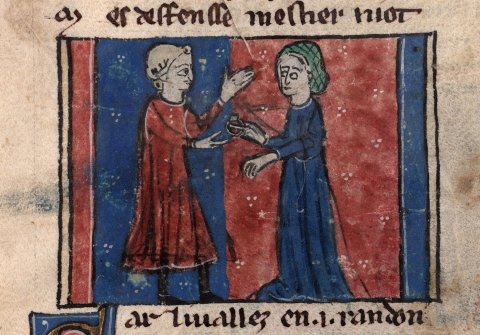
Figure 4 : Coment Perceval osta l'anel du doi à la damoiselle. No tent, no landscape here. The bipartition of the agonistic space is marked by the opposition of the two background colors, which has nothing to do with a realistic representation of space. The gold on which the damsel stands out is the gold of wonder. The ring, essential to the performance, is disproportionately enlarged and placed at the border of the two colored surfaces (F°5r°b.)
.The brutality of the gesture deconstructs the glorious moment that should crown the performance, the armor seized as a symptom contradicts the armor won as a sign.
As for the grail (v. 3158), it's a banquet dish that refers to the immutable ritual of the chivalric meal, a moment when the reconciled world celebrates the power of the code ; but the grail seen by Perceval has no place in the banquet, is out of step with it. By leaving for another room, by soliciting a question that doesn't come, the grail destroys the banquet's fulfillment.
To take the maiden's ring as a token of courtly service (v. 674) is to fulfill the code ; but to brutally take the ring, to do violence to the maiden completely contradicts the principle of submission to the Lady and renunciation of desire for which the gift of the ring is in principle the guarantee. The ring's removal stylizes the rape that the story refrains from depicting. It could well echo the fountain in the Chevalier au lion, a kind of gigantic, monstrous ring whose liquid bubbling symbolizes the both exhibited and forbidden place of the feminine before which the knight must stand guard or, on the contrary, which he must remove in battle :
Li perrons fu d'une esmeraude
Perchie aussi com une bouz
S'avait .iiii. rubins desous,
Plus flamboians et plus vermaus
Que n'est au matin li solaus,
Quant il appert en orïent21.
Compared to a wineskin, the fountain is feminine belly ; loaded with precious stones and pierced in the middle, it constitutes at the same time a gigantic ring22. The fountain of the Lion Knight still structures the whole story and is a recurring and clearly narrativized issue of the adventure.
The ring of Perceval on the contrary deconstructs the adventure, eliciting the damsel's unjust punishment and Perceval's shame. The ring thus fails to make a sign it no longer says the damsel's nonetheless real loyalty to the Orgueilleux de la lande it cannot, must not say the courtly allegiance of Perceval, who has futilely snatched it away. Having become the indecipherable symptom of a brutality whose full extent cannot be known, the ring de-emiotizes itself as an incomprehensible " thing " misunderstood by Perceval and the Orgueilleux de la lande alike.
![How Perceval feri p[ar]mi lueil le chevalier vermeil de s[o]n javelot et l'occist](/system/files/styles/large/private/notices/001/haute_def/001355.jpg?itok=paMBdbY1)
Figure 5 : How Perceval feri p[ar]mi lueil le chevalier vermeil de s[o]n javelin et l'occist. The symmetry of the agonistic space is clear, but curiously the ruddy knight's spear is replaced by the cup, even though the text makes it clear that the cup was placed on " un perron de maubre grise " (v. 1036). He /// The idea here is not to represent a real fight, but a symbolic device, at the center of which must be the stakes of the performance, the cup. (F°3r°a.)
The golden cup overturned and stolen by the chevalier vermeil, then recovered by Perceval (v. 1147) is also part of a whole intertextual network. Explicitly, the theft of the cup is an offense against Arthur, which Perceval makes good by killing the chevalier vermeil. The cup is thus a sign of allegiance to Arthur. But implicitly, the cup is a symptom of Perceval's betrayal of Arthur. Indeed, it alludes to the legend of the marvellous horn repeated in the First Continuation23 : the knight could only drink from this horn or cup if his wife was faithful to him. In the event of adultery, the wine was spilled and could not be drunk.
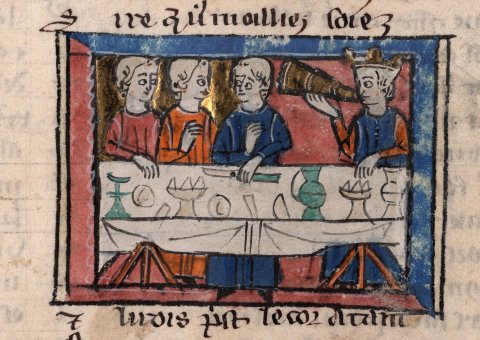
Figure 6 : How li rois Artus but au cor merveilleus. The banquet scene depicts four seated figures and is polarized on one side, in this case the right side, where Arthur, recognizable by the crown, attempts to drink the wine in the horn (he's actually holding it in a way!). However, the illuminator wanted to introduce a bipartition of space by changing the background color in the middle, and arranging the characters so as to place Caradué, the victorious hero of the ordeal, on the border of the two colors. This central position of the banquet hero recalls that of Gauvain on the bed of wonder (F°111v°.)
The wine spilled on the queen (vv. 917-919) constitutes the symptom of Guinevere's adultery with Lancelot and offends Arthur. The disappearance of the cup somehow erases the fault, which Perceval rekindles in the belief that it has been erased. The counter-performance always shows that, behind the "thing thing", something else is at stake. Here, the theft of the cup is symptomatic of Lancelot's betrayal, about which Perceval's novel remains silent.
The " thing " as fetish
The " things " imported from storytelling to become the dazzling yet mysterious stakes of novelistic adventure are objects worked by fetishization. The ring, the grail, the cup are first and foremost objects of desire that need to be appropriated, either materially to enjoy their possession, or intellectually and, hence, spiritually, to master their meaning, to enjoy their significance. These objects of desire are, as it were, slanted entries into the world of chivalry, indirect ways of gaining access to that inaccessible perfection. Not knowing what chivalry is, Perceval clings to the " things " that designate it. Querying the " chose " is a way of taming the chivalric code, of making more familiar what must be achieved.
In this sense, the " chose " functions as the fetish, the familiar, controllable substitute for the inaccessible object of desire. The contradiction of nature that always characterizes the fetish is found in the dual status of the "thing" in the tale, which slips, escapes, and at the same time remains fixed in a closed place, as if the firm enclosure of the place sought to compensate for the vagueness, the indeterminacy of the "thing". The fetishization of the "thing" tends to shift the focus of the narrative from an increasingly vague, hollowed-out content to an increasingly circumscribed, closed, narrowed container. The object fades in favor of the imprint : Perceval moves from Blanchefleur's lips to drops of blood on the snow as for Yvain's fountain, it becomes Perceval's ring, then in Perceval /// even the tent containing the ring. In the Première continuation, the tent where Gauvain enters Perceval-style reveals, at the very bottom, Gauvain's embroidered portrait, a portrait in which nothing further evokes the female object of desire24 ; finally, from the lover or the beloved, we move on to the tower, the orchard, the wall.
It is perhaps the transmutation of the philtre into the grail that constitutes the most characteristic and spectacular process of this metonymic movement, of this fetishization that works the " thing ". The herbal wine that Brangien mistakenly offers to Tristan in Tristan and Yseut25 tragically manifests the active power of the " chose " of the tale ; in Cligès, Thessala's beverages now have only passive power. Prefiguring Romeo and Juliet, the beverage doesn't give love, but the simulacrum of death it absents Fenice, it withdraws the woman's forbidden body from desire. Thessala's drink evades the place of pleasure. It prepares the advent of the grail in Perceval, an almost empty container, containing for all food only a host, i.e., for all " things ", the symbolic substratum closest to immateriality.
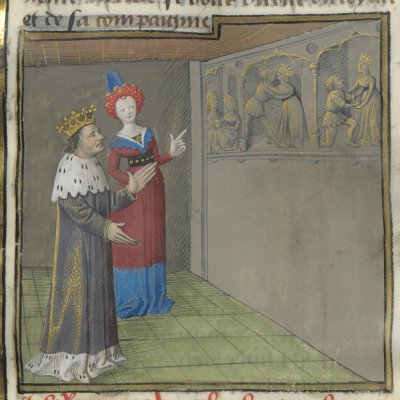
Figure 7 : The image chamber in La Mort du Roi Arthur, from Bnf ms fr. 116, F°688v°. In this much later illumination, the bipartition of space opposes the spectators on the left and what becomes, on the right, a stage where the moments of amorous ritual take place. The characters are installed in a geometrical space whose perspective is represented by the paving on the floor and ceiling. Morgue introduces Arthur to the scene, Arthur whose stunned, petrified gaze was in some way prefigured by Perceval's petrification in the face of the drops of blood.
.
The container now takes charge of representation. The place incorporates, on its very surface, the content and stakes of the narrative. Tristan's statue room26, Morgue's chamber or Morgana, King Arthur's sorceress sister27, become image rooms28 whose walls or sculptures bear the representation of an absent adultery. The place bears witness to a transgression that was made, but is no longer made in the present time of the narrative.
The drops of blood on the snow are also de-emiotized red on a white, and therefore empty, surface, which takes over from a failing agon, or more exactly displaced. " Li vermauz sor lo blanc asis " (v. 4138), the red placed on the white arrives at the end of a long work of stylization and, thereby, Chrétien's reduction of the " thing " of the tale. The contrasting colors reflect the bipartition that characterizes the agonistic space. Red on white can thus be compared to the precious gloss of Soredamor's name, in Cligès (p. 319, vv. 958sq), the overdorure of love consisting in applying gold on red, excellence on love. Red on white is also, in Erec et Enide, Erec's evocation of Enide's anguish for him, " Et vos verroiz covrir de sanc / Les mailles de mon haubert blanc " (p. 246, vv. 5835-6), et vous verrez se couvrir de sang les mailles de mon haubert blanc29.
But red on white crystallizes much more in Perceval than the precious and all things conventional allegory of Cligès, or the fleeting images of the stained haubert. The abstract painting Perceval contemplates echoes, beyond the tableau of Blanchefleur's lips parting her white face, the blood-stained sheets that betray Lancelot in Le Chevalier de la charrette : to join Guinevere in her chamber, where she is dressed in a " molt blanche chemise " and a " d'escarlate " cloak (v. 4579, 4582), red on white, then, Lancelot has to twist the iron bars of the window. He then cuts two of his fingers (vv. 4640sq.). This stains and stains the sheets (v.4700, 4741, 4749, 4752). Keu, who slept in Guinevere's room and whose wounds reopened during the night, is unjustly accused. Here, the drops of blood participate directly in the story, but already function as an ambivalent, failing sign.

Figure 8 : How Perceval resgardoit a cheval tot armé les III goutes de sang sor la noif (the snow). The knightly face-off here becomes a face-off between the hero and an empty place. The white quarter-circle is struck by Perceval's spear, as one would strike down an adversary in combat. Stopped time is symbolized by Perceval's left arm holding the horse's reins. It's impossible to know whether the illuminator has depicted the drops of blood : the traces on the snow are of wear and tear... (F°27v°b.)
Lancelot's episode itself echoes the episode of the bloody scythes in Tristan and Yseut : King Mark, invited to Arthur's house, has hidden sharp iron blades on the floor of the common room where people sleep, supposed to accuse by the wounds they will make him who will get up at night to join Yseut. Tristan is injured. Thanks to the solidarity of the other knights, who cut their legs on purpose, it becomes impossible to distinguish a culprit among the comrades-in-arms30.
The comparison of the three episodes - the bloody scythes, the stained sheets, the blood on the snow - characteristically reveals the process of fetishization : the accusing wound is first dissociated from the lover's body the stained sheets are painted as an autonomous " thing " then the fault is elided in favor of the painting alone, the diffuse, incomprehensible brutality of the goose's cut and the abstract, red-on-white color scheme. Perceval's vision takes the place of Lancelot's or Tristan's action. His fascination with the three drops of blood is a fetishistic pleasure: installing a material but depersonalized " thing "It reduces the transgressive confrontation with the performance's adversary (King Mark, King Arthur) to the fortification of a visual space and Perceval's posture31 in front of this space, even if, indirectly, this posture is received by the other knights as an offense to Arthur, a confrontation with his law, a transgression of the feudal code.
The eviction of the story, the deconstruction of the tale, sets in motion a second logic of communication and signification, a logic of signifiance. Twice detached from Perceval (not his body as with Tristan, not his blood as with Lancelot), the three drops of blood return to him. Like a motif, they take up the blood of the bleeding Spear of the Fisher King, which, through a play on words (between blood /// and meaning ; between bleed, sign and ensign) refers directly to Perceval's misunderstanding.
The bleeding spear is a " anseigne ", i.e. a sign and a knowledge, it is par excellence the " chose " that Perceval32 lacks. Blood is a sign, a sign of the spear that bleeds, itself a sign of the teaching that is at stake here in the adventure ; but the blood is also a symptom, it is what taints the place insofar as the place is hortus conclusus, the feminine womb, this womb remained virgin of Mary that biblical exegesis compares to a closed garden33. The blood that Perceval contemplates with pain and seizure is his work it symptomizes what is at stake behind all his counter-performances : the desecration of woman, his mother whom he has killed with grief by his departure, the damsel with the ring whom he has dishonored, Blanchefleur whom he has deflowered.
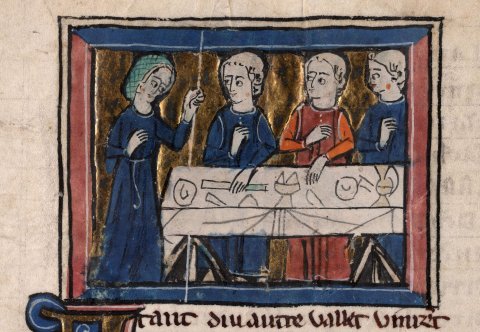
Figure 9 : How Perceval saw the spear that seined and the Holy Grail chies the rich pescheeur. The banquet performance, represented by a line-up of four figures in principle, is here shifted by the intrusion of a young girl (recognizable by the headdress clasping her hair) carrying the bleeding spear. The pictorial space then tends to split on either side of the spear, which overflows the frame; we thus find the elements of an agonistic face-off. All the right hands are placed at the same height, in a way restoring the four-way alignment characteristic of collective performances. All the characters are dressed in blue, except for Perceval at the center of the table, still recognizable by his ruddy clothes. (F°21v°a.)
Whether it manifests itself as a grail, a cup or a garment, as a hat or a drop of blood, the " chose " is thus caught up in the movement of fetishization that works the novelistic " conjointure ". The object borrowed from legendary stories is de-emiotized, rendered indeterminate, then enclosed in a container or place that tends to substitute for it. The marvelous brilliance of the novelistic " thing " then becomes the brilliance of the fetish, whose haunting return interposes itself between the hero and his adversary, to whom it comes to screen.
.III. The obsession with place
We've seen how Perceval and Gauvain clash in their relationship to the code. At stake in the first part of Perceval is bringing the young man to King Arthur's court to be consecrated a knight. To achieve this, Perceval must acquire the knowledge necessary for this consecration. This knowledge is materialized for him by the " things " he encounters and seizes : women, clothes, horses.
From the " thing " of the tale to the " things " of the quest
The challenge of the second part of the novel is to bring Gauvain to the duel against Guingambrésil at the court of the King of Escavalon, a duel that constitutes the performance proper, the knight's ideal and constantly postponed performance. Unlike Perceval, to achieve this, Gauvain must strip himself of his excessive courtesy. But the duel against Guingambrésil, always invoked to avoid immediate confrontation (vv. 4720, 5023sq, 5118sq, 5236sq), will not take place : a rear vassal advises the king to " prandre / Un respit de ceste bataille " (v. 6037), to have this fight postponed and the quest for the Bleeding Spear substituted. At the end of the novel, then, the logic of quest replaces that of performance. This revolution /// structural, which heralds the prose narratives of the thirteenth century, was prepared by the gradual installation of a certain temporality to the narrative.
In the episode of the drops of blood, Perceval's immobilization in the face of the stained snow paradoxically triggers a succession of battles that finally lead him, with Gauvain's intervention, to Arthur : Perceval changes location within a single sequence that has become multiplied. The episodes with Gauvain unfold over several days, presenting a succession of events. The performance then becomes part of a narrative that assigns it an origin and an end if there's a tournament in Tintagel, it's for such and such a reason (vv. 4772-4804) if Gauvain has been attacked in the tower, it's the consequence of such and such an event (vv. 6020-6035).
As a result, the sequences with Gauvain present an inverse internal structure to those with Perceval. Perceval was immediately confronted with the place and the " thing ", before questioning the code and filling in his unfamiliarity : the counter-performance was followed by the heuristic dialogue. Gauvain, on the contrary, resists the advent of the stage : in the face of the now widespread counter-performance, he embodies the resistance of the code.
" Tant irai que je saiche et voie "
J'avancerai jusqu'ce que je sache et que je voie (v. 6538)
Gauvain seeks to pass, to cross the passage, to come to performance. This difficult path opens the text to narration, which both prepares and delays the agonistic confrontation. The principle of novelistic indirection is born here.
The entire second part of Perceval thus prepares the transformation of the sequential narrative, based on adventure as a performance celebrating the knightly code, into a narrative, based on the quest. In this new economy of the text, what's at stake is no longer essentially the face-to-face encounter with the code, constantly postponed, delayed, but below the ultimate face-to-face encounter the acquisition of the " thing " and the knowledge to which this " thing " is identified.
Gauvain is encumbered with " choses ", he is the man of material surplus, to the point that the spectators at the Tintagel tournament mistake him for a merchant (v. 4988)34, " Por ce que deus escuz veoient ", for they saw that he had two shields (v. 4891). Gauvain's excellence at the tournament is evident in the accumulation of horses35 he wins in battle and distributes in largesse : " Onques de gaaigner destriers / Ne fu mes si entalantez ", never had he shown such talent at winning horses (vv.5502-5503). Gauvain brings back a palefroi to the maiden with the mirror (v.6747), then a roussin that Greorreas, the wounded knight, asks him to take from the hideous squire (v.6896), before finally stealing his own horse (v.6986). Gauvain's battle with Greorreas's nephew finally allows him to reclaim his horse, which is immediately claimed by the nocher, with whom his possession must be fiercely negotiated (vv. 7302-7336).
The circulation of horses disorganizes and diverts the knightly adventure : from the testing of ritual we move to a confrontation with the materiality of " things ", which slip, escape and delay the performance. The joust finally comes between Gauvain on his roussin and Greorreas's nephew, who rides Gauvain's horse (vv.7196sq), in front of the spectators at Château de la Roche de Sanguin, where the three queens live. Gauvain triumphs, but what a mockery of combat! The "thing " of the tale has accomplished its work of the negative : the displacement of the horses, of which it is no longer clear which belongs to whom, the parodic deformation of the palefroi into a /// roussin, seize the mechanics of the agon, block the idealization of performance.
The closing of places
The blocking of performance manifests itself not only in the heaviness of " things ", but also in the representation of space : the undefined paths Perceval takes in the gaste forest are succeeded, in the sequences with Gauvain, by places cluttered with things and people, marked by enclosure, impenetrability. Closed in by gates, rivers and walls, these places under siege36 manifest the contradiction between the courtly and feudal demands of the chivalric code, between the code of love and the code of combat: At once containers and contents, these places enclose the Lady or Ladies and at the same time delimit the space of the agonistic performance. The movement of enclosure of the stage is at work here, in its material dimension as well as in its dimension of symbolic superimposition, of putting the symbolic into visual contradiction.
.First, there's Tintagel, the castle of the tournament. To prove his chivalric excellence to the woman he loves, Méliant de Lis is forced by her to organize a tournament against Thibaut de Tintagel, the girl's father, in whose home, however, Méliant de Lis was raised. However, Thibaut was the man-lige of Méliant's father. Thibaut could not enter the tournament against Méliant, who was his lord the men on his council forbade him to do so Thibaut therefore walled up all the entrances to the castle, which thus became the place par excellence of the contradiction between the demands of love and combat, between courtesy and feudalism.
.S'ot bien fait murer et anduire
Do chastel totes les antrees,
Bien furent les portes murees,
Mais c'une petite poterne,
Don li huis n'estoit pas de verne
Qu'il orent laissié a murer.
Li huis fu por toz jors durer,
De cuivre fers a une barre
En l'uis ot de fer une charre
Tant com une charrete porte37.
Faced with this place stricken with restriction, with prohibition, faced with this conjunction of wall and gates that blocks the action, the knights who have come to the tournament assemble, which will ultimately take place in a meadow beneath the tower, a meadow " Qui estoit clos de pes entor ", which was surrounded by a fence of stakes (v. 4845). The performance takes place in front of the enclosed space of the château, and is itself surrounded by another fence. The tournament meadow faces the ramparts of Tintagel; Tintagel is the prize of victory if Méliant de Lis wins38. To win Tintagel is to win Thibaut's daughter. The meadow of agonistic performance contrasts with the castle of courtly reward. The confrontation of the two spaces covers the opposition of two symbolic codes.
The tower of Escavalon castle where Gauvain meets the king's daughter performs the same function of spatializing the symbolic contradiction. The tower manifests itself spatially as a withdrawal of withdrawal : it is after Gauvain's appearance of the castle site (v. 5680) and the entire town (v.5684), Gauvain and his guide reach the tower (v.5711) and, from there, the young girl's room39.
).
Figure 10 : Commant li vilain assaillirent monseignor Gauvain en la chambre a la damoiselle et brisièrent l'uis. Bipartition of space /// agonistic space is marked by the opposition of the villains on the left, against a vague, colorful background signifying the outside, and Gauvain on the right, against the background of the open door and tower wall, signifying the inside, the restricted space. In the center is the axe that split the door, indicating that the door split in two signifies the division of agonistic space. The villains have their hair covered, unlike Gauvain, who is not dressed for battle. The doorman, curiously bent over from behind to defend the door, is shown smaller, signifying the hierarchy between servant and nobleman. The faces are impassive : the figuration of passions on the face only became an obligatory component of representation in the seventeenth century... (F°38v°b.)
The enjoyment of the courtly ritual is abruptly interrupted by the recognition of Gauvain, welcomed as the guest of the brother he met on the hunt, but recognized as the enemy sent by Arthur and against whom the duel with Guingambrésil must be fought. The hospitality and courtesy that bind Gauvain to the young girl are at odds with the feudal demands of combat. The onslaught of the town's burghers puts pressure on the forbidden space of the tower, just as the influx of knights had put pressure on the forbidden space of Tintagel castle. The action is concentrated at the frontier of the forbidden, materialized by the tower gate :
And cil l'uis a force peçoient
As coignies que ils tenoient,
Si l'ont en deus meitiez fendu,
Et molt lor a bien desfendu
Li portiers qui dedenz estoit.
[...]
Et as pis d'acier la tor fueent
Ausin con por la tor abatre,
C'asaillir n'osent ne combatre
A l'uis qui bien lor est veez40.
The split door rhymes with the forbidden passage41 : the cut in two that signifies the agon, the violent bipartition of space between the inside and outside of the tower, is superimposed on the interdict of " l'uis veez " : this defense materializes the blocking of performance by the contradiction of the code. The place manifests itself as forbidden to adventure, the space marks its discrepancy from the agon. The entrenched space is finally invested: the symbolic transgression constituted by Gauvain's presence in the tower gives rise to the irruption of the villains, axes and picks against chessboard and chess pieces, " things " of the brutal triviality of reality against " pieces " of the most refined game, savage blows of force against the sieve of culture. Yet the bourgeois have the law on their side, and the king's daughter behaves like a herring : " Si s'estroite et escorcie, Et jure comme corrocie " (vv. 5929-5930), she has foxed and curled up, and swears like an outraged woman. Brutality here turns into legitimacy, and culture breaks down into brutality. The real returns to the space of courtly ritual, not as pure barbarism, as a negation of the law, but on the contrary as a reminder of the feudal law transgressed by the courtly couple, which in turn manifests itself here only in the hideous outburst of hysteria. The law of loyalty to the chief is brutally confronted by the law of paradoxical submission to the feminine delicacies of lady service. Two laws clash and overturn in the brutal reverse of the reality that founds them.
Beyond the fence, the scene
The motif of the narrowing of the performance space is gradually accentuated to the point of obsession in the episodes with Gauvain. Barely out of the tower, Gauvain is confronted with Gauvoie's milestone,
Que c'est la bone de Galvoie
Que chevaliers ne puet passer
Qui jamais puisse retorner42.
The milestone will be referred to later as a bridge43 :
Que chevaliers de mere nez
Ne passa lo pont de Galvoie44.
precises the guardian of the passage, imaginatively identifying the now virtually impossible entry into the space of chivalric performance with the exit without possible return from the maternal womb. To enter the scene of the knightly face-off is to confront the unknown brutality of the world beyond the maternal feminine.
Further still, the bridge becomes a port:
And keep the porz de Galvoie45
Each time, the point is to evoke the constricted, forbidden and liquid space of the feminine, to designate the chivalric challenge as a crossing beyond this space characterized by enclosure46.
Gold beyond the Gauvoie boundaries, past the perilous ford (v. 8411), there is nothing, nothing other than the dialogue with Guiromelant which, like Perceval's heuristic dialogues, reveals to Gauvain the knowledge and meaning of the performance accomplished below, at the castle of the three queens finally designated as the castle of " la Roche del Chanpguin " or " de Sanguin "47, a kind of matrix of the tale where the vermeil hue, the very principle of the novelistic wonder, is manufactured.
The last great performance of Gauvain will thus have been, at the castle of the three queens, that of the Lit de la merveille ; like the test of the grail for Perceval, the Lit de la merveille for Gauvain constitutes an epureure of the agon. From the confrontation with the adversary, which in principle constitutes the performance, all that remains is the empty, uninhabited place of the bed. What Gauvain is fighting is the place itself, an impersonal place whose mechanical defenses move in the absence of any agent. The test consists solely in investing the place, in sitting on the bed.
The bed itself elicits its defenses. The ropes (v. 7740) first set in motion the mysterious, indeterminate emergence of wonder (" Et les merveilles se descœuvrent / Et li enchantement aperent ", vv. 7744-5, les merveilles se découvrent et les enchantements apparaissent) ; then come the arrows and crossbow bolts (v. 7747) whose throw and impact constitute the agonistic moment, the test of brutality. But there is no visible human opponent, " Que nus hom veoir ne pooit / De quel part li carrel venoient " (vv. 7752-3), for no one could see from where the arrows came.
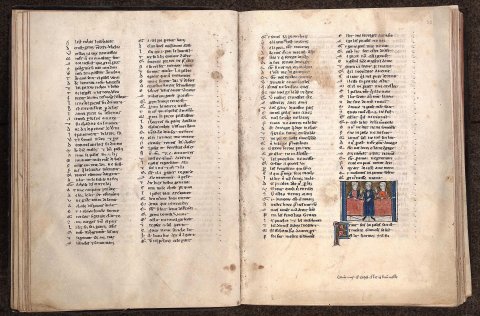
Figure 11 : How messire Gauvain s'assist el lit de la merveille. The agonistic performance here cannot be represented according to the usual bipartition of space, since Gauvain is supposed to be alone. Who, then, are the two men flanking Gauvain, as if to re-establish the alignment of men characteristic of representations of collective performances? The illumination is placed in the text after v.7734, when the nocher (accompanied by his valet ?) gives his final warning to Gauvain before leaving the scene. The raised hand could signify the warning. But above all, the two figures facing each other on either side of Gauvain stylize, through their face-to-face symmetry, a agon that has become unrepresentable. (F°50r°b.)
A second trial follows: the fight with the lion. The lion is not an adversary but a sign. Introduced by a mysterious villain, he reduces the agon to the pure bestiality of confrontation. The claws of his severed paws left stuck in Gauvain's shield will serve as proof that the performance did indeed take place in front of Guiromelant (vv. 8609-8622). The lion thus constitutes the " anseigne " (v. 8622), the sign of the agon. It is the brutal materiality of the performance, the sign stuck as if in wax (v. 7776) on Gauvain's shield : the lion inscribes an agon that consisted in the mechanical convulsion of the place.
The bed of wonder takes a further step beyond the grail and even the drops of blood in shifting the agonistic face-off to the (masculine) dwelling of the (feminine) place. The bed is the place and the thing to fight and to invest it, it's all one the fight is translated by the inscription of a sign : the lion's claws are the graphically incomprehensible hieroglyph of this first scene they serve as an iconic witness facing Guiromelant, when all speech is lacking.
Conclusion
By exploring Perceval and studying through it the workings of the first medieval novels of the twelfth century, before the transition to the prose novel and the narrativization of the quest, we have been able to identify three phenomena in the novelistic text that prelude the birth of the scene.
Parody, scandal
First, it's the transgression of the code. Perceval parodies chivalric performance, diverting it into the counter-performance of the one who doesn't know (Perceval) or, on the contrary, the one who, knowing too much, gets caught up in the contradictions of chivalric and courtly code (Gauvain). In this way, the celebration of the ritual of chivalry is shifted; the novel sets its scene not where the ritual is performed, but alongside it it deconstructs the ritual through reality. This transgression of the code, this novelistic subversion, installs scandal at the heart of the text's tableau. Scandal will be one of the essential components of the classical stage.
The " thing "
The second striking phenomenon is the de-emiotization of the " thing " of the tale. The " thing " comes from a legendary tale : medieval myths provided the novelist with marvelous objects that took on meaning in the story that carried them. The novelist evacuates the story, detaches the object from the legendary narrative, and installs it in the novel as an incomprehensible "thing", whose mysterious aura, whose marvellous brilliance derives precisely from this vagueness, this indeterminacy of what no longer belongs to any story. The incomprehensible dimension of the tale's "thing", which becomes the "something" of the novel scene, allows us to establish a double articulation from this object that is no longer an object: in the novel, the "thing" is both the sign that refers back to the code and the symptom of the subversion of this code. It is both a reminder of ritual and a marker of the gap between ritual and reality. In this way, a system of symbolic reversal is established, a reversion around the vague materiality of the " thing ", a reversion that prefigures the reversal of situation and revolt through which the classic novelistic scene ordinarily manifests itself.
The articulation of time and space
The third characteristic phenomenon is the articulation, in the novelistic sequence, of time to space. Performance gradually manifests itself in the novel not as an encounter between the subject and another subject (the battle of two knights), but as an encounter between a subject inscribed in time and a space, located outside time. This space is the result of a process of depersonalizing the adversary: the other knight whom he /// had to be defeated in battle is reduced to the "thing" that appears before the hero. Initially understood as a content, the "thing" in turn evaporates, becoming a pure container, a vessel, a tower, a room, a bed. In this way, the "thing" is reduced to the place that contains or simply recalls it. The novel sequence then becomes the moment of fusion between the hero inscribed in the time of adventure and the timelessness of place. It gives rise to the moment of the scene, that all-important moment of suspended action, which both concentrates time (a whole narrative unfolding is gathered and crystallized there) and dilates it to the extreme by transfusing it into space: time becomes the object of description and, in so doing, becomes spatialized. To make dramatic suspense a reality, to delay the passage of time, space is described. The illumination vividly demonstrates what the text indicates more discreetly: that the space of novelistic performance always tends towards bipartition. This space, divided into an inside and an outside, a below and a beyond, expresses the contradictory nature of the chivalric code. The moment of the scene will be the moment of the superimposition of the spatial cleavage and the symbolic cleavage, a superimposition constitutive of the device.
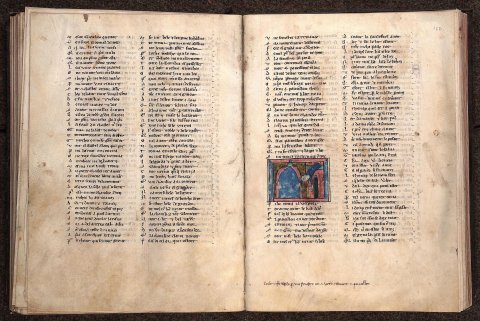
Figure 12 : Coment un chevalier descent par une fenestre en un jardin devant un paveillon. The illumination illustrates, in the Première continuation, the episode of Guerehet in the orchard (p. 568). The bipartition of the agonistic space is formally respected, the tent on one side, the château on the other, with the focal point of the action in the middle: Gueheret leaves the château through a window to sneak into the orchard. The absence of the agonistic adversary is made particularly striking by the opening of the empty tent on the left. This exhibition of an intimate, empty place prepares the way for the scenic device (F°150r°a.)
Notes
. ///At the moment when Yvain overhears the lion and snake fight in Le Chevalier au lion, what David F. Hult translates as " scene " actually corresponds to the " merveille " of medieval French : " N'ala mie mout regardant / Mesire Yvains chele merveille ", Monseigneur Yvain didn't spend much time looking at this extraordinary scene. (P. 821, vv. 3352-3353.) On the relationship of the wonder to the scene, see infra p. 29.
The literary posterity of Perceval is immense. We might also mention Wagner's opera, Parsifal (1882), and T. S. Eliot's poem, The Waste land (1922).
The knight is one who goes " Querant battle and adventure " (c. 1429), in search of battle and adventure. In principle, battle has nothing to do with the collective melee on the battlefield, and refers instead to single combat.
In fact, the distinction between the tale and the novel, though emphatically repeated in Chrétien de Troyes, is not so clear-cut lexically. The " roman de Perceval " (v. 8, 9067) is also called " conte du graal " (v. 64, 6141).
The first medieval novel is a Eneas directly linked to Virgil, and one of Chrétien's first novels, Cligès, features Alexander, son of the emperor of Constantinople.
Perceval had four continuations. The first, also known as the Continuation-Gauvain, is anonymous. The second, in which Perceval reaches the castle of the Roi Pêcheur, but fails to resolder the broken sword, is the work of Wauchier de Denain. The third, in which a third visit by Perceval to the Roi Pêcheur allows the sword to be resoldered, was written by Gerbert, probably Gerbert de Montreuil (Tristan et Yseut, les premières versions européennes, pp. 975-1010). Finally comes Manessier's Continuation: Perceval succeeds the Fisher King, and we learn that the bleeding spear is that of Longin, by whom Christ was wounded on the cross. At the same time, from the thirteenth century onwards, the immense prose novel cycles begin: Lancelot en prose with its Quête du graal, Lancelot-Graal or Vulgate cycle, then Roman du Graal. We must add Robert de Boron's Estoire dou Graal (late 12th century), the Perceval en prose or Didot-Perceval, the Perlesvaus prose epic and Wolfram von Eschenbach's German Parzifal, where the grail becomes a precious stone.
" Tant que vint au chemin tot droit / Ou li chevaliers atandoit / Chevalerie et avanture " (vv. 1029-1031), Ivonet opened directly onto the path where the ruddy knight awaited chivalry and adventure. By chivalry is meant here chivalric performance. Compare with the expression " faire chevalerie ", v. 2358.
" Se aventure la vos maine " (v. 3616), if adventure takes you there. " Quel avanture vos maine / A tel dolor et a tel paine " (vv. 3742-3), what adventure leads you, in such pain and sorrow.
Nice comes from the Latin nescius, who does not know.
" il covient " (c. 1414), " an doit " (v. 1383, 1387, 6193), " m'estuet " (v. 3563).
For example, in the dialogue with Ivonet, " What do your ? - Je ne sai coi. " (v. 1089), I don't really know, replies Perceval, who doesn't know how to undress the ruddy knight. At the meeting with the pilgrims, " Respont : "Quel jor est il donc aujourd ?" / - Quel jor, sire ? Se ne savez, / C'est li vendredis aorez. " (vv. 6190-6192), - Quel jour, seigneur ? If you don't know, it's Good Friday. In the dialogue with the hermit, an even deeper misunderstanding then erupts, covering all the others : " Sire, fait il, bien a .V. anz / Que je ne soi ou je me fui, / Ne Deu n'amai ne Deu ne crui. " (vv. 6290-6292) it's been a good five years since I've known where I stand, since I've loved God, since I've believed in him.
Perceval doesn't even know his name (vv. 3511-4).
Lancelot can indeed be read lance los, the glory of the spear. Chrétien's verse text, the poetic practice of the time, and the abundance of polysemous monosyllables in the medieval language favor this kind of wordplay, particularly on the occasion of rhyme. In Cligès, Soredamor uses this principle to gloss her own name, which she has read as sororee d'Amors, surdorée d'Amour (Romans, p. 319, vv. 958-978).
Romans, pp. 511-512, vv. 362, 369, 376, 391.
Tristan's courtesy is opposed to Lancelot's shame : Lancelot is heroic only because he assumes chivalric counter-performance out of love. This heroism of shame culminates in the Tournoi du Pire (" de Noauz ") where, at a sign from Guinevere, Lancelot loses the jousts on purpose and makes a fool of himself before prevailing in extremis (Romans, pp. 661-672, vv. 5621-5992).
" until he knows, about the Grail,
to whom it is brought, and until he has
found the spear that bleeds;
until the proven truth
is told him why it bleeds." (v. 4665-9
See also v. 605-6, v. 3139-3140, v. 7835-6.
Twice, before the funeral service and then the grail show at the Fisher King's castle, Gauvain " Devant ses ix a mis ses mains ", put his hands before his eyes, and De son mantel sa ciere cuevre ", cover his head with his cloak (Première continuation, pp.480-482, vv. 7251 and 7310).
Speaking of his work as a novelist, importing and reordering the disparate, heteroclite and fragmentary material of the tale into a composed text, Chrétien de Troyes writes at the beginning of Erec et Enide : " Et trait [d'] un conte d'aventure / Une mout bele conjointure "(p. 61, vv. 13-14), Et il tire d'un conte d'aventure a very fine composition (unless one should read without the d', Et il tire un conte d'aventure, a fort beau assemblage). Specialists of the Champagne novelist agree that this conjunction is the essential requirement and challenge of Chrétien's poetics.
See infra p. 53 and note 27.
" The rim was a single emerald
.
Pierced like a wineskin
.
It had four rubies underneath
More flamboyant and ruddy
than the morning sun.
Than the morning sun
When it appears in the east.
When it appears in the east." (P. 725, v. 422-427.)
The fountain is moreover redoubled by the magic ring Lunete gives Yvain, a ring that doesn't exactly make one invisible but, more strangely and significantly, covers who wears it and turns it as bark covers the trunk. Yvain will have the same power " Comme a li fus desous l'escorche, Qui le keuvre, c'on ne le voit point " (p. 744, vv. 1026-1027), as the trunk under the bark, which covers it so that it cannot be seen. In the manner of the fountain's emerald, in the manner of the tree's bark, the ring is an enveloping place, a synecdoche in motion.
Première continuation, p. 237, v. 3193. Here and in many other places the Continuation must be read as an exegesis of Perceval far more than as a narrative continuation, as Charles Méla has shown. This is yet another indication that narrative structure is not the basic structure of these texts, governed first and foremost by their relationship to the symbolic, i.e. to the codes and meanings of chivalry.
Première continuation, p. 140-149, v. 12012-12139. Gauvain depucating the girl in the tent repeats Perceval's theft of the ring. But he takes no material "thing" with him. On the other hand, the embroidered portrait of Gauvain in the back of the tent prepares and signs the deflowering, imprinted as it were on the fabric: it's thanks to it that the damsel recognizes Gauvain, to whom she had promised to give her virginity. Gauvain undergoes the "thing " which Perceval had initiated, but already without concluding. The motif of rape is worked by negativity and gradually turned upside down. The sign of defloration is no longer the ring, which refers back to the Lady, but the portrait, which returns on Gauvain, the hero of the performance.
Tristan and Yseut, the first European versions, pp. 294-295. All references to the myth of Tristan and Yseut are to this edition, which brings together texts from different periods, contemporary with Chrétien de Troyes or later (12th and 13th centuries). But what's important here is Chrétien's use of the legend, whose most archaic elements sometimes appear in later texts. The filiations proposed here and below therefore do not necessarily overlap with the chronology of the texts.
Tristan and Yseut, p. 153, p. 894. Tristan has statues of Yseut and Brangien executed in a cave, offering him the philtre. While he is married to the other Yseut, Yseut aux blanches mains, in secret it is with the statue that he converses, it is to her that he testifies his love.
La Mort du roi Arthur, pp. 99-100. Morgue, afraid of incurring Lancelot's vengeance if she tells Arthur orally that his wife Guinevere is cheating on him, leads him to his chamber, where Lancelot, who had been imprisoned there for a time, had painted his story.
imago in Latin, image in medieval French designate both a painting and a statue. Also noteworthy is the painted room in the Première continuation, p. 358, vv. 5184-5194.
The same image of the bloodied white haubert is repeated in Le Chevalier au lion, p. 739, vv. 867-8.
Tristan and Yseut, pp. 332-5, 726-7.
A pensive Perceval joins a pensive Arthur (v. 866) and above all Lancelot petrified with pain at Guinevere's comb (Romans, p. 541, vv. 1424sq). But this is the first time this posture has been so clearly fixed in the text.
The words " ensaigne ", " enseigner " recur obsessively in the text, sometimes to designate knowledge (teaching), sometimes as a sign, even as a sign of the cross : vv. 113, 333, 648, 659, 748, 795, 852, 1135, 1311, 1357, 1385-6, 1499, 1503, 1635, 1646, 1651, 2917, 2952, 3443, 5226, 7122, 7998, 8105, 8622.
The identification of the Virgin with a house is found in Bernard de Clairvaux (1091-1153), who was a contemporary of Chrétien de Troyes. But the hortus conclusus and the Virgin-tabernacle become a central theme of theological meditation on Mary from Albert the Great (1193-1280).
The motif is also found in Tristan and Yseut. But Tristan knowingly disguises himself as a merchant (Tristan et Yseut, p. 279, 284-285). As for Perceval, he faces the merchants in a relationship of pure exteriority (vv. 2477sq).
If Gauvain is always in search of a horse, in loss of a horse, in excess of a horse, it is perhaps by parodic repetition of the original fault of the Chevalier de la charrette, where he refused to trade his horse for the cart of shame : " Car trop vilain change feroit / Se charrete a cheval chanjoit " (Romans, p. 512, vv. 391-392).
Perceval had already entered Beaurepaire besieged by Aguingueron. But the castle gate, which he violently smashes (c. 1678), is not yet the subject of the detailed descriptions that Tintagel's is. The place is empty, moreover, like the vast forest.
" ... he had all the entrances to the château walled up and sealed
.
all the entrances to the castle.
The gates had been well walled,
except for one small postern.
except for one small postern.
The door wasn't just made of wood.
They had left it un-walled.
The door was made to last forever,
closed with a copper bar.
On the door was metal
.
The weight of a cart." (v. 4826-4835.)
He will be defeated by Gauvain, who finally fights, out of courtesy to the little girl with the little sleeves (v. 5459, 5461). The Première continuation assumes that Méliant's fall resulted in his death, which his brother Bran de Lis seeks to avenge (p. 150, v. 1745 and p. 310, vv. 4380-2)
Gauvain's journey to the chamber is built in opposition to Perceval's in Beaurepaire to Blanchefleur. The desolation of Beaurepaire, an empty place, is contrasted with the overabundance of objects that clutter Gauvain's itinerary.
" And they to break the door knocked
with the axes they were holding.
In two halves they split it
but the passage was well defended
by the doorman inside.
by the doorman who was inside.
With picks they undermined the tower
.
As if to bring it down
.
For they dare not climb or fight
At the gate which is forbidden to them. "
The motif of the impregnable gate is found in almost all of Chrétien 's novels: in Cligès, Jean's tower, where Cligès and Fenice are hidden, opens through a door whose " joint " is invisible (p. 458, v. 5514 and p. 482, vv. 6368-6373). In Le Chevalier de la charrette, Lancelot, prisoner of Méléagant's seneschal, is walled up in a tower (p. 676, vv. 6127-6139). In Le Chevalier au lion, Yvain enters the castle of the lady of Landuc through a " porte a coulant / De fer, esmolue et trenchant ", an iron sliding door, sharp and cutting, a trap door supposed to cut in two any intruder (p. 741, vv. 921-951).
" for this is Gauvoie's milestone
that no knight can cross
if he ever wants to
if he ever wishes to return." (v. 6522-6524)
See however the variants, which give /// " les porz " instead of " lo pont ".
" for never knight of mother born
passed the bridge of Gauvoie " (v. 8300-8301)
" and he guards the ports of Gauvoie. " (v. 8560)
In Le Chevalier de la charrette, the focal point of the novel is the kingdom of Gorre, where Guinevere is imprisoned. To enter Gorre is to obtain Guinevere, the Lady par excellence. To reach this kingdom, there are only two passages, with highly symbolic configurations (Romans, p. 519, vv. 653-699) : the bridge under the water (water designating the Lady, as marked, for example, by the fountain in Chevalier au lion) and the sword bridge (the sword being the knight's attribute), reputedly more perilous. Unlike Lancelot, Gauvain, who has already chosen the feminine side of the equation, is unable to perform the feat and complete the adventure. What will become the scene involves the installation of chivalric performance (the masculine combat, the " battle ") in the place of the feminine ; but this installation is only initiated in Perceval with the transition from Lancelot's novel to Gauvain's novel.
This passage corresponds to a gap in manuscript B, noted around 41 in Romans, p. 1199.
Référence de l'article
Stéphane Lojkine, « Trois gouttes de sang sur la neige… Perceval ou la parodie de la performance », La Scène de roman, Armand Colin, collection U, 2002, p. 14-42.
Critique et théorie
Archive mise à jour depuis 2008
Critique et théorie
Généalogie médiévale des dispositifs
Entre économie et mimésis, l’allégorie du tabernacle
Trois gouttes de sang sur la neige
Iconologie de la fable mystique
La polémique comme monde
Construire Sénèque
Sémiologie classique
De la vie à l’instant
D'un long silence… Cicéron dans la querelle française des inversions (1667-1751)
La scène et le spectre
Dispositifs contemporains
Résistances de l’écran : Derrida avec Mallarmé
La Guerre des mondes, la rencontre impossible
Dispositifs de récit dans Angélique de Robbe-Grillet
Disposition des lieux, déconstruction des visibilités
Physique de la fiction
Critique de l’antimodernité
Mad men, Les Noces de Figaro
Le champ littéraire face à la globalisation de la fiction
Théorie des dispositifs
Image et subversion. Introduction
Image et subversion. Chapitre 4. Les choses et les objets
Image et subversion. Chapitre 5. Narration, récit, fiction. Incarnat blanc et noir
Biopolitique et déconstruction
Biographie, biologie, biopolitique
Flan de la théorie, théorie du flan
Surveiller et punir
Image et événement